
 About the Book
When he hears a story about a huge dinosaur fossil locked deep inside an Alpine glacier, university professor Stan finds a childhood dream reignited. Whatever it takes, he is determined to find the buried treasure.
But Stan is no mountaineer and must rely on the help of old friend Umberto, who brings his eccentric young assistant, Peter, and cautious mountain guide Gio. Time is short: they must complete their expedition before winter sets in. As bonds are forged and tested on the mountainside, and the lines between determination and folly are blurred, the hazardous quest for the Earth’s lost creatures becomes a journey into Stan’s own past.
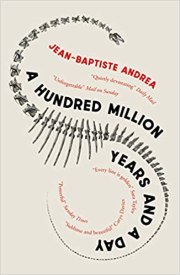
Format: Paperback (176 pages) Publisher: Gallic Books
Publication date: 7th May 2021 Genre: Literary Fiction, Literature in Translation
Find A Hundred Million Years and a Day on Goodreads
Purchase links
Bookshop.org
Disclosure: If you buy a book via the above link, I may earn a commission from Bookshop.org, whose fees support independent bookshops
Hive | Amazon UK
Links provided for convenience only, not as part of an affiliate programme
My Review
‘It’s true that a story often begins with a road, but I wish I knew what made mine so tortuous.’
The book opens with Stan’s poignant childhood memory of returning home after school, seeing the closed shutters of a bedroom window and realising, even as a six year old, that he should not disturb his mother. ‘In such moments she needed darkness, and darkness alone.’ The reasons for this will gradually become apparent.
Stan’s discovery near his farmland home of a fossil – a trilobite – awakens an interest in palaeontology. ‘It was three hundred million years old, and I was six.’ It’s an interest that is encouraged by his mother but discouraged by his bully of a father (known as the Commander) who desires Stan to take over the family business.
Moving ahead forty years to 1954 and Stan is now a Professor of Palaeontology in Paris. He has never forgotten the story of an old man’s discovery of a dinosaur fossil in a cave within a glacier in the Alps. Finding the site has become an obsession. Along with Umberto, a friend and colleague of many years, Umberto’s assistant Peter, and local guide Gio, the four men embark on the expedition of a lifetime. (There is another member of the group but I’ll leave you to read the book to find out more about him!)
I loved the way each of the men were fully rounded characters. Umberto is a giant of a man with a ‘good, big, stone soul’. When it comes to excavation he has ‘magic in his hands’ able to gently release ‘time’s grip’ on a fossil. His loyalty to Stan means leaving personal commitments back home. Gio’s instinct for changing weather conditions and his knowledge of the mountains is unparalleled. However, he also knows only too well what dangers they hide. Peter is described as having a ‘genius for the absurd’ which will be demonstrated all too clearly.
I admired the way the author explored the dynamics between the men, especially as summer gives way to autumn and every day seems to present a new obstacle to overcome in order to achieve their objective. The frustration and anger that festers beneath the surface is vividly brought to life in a memorable paragraph delivered in stream of consciousness style.
Another striking aspect of the book is its use of anthropomorphism so that even the weather seems to exhibit a life of its own. For example, autumn is described as ‘prowling at the edge of the plateau… a beast of flesh and claws’. As weeks turn to months it becomes akin to a battle of wits between the men and the glacier, as if the glacier is actively seeking to thwart their efforts. It certainly feels that way to Stan.
When winter truly arrives, every day, every hour even, becomes a struggle to survive and retain a grip on sanity. I really felt I was there on the mountain alongside Stan but, of course, invisible to him, which makes his feelings of loneliness and attempts to ward off madness all the more poignant. At one point he observes, ‘I am surrounded by millions and millions of cubic metres, acres, tons of nothingness, void, absence’.
Interspersed with the story of the expedition are Stan’s memories of events earlier in his life: memories of rejection, loss, cruelty and violence. However, Stan’s history of misreading situations or misinterpreting the feelings of others made we wonder how much I could truly trust his viewpoint. The author challenged me to think about Stan’s real motivation. Is it the professional acclaim that will come from the discovery of possibly a new species of dinosaur, the achievement of a long-held dream, or a belated attempt to prove to his father that he is not the failure and weakling he was accused of being?
Sam Taylor’s translation expertly showcases the author’s wonderful turns of phrase. For example, the description of the valley from which the group start their climb as being an ‘eternal vendetta between stone and water’. Or when, later in the book, the men awake to a heavy snowfall that finds them in snow up to their chests, the scene is likened to a ‘polar morning in Pompeii: our torsos floating on an ocean of powder, statues lost at sea’.
The low page count of A Hundred Million Years and a Day belies the power of the story it contains. As is often the case, the best things do come in small packages. My thanks to Isabelle Flynn at Gallic Books for my review copy, published today in a new paperback edition.
In three words: Powerful, moving, immersive
Follow this blog via Bloglovin
 About the Author
Jean-Baptiste Andrea was born in 1971 in Saint-Germain-en-Laye and grew up in Cannes. Formerly a director and screenwriter, he published his first novel, Ma Reine, in 2017. It won twelve literary prizes including the Prix du Premier Roman and the Prix Femina des Lycéens. (Photo credit: Publisher author page)
About the Translator
Sam Taylor is an author and former correspondent for The Observer. His translations include Laurent Binet’s HHhH, Leila Slimani’s Lullaby and Maylis de Kerengal’s The Heart, for which he won the French-American Foundation Translation Prize.

 About the Book
 About the Author
 What Cathy Read Next...