I’m thrilled to welcome Paul Linggood to What Cathy Read Next today to talk about his novel The Boy on the Sofa which was published by Broadwater Books on 25th September 2026. The Boy on the Sofa is available to purchase as an ebook or in paperback from Amazon and other retailers.
Although I’m ‘officially’ closed to review requests, Paul’s book sounded so compelling I couldn’t help agreeing to add it to my review pile. I hope once you’ve read his guest post you’ll want to do the same.
About the Book
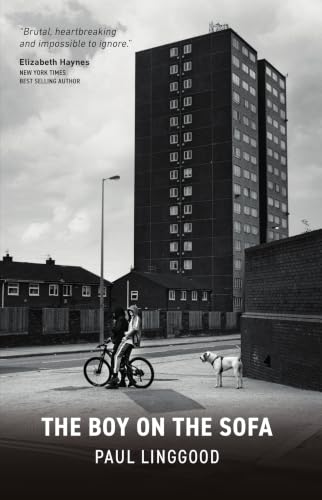
Billy Mercer is fourteen years old and tired of being laughed at.
At school, the other boys mock his cheap clothes and the holes in his trainers. At home, his mother works herself to exhaustion just to keep food on the table. Money is always short. Respect is even harder to come by.
So when someone notices him, Billy is pulled into a world of manipulation, intimidation and empty promises. What begins with subtle threats soon becomes something far more dangerous than he ever imagined.
Meanwhile, on the Ashbourne estate, Terry Foster watches helplessly as strangers slowly take over his flat, his routine and what remains of his life.
Told through alternating perspectives from opposite ends of a brutal spectrum, The Boy on the Sofa is a raw and deeply human novel about poverty, exploitation and survival in modern Britain.
Find The Boy on the Sofa on Goodreads
Finding Kindness in Dark Places: The Unlikely Friendship at the Heart of The Boy on the Sofa by Paul Linggood
“I wanted to write a novel about county lines – a topic most people only know from the news. A book that deals with addiction, poverty, exploitation and neglect. I wanted to write it ‘warts and all’, with none of the hard truths spared.
On paper, I realised this sounded extremely bleak. Not only did I not want to alienate audiences and expose the reader to misery, but I also did not want to write such a book. Granted, this subject will always be bleak. I have tried to highlight an important issue and not simply show what is happening, but give an indication as to why. But there is more to it than that. There are human beings involved. People who have experienced a lot of hardship. People in tough situations. For me, the human relationships in the novel, particularly that of Billy and Terry, became more important than the criminal world that was suffocating them.
Billy is a 14-year-old boy from a single-parent, working-class home. A typical candidate for county lines grooming. When he is sent to his new place of work, a crack house in a council tower, he meets Terry, an adult in his fifties fully trapped in that world. Terry is wise, kind and broken, his home invaded by drug dealers. Billy is young, naive and seeking respect. They meet at completely different points in the same destructive system. They are an unlikely pairing. Billy may look upon Terry as someone he might become. Terry looks at Billy and sees a past he can never retrieve or rectify. Both are vulnerable in different ways. Both of them are lonely. Ideally, neither would be in a situation where they would need each other. But they need each other in that space more than they realise. They can give each other things they lack.
Billy is a victim, but it was essential that he was more than that. Likewise with Terry. It would have been so easy to have Billy lodge with an addict with bad intentions, someone lacking in a moral compass who would only add to the danger in Billy’s everyday life. But addiction does not automatically strip somebody of kindness or a moral compass.
The labels I could have given them would only describe stereotypical circumstances, not everyday people. Not human beings with human natures. There needed to be kindness in an unlikely place. Both their lives are hard enough. There needed to be humour (dark, yes, but humour), there needed to be irritation and contradictions, bad decisions and ordinary conversations. There needed to be affection and sympathy. They needed to be like people you could actually encounter rather than mere vehicles for a social message. I hope I achieved that.
I often ask my children to stay kind. It is one thing they both have, and something I hope they never lose as they grow older. In Billy’s situation, kindness becomes even more important. Small acts of kindness can become disproportionately valuable when someone has next to nothing. It doesn’t have to be something of great magnitude. Nothing heroic or grand. It can be a cup of tea. A roll-up. Someone checking in on you. A place to sit down that you can call your own. Ordinary things can carry the most weight.
It was important not to let the book fall into a text of misery-porn. These are serious themes that needed to be addressed honestly, without suffering being presented as entertainment. The book is very dark at times, but not for shock value – only because this is what the subject demands. But I don’t believe the kindness I have mentioned weakens the social realism the novel consists of. The humour, warmth and tenderness only make the characters experiencing their hardship more real. People living tough lives still take the piss out of each other. They still laugh when they can. They need to in order to survive.
This is what draws me to writing fiction like this. To show real people living through a very serious issue and to give them a voice when nobody normally listens. Statistics and articles tell us about children who are exploited. The Boy on the Sofa is an invitation to witness these lives. Maybe people will care about Billy because he is Billy, not because he is a representation of a social problem. Just because Terry is an addict doesn’t mean he has lost all humanity.
Even Bigman – yes, he is a bad person doing bad things, but why? What might have happened to somebody like him before we met him? What if he grew up hungry, without love and with a heart full of anger? Why would he be rich in sentiment? Why wouldn’t he feel the system owed him something, and that if he wanted anything from life he had to take it?
Billy and Terry’s relationship was born from their situation, but for me, it was not just a way of escaping the dark subject matter. It was my way of exploring it.
I found their relationship becoming the most important thing as the writing progressed. The book needed to be more dynamic than simply a vehicle for social messages and a young boy’s turbulent experience.
Because kindness matters most when the people who need it are not expecting it.”
About the Author

Paul Linggood is a novelist and poet from Hertfordshire. His debut, Just a Small Town, was published by Hookline Books in 2020 and republished by Bloodhound Books in 2023. His second novel, The Boy on the Sofa, is the first release from his independent publishing imprint, Broadwater Books.
Paul writes literary fiction centred on ordinary people navigating extraordinary circumstances. His work explores poverty, addiction, exploitation and the lives too often overlooked, combining social realism with compassion to find humanity and hope even in the darkest places.
After studying English literature, Paul completed a Master’s degree in creative writing before going on to teach English. Alongside his writing, he has spent more than two decades working as a painter and decorator, experiences that continue to shape the authentic voices and communities at the heart of his fiction. Paul founded Broadwater Books to create a home for his own writing and, in time, hopes to grow the imprint into a publisher that champions distinctive voices and helps emerging writers bring their stories to readers.
He lives in Hertfordshire with his family and is currently at work on his next novel. (Photo/bio: Amazon author page)