
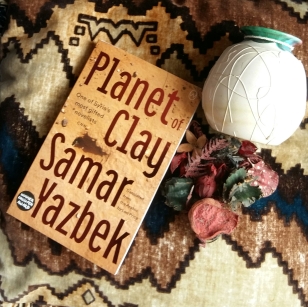
 About the Book
Rima is a young girl in war-torn Damascus. Her feet seem to work independently, she says. Is this an affliction? Or is she just an inquisitive, adventurous young child? Her exhausted mother keeps her tied with a rope around her wrist to stop her wandering off.
As a young girl, Rima also loses the ability to speak, although she can recite sutras of Qur’an. And she can use her voice to scream – which, tragically, happens more as the story progresses.
Hidden in the library of the school where her mother works as a cleaner, she finds refuge in a fantasy world full of coloured crayons, secret planets, and The Little Prince, reciting passages of the Qur’an like a mantra as everything and everyone around her is blown to bits.
Since Rima hardly ever speaks, people think she’s crazy, but she is no fool – the madness is in the battered city around her. One day while taking a bus through Damascus, a soldier opens fire and her mother is killed. Rima, wounded, is taken to a military hospital before her brother leads her to the besieged area of Ghouta – where, between bombings, she writes her story.
In Planet of Clay, Samar Yazbek offers a surreal depiction of the horrors taking place in Syria, in vivid and poetic language and with a sharp eye for detail and beauty.
Format: Paperback (320 pages) Publisher: World Editions
Publication date: 26th August 2021 Genre: Literature in Translation, Literary Fiction
Find Planet of Clay on Goodreads
Purchase links
Bookshop.org
Disclosure: If you buy a book via the above link, I may earn a commission from Bookshop.org, whose fees support independent bookshops
Hive | Amazon UK
Links provided for convenience only, not as part of an affiliate programme
My Review
I don’t think Planet of Clay is a book I would have picked up had it not been for Ruth Killick and World Editions kindly sending me an advance review copy. How glad I am that they did because reading this book was to enter a strange, unsettling world and meet an unforgettable character.
Translated from Arabic by Leri Price, Planet of Clay‘s narrator, Rima, recounts her story in a non-linear fashion, switching back and forth in time between different memories of events she has witnessed. The stories seem to pour out of her, with many left unfinished as she takes up another story, along with frequent promises that she will return at some point to complete the earlier stories. As she admits, ‘I’m writing without restraint and without sequence’. This takes some getting used to but I found it best to go with the flow and see where Rima took me.
Through Rima’s eyes the reader experiences the horror of daily life in war-torn Damascus: checkpoints, armed militia and tanks on the street, aeroplanes flying overhead and the sound of bombs falling across the city. ‘We wait, every day, for the bombs to fall on us.’ At one point, she muses, ‘I don’t understand how a giant plane can come and kill small, weak people in such quantities.’ Quite. Rima witnesses random acts of violence, one of which results in the death of her mother, just one of the people who disappears from Rima’s life. Worse is to come as parts of the city are subjected to attack from lethal weapons. In the words of Rima, ‘the planes and the sky rained smells in August‘. Rima herself suffers the after-effects of this attack.
Rima’s view of the world is different from those around her, sensed as colours rather than words, and expressed through drawings. For her, ‘every adjective in language is like a painting‘. The writing has moments of intense beauty with some memorable turns of phrase, often influenced by Rima’s beloved The Little Prince by Antoine de Saint-Exupéry. ‘Love is a group of small planets with long thin arms dancing then lacing together into a knot of dazzling light.’
Before long, Rima’s existence has contracted to a tiny cellar room which she cannot leave. She perceives her life as a series of planets, and retreats in her mind to the most secret of them, one which is ‘hard to invade’ and cannot disappear until she disappears too. And as for the book’s title? As Rima observes, ‘We are toys made out of clay, small toys, quick to break and crumble’.
Towards the end of the book Rima observes, ‘You are starting to know my theory now, about circular stories with intersecting centres which are only completed by retelling and new details’. The stories Rima tells are heartbreaking and paint a unique picture of a world gone mad. I’m sure I won’t be the only reader to see parallels with the terrible events taking place in Afghanistan.
In three words: Mesmerising, imaginative, moving
Try something similar: The Storyteller by Pierre Jarawan
Follow this blog via Bloglovin
 About the Author
Samar Yazbek is a Syrian writer, novelist, and journalist. She was born in Jableh in 1970 and studied literature before beginning her career as a journalist and a scriptwriter for Syrian television and film. Her novels include Cinnamon (2012) and Planet of Clay (2021). Her accounts of the Syrian conflict include A Woman in the Crossfire: Diaries of the Syrian Revolution (2012) and The Crossing: My Journey to the Shattered Heart of Syria (2015). Yazbek’s work has been translated into multiple languages and has been recognized with numerous awards – notably, the French Best Foreign Book Award, the PEN-Oxfam Novib, PEN Tucholsky, and PEN Pinter awards.
Connect with Samar
Goodreads
About the Translator
Leri Price is an award-winning literary translator of contemporary Arabic fiction. Price’s translation of Khaled Khalifa’s Death Is Hard Work was a finalist for the 2019 National Book Award for Translated Literature (US) and winner of the 2020 Saif Ghobash Banipal Prize for Arabic Literary Translation. Her translation of Khaled Khalifa’s No Knives in the Kitchens of This City was shortlisted for the ALTA National Translation Award. Price’s other recent translations include Sarab by award-winning writer Raja Alem.

 About the Book
 About the Author

