
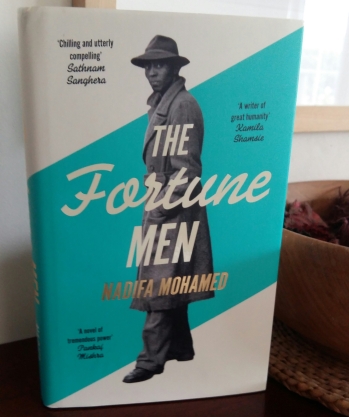
 About the Book
The story of a murder, a miscarriage of justice, and a man too innocent for his times . . .
Mahmood Mattan is a fixture in Cardiff’s Tiger Bay, 1952, which bustles with Somali and West Indian sailors, Maltese businessmen and Jewish families. He is a father, chancer, petty criminal. He is a smooth-talker with rakish charm and an eye for a good game. He is many things, but he is not a murderer.
So when a shopkeeper is brutally killed and all eyes fall on him, Mahmood isn’t too worried. Since his Welsh wife Laura kicked him out for racking up debts he has wandered the streets more often, and there are witnesses who allegedly saw him enter the shop that night. But Mahmood has escaped worse scrapes, and he is innocent in this country where justice is served. Love lends him immunity too: the fierce love of Laura, who forgives his gambling in a heartbeat, and his children. It is only in the run-up to the trial, as the prospect of returning home dwindles, that it will dawn on Mahmood that he is in a fight for his life – against conspiracy, prejudice and cruelty – and that the truth may not be enough to save him.
Format: Hardcover (372 pages) Publisher: Viking
Publication date: 27th May 2021 Genre: Historical Fiction
Find The Fortune Men on Goodreads
Purchase links
Bookshop.org
Disclosure: If you buy a book via the above link, I may earn a commission from Bookshop.org, whose fees support independent bookshops
Hive | Amazon UK
Links provided for convenience only, not as part of an affiliate programme
My Review
Shortlisted for the Booker Prize 2021, The Fortune Men is a fictionalized account of a true story of a miscarriage of justice.
Set in Cardiff in 1952, the author really conjures up the melting pot that is the Tiger Bay area of the city, inhabited by people from different cultures – Somali, Jamaican, India – and religions – Jewish, Hindu, Muslim. However, many of its inhabitants live a hand-to-mouth existence on the margins of society: ‘the unfortunate, distant-eyed flotsam of Cardiff, their quiet lives sustained by day wages and borrowed rations’. Non-whites face racial discrimination, especially from the police who consider them guilty until proven innocent. When Mahmood is arrested, he initially believes it is for theft. When he discovers he is suspected of the murder of a local woman, he protests his innocence. ‘He won’t let them use him as the rag they soak up spilt blood with’.
The book also explores the feelings of Diana, the sister of the murdered woman. As well as shock and a desire for justice, Diana feels a sense of guilt given the murder took place barely feet away, albeit in another section of the house that served as a shop. The loss of her sister causes her to reflect on other losses in her life and her wartime experiences.
As Mahmood awaits trial in prison, the reader gets an insight into his childhood in Somalia, his religious education and the country’s history which is one of occupation by the British and Italians. We learn how Mahmood, seeking a new and better life, became a stoker on board cargo ships travelling the world, eventually leading him to Cardiff and a meeting with the young woman, Laura, who would eventually become his wife and the mother of his children. Despite the difficulties of an interracial marriage, theirs is a deep and loving relationship. As Laura tells Mahmood at the end of the book, in circumstances which will surely tug at your heartstrings, ‘You have been the best thing to happen in my life, you know that’.
I loved the way the author explored the character of Mahmood who, by his own admission, has not led the life of a saint. During his trial he is incredulous at the picture painted of him by the police and prosecution witnesses. ‘They are blind to Mahmood Hussein Mattan and all his real manifestations: the tireless stoker, the poker shark, the elegant wanderer, the love-starved husband, the soft-hearted father.’ The situation he finds himself in doesn’t seem real. ‘His life was, is, one long film with mobs of extras and exotic, expensive sets’. The verdict, when it comes, is a foregone conclusion but is no less upsetting for that. In the weeks and months that follow, which are described in unflinching detail, Mahmood hopes against hope for a different outcome. It’s one he is powerless to influence, leading him to ponder on the gulf that exists between him and the people who have the power to decide his destiny. His thoughts even turn to the Queen: ‘You rich, I’m poor, you white, I’m black, you Christian, I’m Muslim, you English, I’m Somali, you’re loved, I’m despised’.
There are many features of the book I enjoyed, such as the chapter numbers also being shown in Somali, the occasional use of vernacular words and phrases (although a glossary would have been useful) and the section of the book covering Mahmood’s trial which takes the form of a Q&A mimicking a transcript. But perhaps my favourite thing was the detailed lists the author includes from time to time. For example, this from near the beginning of the book listing the various roles of the migrant workers who have ended up in Tiger Bay: ‘dockers, talleymen, kickers, stevedores, winch men, hatch men, samplers, grain porters, timber porters, tackle men, yard masters, teamers, dock watchmen, needle men, ferrymen, shunters, pilots, tugboatmen, foyboatmen, freshwater men, blacksmiths, jetty clerks, warehousemen, measurers, weighers, dredgermen, lumpers, launch men, lightermen, crane drivers, coal trimmers…stokers.’ Yes, I don’t know what a lot of them do either!
The final chapter of The Fortune Men made me cry; the epilogue made me angry. I think the book thoroughly deserves its place on the Booker Prize shortlist and I would love to see it win. You can learn more about the case and the author’s research for the book in this article on the BBC website.
In three words: Compelling, intense, chilling
Try something similar: This Mortal Boy by Fiona Kidman
Follow this blog via Bloglovin
 About the Author
Nadifa Mohamed was born in Hargeisa, Somaliland in 1981 and moved to Britain at the age of four. Her first novel, Black Mamba Boy, won the 2010 Betty Trask Prize; it was shortlisted for the Guardian First Book Award, the John Llewellyn-Rhys Memorial Prize, the Dylan Thomas Prize and the PEN Open Book Award. Her second novel, Orchard of Lost Souls, won a Somerset Maugham Award and Prix Albert Bernard. Nadifa Mohamed was selected for the Granta Best of Young British Novelists in 2013, and is Fellow of the Royal Society of Literature. She lives in London.
Connect with Nadifa
Twitter | Instagram

 About the Book
 About the Author
 What Cathy Read Next...