
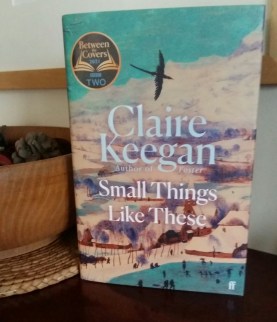
#BookReview Small Things Like These by Claire Keegan @FaberBooks

Small Things Like TheseAbout the Book

It is 1985, in an Irish town. During the weeks leading up to Christmas, Bill Furlong, a coal and timber merchant, faces into his busiest season.

As he does the rounds, he feels the past rising up to meet him – and encounters the complicit silences of a people controlled by the Church.

Format: Hardcover (128 pages)         Publisher: Faber & Faber
Publication date: 21st October 2021 Genre: Literary Fiction

Find Small Things Like These on Goodreads

Purchase links
Bookshop.org
Disclosure: If you buy a book via the above link, I may earn a commission from Bookshop.org, whose fees support independent bookshops

Hive | Amazon UK
Links provided for convenience only, not as part of an affiliate programme


My Review

I rarely re-read books but in the case of Small Things Like These as soon as I’d finished the book I turned back to the beginning and read it again, not wanting to miss any little detail I may have overlooked first time around. And there were many.

The book is set in the approach to Christmas – ‘It was a December of crows’ – traditionally a time of generosity which, although absent in others, is embodied in the person of Bill Furlong.  Although they may be considered ‘small things’ by some, Bill’s acts of kindness – a lift home in the rain, a pile of logs for a loyal customer – are of great significance to the recipients.

I loved all the domestic details of family life in the Furlong household – making the Christmas cake, baking mince pies, decorating the Christmas tree and Bill’s daughters writing their letters to Santa. (One of many poignant moments for me was later in the book when Bill goes into a toyshop to ask if they have a five hundred piece jigsaw puzzle of a farm.)

At one point, Bill asks himself ‘was there any point in being alive without helping one another?’ It’s that instinct that motivates him to take the action he does at the end of the book even though it will mean going up against the power of the Church and may have unwelcome consequences for him and his family. In part, it’s a way of ‘paying forward’ the generosity of Mrs Wilson, the woman who continued to employ his unmarried mother even after she became pregnant, provided Bill with a home after his mother’s death and gave him the funds to start up his business. He recalls Mrs Wilson’s daily kindnesses ‘how she had corrected and encouraged him, of the small things she had said and done’.  Yes, those small things again.

How can any reader not fall in love with Bill, the quiet, unassuming hero of the book who epitomises the generosity of spirit preached in the Bible, a generosity which is not always demonstrated in practice by others, especially those proven to have offered only cruelty and condemnation where there should have been mercy and understanding.

I loved the gentle lilt of Claire Keegan’s writing and the sense that every single word has been carefully chosen – which it probably has. The opening paragraph of the book is a good example. ‘In October there were yellow trees. Then the clocks went back the hour and the long November winds came in and blew, and stripped the trees bare. In the town of New Ross, chimneys threw out smoke which fell away and drifted off in hairy, drawn-out strings before dispersing along the quays, and soon the River Barrow, dark as stout, swelled up with rain.’ 

Small Things Like These is a quietly powerful novel, an exquisite little gem of a book. It’s no surprise that so many readers have fallen in love with it.

In three words: Eloquent, tender, sublime

Try something similar: Stoner by John Williams

Follow this blog via Bloglovin


Claire KeeganAbout the Author

Irish writer Claire Keegan’s debut collection of stories, Antarctica, was a Los Angeles Times Book of the Year. The Observer called these stories: ‘Among the finest recently written in English’. It was also awarded the William Trevor Prize, judged by William Trevor.  In 2007, her second collection, Walk the Blue Fields, was published to huge critical acclaim and went on to win The Edge Hill Prize for the strongest collection published in The British Isles. The prize was adjudicated by Hilary Mantel.  Foster (2010) won The Davy Byrnes Award, then the world’s richest prize for a story. It judged by Richard Ford: “Keegan is a rarity-someone I will always want to read’.”

Keegan’s stories are published in English by Faber & Faber, have appeared in The New Yorker, Granta, The Paris Review, Best American Stories, won numerous awards  and are translated into 17 languages.  She is internationally renowned as a teacher of creative writing. (Photo/bio: Author website) 

Connect with Claire
Website | Twitter | Goodreads

#BookReview The Alphabet of Heart’s Desire by Brian Keaney @hhousebooks

The Alphabet of Heart's DesireAbout the Book

In 1802 Thomas de Quincey, a young man from a comfortable middle-class background who would go on to become one of the most celebrated writers of his day, collapsed on Oxford Street and was discovered by a teenage prostitute who brought him back to her room and nursed him to health.

It was the beginning of a relationship that would introduce Thomas to a world just below the surface of London’s polite society, where pleasure was a tradeable commodity and opium could seem the only relief from poverty. Yet it is also a world where love might blossom, and goodness survive.

The lives of a street girl, an aspiring writer, and a freed slave cross and re-cross the slums of London in this novel about the birth of passion, the burden of addiction, and the consolations of literature.

Format: Paperback (392 pages)              Publisher: Holland House
Publication date: 16th November 2017 Genre: Historical Fiction

Find The Alphabet of Heart’s Desire on Goodreads

Purchase links
Bookshop.org
Disclosure: If you buy a book via the above link, I may earn a commission from Bookshop.org, whose fees support independent bookshops

Hive | Amazon UK
Links provided for convenience only, not as part of an affiliate programme


My Review

I’ve been attempting to continue the good work started through taking part in NetGalley November by reading some of the older books on my NetGalley To-Read shelf. The Alphabet of Heart’s Desire is one of those, having been on my shelf for, um… quite a few years.

Set in Georgian London, the book follows the lives of three people: Anne, a young woman forced into prostitution in order to escape a violent stepfather; Tuah, captured by Dutch slavers and brought to England by the captain of a trading ship; and aspiring writer, Thomas De Quincey.  Their parallel stories are told in alternating chapters, in the first person in the case of Anne and Tuah, and in the third person in the case of Thomas.

Thomas comes across as naïve and something of a dreamer, creating imaginary worlds in which everyday practicalities do not exist. As Anne later observes, ‘He looked at the world but all he ever saw was his own strange thoughts’. In fact, imaginary worlds are something of a theme of the book. For example, Anne, focussing on a stain on the ceiling of her dingy room, imagines herself on a ship travelling the seas to distract herself whilst servicing customers. Meanwhile, Tuah has dreams in which he is back on the island of his birth, an island he doesn’t even know the name or location of. At other times, he loses himself in books.

For much of the book, the lives of Thomas, Anne and Tuah unfold quite separately with only the occasional ‘near miss’ or the revealing of a shared acquaintance with a third party. Gradually, their lives begin to interconnect more significantly. One connection between them is opium. The naval captain who brought Tuah to London was involved in the opium trade whilst Anne and Thomas both become consumers of the drug in the form of laudanum. For Anne, initially this is to relieve physical pain but increasingly it becomes a refuge, a way to distance herself from what she is forced to endure. For Thomas, it’s a way to escape the harsh realities of his existence which has left him homeless and penniless. However, as Thomas discovers, excessive use of the drug can unearth nightmarish memories.

Although I thought Thomas and Tuah were wonderful characters, my favourite was Anne. I loved her fortitude and determination, despite all the disappointments and obstacles thrown in her way. ‘I would find a ledge to stand on and keep standing there, whatever winds might buffet, whatever rain might fall.’ I also liked the distinctive, spirited voice the author created for her, describing her first client as ‘a great fat, red-faced gundiguts with lips as thick as rope and eyes like a pig’.  Having fallen so low herself, she offers Thomas a lifeline just when he needs it most and is rewarded with the prospect of a different future.

I loved the way the author created a vivid picture of the London of the period: its sights, sounds… and smells. With the eyes and ears of a newcomer, Tuah likens the hubbub of the city to bees at work in a giant hive. ‘A great welter of human voices and animal cries all mixed up with the trundling of cart wheels, the grinding of stone, the hammering of metal, the banging of timber and the mighty creaking and groaning of all those buildings as the restless population swarmed back and forth in their constant frenzy of activity.’ Or how about this description of London in the heat of June: ‘The nights were sticky, full of the smells of the city: beer and dung, smoke and tallow, meat and tar, bread and grease, blood and fish and, hanging over everything, the great stink of the river’.  

I had heard of Thomas De Quincey but knew little about his life and, although The Alphabet of Heart’s Desire is fiction, much of it is based on known facts, as the author’s historical note explains.  Anne existed in real life too although she quickly disappears from the historical record. So, as well as the author’s own imagining of how things may have played out for her, there’s also space for the reader to reach their own conclusion.

The Alphabet of Heart’s Desire is a wonderfully imagined story that blends fact and fiction, and positively oozes period atmosphere. I received a review copy courtesy of Holland House via NetGalley and am only  sorry it’s taken me this long to get around to reading it.

In three words: Immersive, atmospheric, enthralling

Try something similar: Blackberry & Wild Rose by Sonia Velton

Follow this blog via Bloglovin


Brian KeaneyAbout the Author

Brian Keaney is an award-winning author, best known for his young adult and children’s fantasy novels Jacob’s Ladder, The Hollow People and The Magical Detectives. For a number of years he was Royal Literary Fund Fellow at Goldsmiths College and at the London College Of Fashion and he taught creative writing on the Pembroke College Cambridge summer programme.

He has a house in the west of Ireland where he spends as much time as possible. His writing has been translated into twenty languages. (Photo: Author website)

Connect with Brian
Website | Twitter | Goodreads