
 Welcome to today’s stop on the blog tour for Villager by Tom Cox. My thanks to Anne at Random Things Tours for inviting me to take part in the tour and to Unbound for my digital review copy.
 About the Book
There’s so much to know. It will never end, I suspect, even when it does. So much in all these lives, so many stories, even in this small place.
Villages are full of tales: some are forgotten while others become a part of local folklore. But the fortunes of one West Country village are watched over and irreversibly etched into its history as an omniscient, somewhat crabby, presence keeps track of village life.
In the late sixties a Californian musician blows through Underhill where he writes a set of haunting folk songs that will earn him a group of obsessive fans and a cult following. Two decades later, a couple of teenagers disturb a body on the local golf course. In 2019, a pair of lodgers discover a one-eyed rag doll hidden in the walls of their crumbling and neglected home. Connections are forged and broken across generations, but only the landscape itself can link them together. A landscape threatened by property development and superfast train corridors and speckled by the pylons whose feet have been buried across the moor.
Format: Hardcover (448 pages) Publisher: Unbound
Publication date: 28 April 2022 Genre: Literary Fiction
Find Villager on Goodreads
Purchase links
Bookshop.org
Disclosure: If you buy a book via the above link, I may earn a commission from Bookshop.org, whose fees support independent bookshops
Hive | Amazon UK
Links provided for convenience only, not as part of an affiliate programme
My Review
This is the first book I’ve read by Tom Cox so, unlike some other reviewers, I’m not familiar with his nonfiction writing and as I usually scroll past images of dogs or cats on Instagram or Twitter I’ve not come across him on social media either. Therefore I didn’t know quite what to expect, a sensation that remained throughout the time I was reading the book.
Villager is a book which almost defies description due to its idiosyncratic style and non-linear structure. The novel ranges over a vast period from the dawn of time to the end of this century. It’s a cocktail of different narratives, in a variety of styles, all of which are connected to the village of Underhill and to an American musician, RJ McKendree who visited the area in the late 1960s and composed music inspired by local folksongs. Some meet him, others inhabit places he did, observe the same views as him or are inspired by his music.
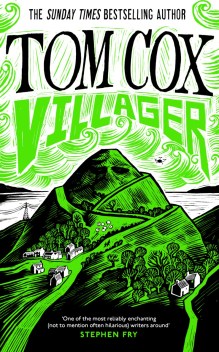
One of the most inventive elements of the book is that Underhill and the surrounding area is presided over by an omniscient narrator, referred to as ‘Me’, whom I took to be the landscape itself. (Have a peek at the cover and you might spot ‘Me’.) ‘Me’ observes the goings-on of the inhabitants, knows all their secrets and reflects on the changes that have been wrought on the landscape by mankind, changes which have often caused it something akin to physical pain. ‘The countryside looks on, bemused at the way it’s been outgrown, bludgeoned, smoothed over, suppressed, raped, waiting for the revenge it will surely enjoy when we are gone.’ At times the landscape fights back. For example, the final nine holes of the golf course that has reduced many a player to swearing at sheep or hurling their golf clubs in the river. It works the other way as well. As ‘Me’ ruefully observes, ‘I don’t feel great today, and my not-greatness influences those around me. I made a buddleia visibly ill at ease this morning’.
An appreciation of nature and concern for the environment flow through the book. There are wonderful descriptions of the local landscape and wildlife. ‘The last purple streaks of the sun toasted the hilltops and owls made lewd suggestions to one another down in the woods by the river.’ On the subject of flowing, I especially enjoyed the way the author gives the rivers a personality, at times rebellious – ‘One is being a thug out back of the Coop, hissing and swearing at the locals’ – at other times, placid – ‘Today, though, the river was a pussycat. It purred around the boulders beneath his feet’.
The author employs a number of different narrative formats including journals, interactions with a search engine which has developed an unnerving ability to empathise and, most memorably for me, a community message board. The latter allows the author to give full rein to his wicked sense of humour in the often inconsequential chatter of the locals, the acerbic comments of one resident or the contributions of the mysterious Megan Beaker.
My favourite section was the one entitled ‘Papps Wedge’ which features couple, Sally and Bob (not Bob and Sally) whom we first in middle-age and then much later in 2043. It provides a glimpse of a future in which profit and human convenience is prioritised over environmental protection so a new train line ‘smashes through ancient woodland, f**ks over a couple of Elizabethan farmhouses, rapes and pillages the homesteads of hares, otters, stoats and badgers’. In addition, immersive technology has replaced direct experience for many people. Only Bob and a few like-minded people have rejected its use leaving them isolated in some ways but more in touch with the natural environment.
I’ll confess I found some parts of the book more challenging than others. For instance, many of the musical references in the section ‘Report of Debris’ went over my head. Alternatively if they were pure invention, I couldn’t tell.
Villager is endlessly inventive and jam-packed with thought-provoking ideas. I think it’s the kind of book that would repay re-reading.
In three words: Lyrical, original, stimulating
Follow this blog via Bloglovin
 About the Author
Tom Cox lives in Devon. He is the author of the Sunday Times bestselling The Good, the Bad and the Furry and the William Hill Sports Book longlisted Bring Me the Head of Sergio Garcia. 21st-Century Yokel was longlisted for the Wainwright Prize, and the titular story of Help the Witch won a Shirley Jackson Award.
He is also the man behind the enormously popular Why My Cat Is Sad account.
Connect with Tom
Website | Twitter | Facebook | Instagram

 Welcome to today’s stop on the blog tour for Only May by Carol Lovekin. My thanks to Anne at Random Things Tours for inviting me to take part in the tour and for Honno for my digital review copy.
 About the Book
 About the Author

