
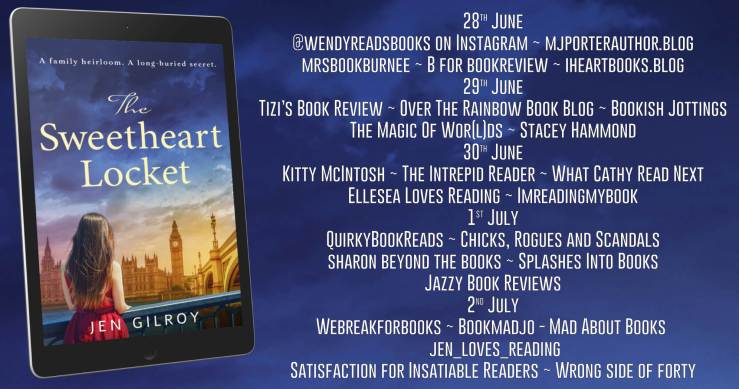
 Welcome to today’s stop on the blog tour for The Sweetheart Locket by Jen Gilroy. My thanks to Rachel at Rachel’s Random Resources for inviting me to take part in the tour and to Orion Dash for my digital review copy via NetGalley. Do check out the posts by my four tour buddies for today, Kylie at Kitty-Kat Chronicles, Marg at The Intrepid Reader, Linn at Ellesea Loves Reading and Faye at imreadingmybook.
 There’s also a giveaway with a chance to win one of two Kindle copies of The Sweetheart Locket. Enter via Rafflecopter here.
Terms and Conditions
- Open to entrants aged 18 or over
- UK & Canada entries only
- The winner will be selected at random via Rafflecopter from all valid entries and will be notified by Twitter and/or email. If no response is received within 7 days then Rachel’s Random Resources reserves the right to select an alternative winner.
- Any personal data given as part of the competition entry is used for this purpose only and will not be shared with third parties, with the exception of the winners’ information. This will passed to the giveaway organiser and used only for fulfilment of the prize, after which time Rachel’s Random Resources will delete the data.
- I am not responsible for despatch or delivery of the prize.
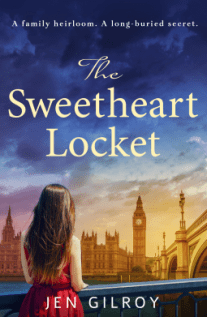 About the Book
What if the key to your present lies in the past?
London, 1939. On the eve of the Second World War, Canadian Maggie Wyndham defies her family and stays in England to do her bit for the war effort. Torn between two countries, two men and living a life of lies working for the Special Operations Executive (SOE), Maggie’s RAF sweetheart locket is part of who she is…and who she isn’t.
San Francisco, 2019. Over twenty years after Maggie’s death, her daughter Millie and granddaughter Willow take a DNA test that’s supposed to be a bit of fun but instead yields unexpected results. Willow has always treasured her grandmother’s sweetheart locket, both family heirloom and a symbol of her grandparents’ love story. But now she doesn’t know what to believe. She embarks on a search for the truth, one she doesn’t know will reveal far more about herself…
Format: ebook (358 pages) Publisher: Orion Dash
Publication date: 17th March 2022 Genre: Historical Fiction
Find The Sweetheart Locket on Goodreads
Purchase links
Hive | Amazon UK
Links provided for convenience only, not as part of an affiliate programme
My Review
The book alternates between Maggie’s story starting at the outbreak of the Second World War and Willow’s in the present day (2019) as she searches for information about her grandmother’s life. It’s a search that initially will raise just as many questions as answers but possibly serve to lessen the distance that has developed between Willow and her mother, Camilla.
I found Maggie’s story particularly compelling, especially as it shines a light on the vitally important contribution women made to the war effort both at home and abroad, a contribution that often placed them in great personal danger. Willow’s research into her grandmother’s life allows the author to provide the reader with information about a secret wartime role performed by women not fully known about until recently. Inevitably, because of the book’s structure, the tension surrounding Maggie’s wartime experiences is lessened because we know she will survive the war. However, that’s not the same for other characters, injecting a welcome sense of jeopardy.
I liked the way the author brought out connections between the two women, despite the many decades that divide them. Both Maggie and Willow change over time, becoming more independent and determined to forge their own direction in life, even if that involves making a life in a new country. They become more willing to take risks in other ways too. There is a romantic aspect to both storylines although I thought Maggie’s was more believable, reflecting the fact that in wartime people have to live in the moment and snatch any chance of happiness.
I thought it was clever of the author to reflect the differences between then and now. For us, London at night with a sky bright with stars might be magical but for Maggie and others who lived through the Second World War it meant ‘bombing weather’, something to be feared rather than enjoyed. And for Maggie, clear skies has an additional significance linked to her wartime work.
Those who enjoy a mixture of tears of sadness and of joy in their historical fiction will find themselves well rewarded. There are also poignant, bittersweet moments and a few surprises, some more foreseeable than others, but given the fog of war not completely implausible. And after all, this is fiction. A neat touch is the epilogue which acts as a ‘what happened next’ for many of the secondary characters featured in the book.
The Sweetheart Locket is an absorbing dual timeline novel combining wartime drama, the uncovering of family secrets and new beginnings.
In three words: Romantic, engaging, heartwarming
Try something similar: The Girl From Bletchley Park by Kathleen McGurl
Follow this blog via Bloglovin
 About the Author
Jen Gilroy writes sweet contemporary romance and dual timeline historical women’s fiction – warm, feel-good stories to bring readers’ hearts home. A Romance Writers of America® Golden Heart® finalist and shortlisted for the Romantic Novelists’ Association Joan Hessayon award, Amazon named her third book, Back Home at Firefly Lake, a ‘Best Book of the Month: Romance’ in December 2017.
A dual British-Canadian citizen, Jen lived in England for many years and earned a doctorate (with a focus on British cultural studies and social history) from University College London. Returning to where her Irish family roots run deep, she now lives with her husband, teenage daughter and floppy-eared rescue hound in small-town Eastern Ontario, Canada. When not writing, she enjoys reading, ice cream, ballet and paddling her purple kayak.
Connect with Jen
Website | Twitter | Facebook | Instagram

 About the Book
 About the Author

