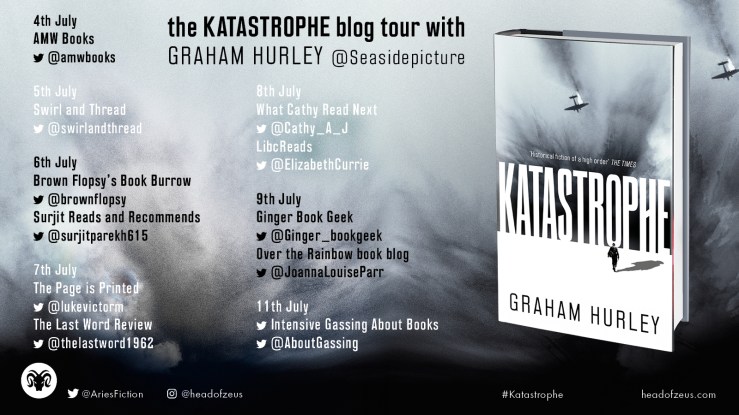
 Welcome to today’s stop on the blog tour for Katastrophe by Graham Hurley. My thanks to Sophie at Ransom PR for inviting me to take part in the tour and to Head of Zeus for my review copy. Do check out the review by my tour buddy for today, Elizabeth at Libcreads.
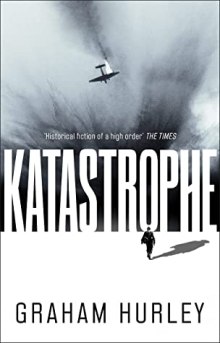 About the Book
Confidant of Goebbels. Instrument of Stalin. What’s the worst that could happen?
January 1945. Wherever you look on the map, the Thousand Year Reich is shrinking. Even Goebbels has run out of lies to sweeten the reckoning to come. An Allied victory is inevitable, but who will reap the spoils of war?
Two years ago, Werner Nehmann’s war came to an abrupt end in Stalingrad. With the city in ruins, the remains of General Paulus’ Sixth Army surrendered to the Soviets, and Nehmann was taken captive. But now he’s riding on the back of one of Marshal Zhukov’s T-34 tanks, heading home with a message for the man who consigned him to the Stalingrad Cauldron.
With the Red Army about to fall on Berlin, Stalin fears his sometime allies are conspiring to deny him his prize. He needs to speak to Goebbels – and who better to broker the contact than Nehmann, Goebbels’ one-time confidant?
Having swapped the ruins of Stalingrad for the wreckage of Berlin, the influence of Goebbels for the machinations of Stalin, and Gulag rags for a Red Army uniform, Nehmann’s war has taken a turn for the worse. The Germans have a word for it:
Katastrophe.
Format: Hardback (448 pages) Publisher: Head of Zeus
Publication date: 7th July 2022 Genre: Historical Fiction
Find Katastrophe on Goodreads
Purchase links
Bookshop.org
Disclosure: If you buy a book via the above link, I may earn a commission from Bookshop.org, whose fees support independent bookshops
Hive | Amazon UK
Links provided for convenience only, not as part of an affiliate programme
My Review
Katastrophe, the latest book in the author’s ‘Spoils of War’ series, is set in the final months of the Second World War. There’s a real sense of finality about the book as we witness the ruin of people and places. The terrible and lasting impact of war – physical and psychological – is reflected in the experiences of the four main characters – British MI5 operatives, Tam Moncrieff and Ursula Barton, journalist and propagandist, Werner Nehmann, and German intelligence officer, Wilhelm Schultz – some of whom make return appearances from the author’s previous two novels, Last Flight to Stalingrad and Kyiv.
There are some intense, dark and harrowing scenes involving Nehmann and Schultz, both survivors of the siege of Stalingrad, but now respectively subjected to the horror of a Soviet labour camp and brutal interrogation. Subsequently they find themselves pawns in a wider political game. For Moncrieff and Barton, their experience is one of overwhelming disillusionment and a sense of betrayal. It’s something that has left Barton ‘a frail, tormented figure’ and Moncrieff with unanswered questions about the fate of someone close to him.
The title of the series – Spoils of War – is particularly apt because in Katastophe the reader sees played out the manoeuvring even amongst supposed allies for control of territory occupied during the conflict. The co-operation that existed between Western nations and the Soviet Union in order to defeat Hitler is crumbling, replaced by suspicion, secrecy and underhand tactics. Stalin emerges as a ruthless and malevolent player in this attempted power grab. As Ursula Barton observes at one point, ‘The war’s coming to an end. Everyone knows that. The question is how, and when, and who controls which bits of our poor bloody continent when it’s over’. We also witness those formerly high up in the Third Reich, now in shattered pieces, struggling to come to terms with defeat or even in their delusion refusing to accept it.
Behind all the political manouvering the suffering inflicted on civilians on both sides is laid bare: the bombing of cities, the displacement of people, the ravages of hunger or the ruthlessness of invading forces. It’s brought vividly to life in a way that can’t help make you think of the current situation in Ukraine. Indeed, I found myself thinking of that poor country repeatedly whilst reading the book, leaving me with an overwhelming sense of sadness that we seemed to have learned nothing. As a character observes, ‘No one was ready for Hitler, not because he hadn’t warned them what was coming, but because they hadn’t listened.’ For Hitler, substitute Putin?
Katastrophe is a brilliant blend of fact and fiction that even in its darkest moments remains utterly compelling. It takes a fair degree of skill to create a sense of tension in a series of events where the outcome is already known, but the author definitely achieves it. I felt totally immersed in the lives of the characters and eager to learn their fate. None of them emerge unscathed but there are one or two glimmers of hope that demonstrate perhaps war hasn’t robbed them all of everything. If Katastrophe does mark the conclusion of the series, it’s definitely ended on a high note.
In three words: Gripping, immersive, masterful
Try something similar: Vienna Spies by Alex Gerlis
Follow this blog via Bloglovin
 About the Author
Graham Hurley is an award-winning TV documentary maker and the author of the acclaimed Faraday and Winter crime novels, two of which have been shortlisted for the Theakston’s Old Peculier Award for Best Crime Novel. His Second World War thriller Finisterre, part of the critically acclaimed Spoils of War collection was shortlisted for the Wilbur Smith Adventure Writing Prize. (Photo: Goodreads author page)
Connect with Graham
Website | Twitter

 The Historical Fiction Reading Challenge is hosted by Marg at The Intrepid Reader. You can find full details of the challenge here (and you can still sign up to take part) but the idea is to choose one of six different reading levels to aim for:


