Finding Kindness in Dark Places: The Unlikely Friendship at the Heart of The Boy on the Sofa: A Guest Post by Paul Linggood @BroadwaterBooks

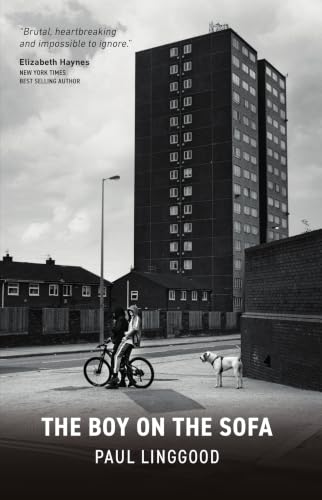
I’m thrilled to welcome Paul Linggood to What Cathy Read Next today to talk about his novel The Boy on the Sofa which was published by Broadwater Books on 25th September 2026. The Boy on the Sofa is available to purchase as an ebook or in paperback from Amazon and other retailers.

Although I’m ‘officially’ closed to review requests, Paul’s book sounded so compelling I couldn’t help agreeing to add it to my review pile. I hope once you’ve read his guest post you’ll want to do the same.

About the Book

Billy Mercer is fourteen years old and tired of being laughed at.

At school, the other boys mock his cheap clothes and the holes in his trainers. At home, his mother works herself to exhaustion just to keep food on the table. Money is always short. Respect is even harder to come by.

So when someone notices him, Billy is pulled into a world of manipulation, intimidation and empty promises. What begins with subtle threats soon becomes something far more dangerous than he ever imagined.

Meanwhile, on the Ashbourne estate, Terry Foster watches helplessly as strangers slowly take over his flat, his routine and what remains of his life.

Told through alternating perspectives from opposite ends of a brutal spectrum, The Boy on the Sofa is a raw and deeply human novel about poverty, exploitation and survival in modern Britain.

Find The Boy on the Sofa on Goodreads

Finding Kindness in Dark Places: The Unlikely Friendship at the Heart of The Boy on the Sofa by Paul Linggood

“I wanted to write a novel about county lines – a topic most people only know from the news. A book that deals with addiction, poverty, exploitation and neglect. I wanted to write it ‘warts and all’, with none of the hard truths spared.

On paper, I realised this sounded extremely bleak. Not only did I not want to alienate audiences and expose the reader to misery, but I also did not want to write such a book. Granted, this subject will always be bleak. I have tried to highlight an important issue and not simply show what is happening, but give an indication as to why. But there is more to it than that. There are human beings involved. People who have experienced a lot of hardship. People in tough situations. For me, the human relationships in the novel, particularly that of Billy and Terry, became more important than the criminal world that was suffocating them.

Billy is a 14-year-old boy from a single-parent, working-class home. A typical candidate for county lines grooming. When he is sent to his new place of work, a crack house in a council tower, he meets Terry, an adult in his fifties fully trapped in that world. Terry is wise, kind and broken, his home invaded by drug dealers. Billy is young, naive and seeking respect. They meet at completely different points in the same destructive system. They are an unlikely pairing. Billy may look upon Terry as someone he might become. Terry looks at Billy and sees a past he can never retrieve or rectify. Both are vulnerable in different ways. Both of them are lonely. Ideally, neither would be in a situation where they would need each other. But they need each other in that space more than they realise. They can give each other things they lack.

Billy is a victim, but it was essential that he was more than that. Likewise with Terry. It would have been so easy to have Billy lodge with an addict with bad intentions, someone lacking in a moral compass who would only add to the danger in Billy’s everyday life. But addiction does not automatically strip somebody of kindness or a moral compass.

The labels I could have given them would only describe stereotypical circumstances, not everyday people. Not human beings with human natures. There needed to be kindness in an unlikely place. Both their lives are hard enough. There needed to be humour (dark, yes, but humour), there needed to be irritation and contradictions, bad decisions and ordinary conversations. There needed to be affection and sympathy. They needed to be like people you could actually encounter rather than mere vehicles for a social message. I hope I achieved that.

I often ask my children to stay kind. It is one thing they both have, and something I hope they never lose as they grow older. In Billy’s situation, kindness becomes even more important. Small acts of kindness can become disproportionately valuable when someone has next to nothing. It doesn’t have to be something of great magnitude. Nothing heroic or grand. It can be a cup of tea. A roll-up. Someone checking in on you. A place to sit down that you can call your own. Ordinary things can carry the most weight.

It was important not to let the book fall into a text of misery-porn. These are serious themes that needed to be addressed honestly, without suffering being presented as entertainment. The book is very dark at times, but not for shock value – only because this is what the subject demands. But I don’t believe the kindness I have mentioned weakens the social realism the novel consists of. The humour, warmth and tenderness only make the characters experiencing their hardship more real. People living tough lives still take the piss out of each other. They still laugh when they can. They need to in order to survive.

This is what draws me to writing fiction like this. To show real people living through a very serious issue and to give them a voice when nobody normally listens. Statistics and articles tell us about children who are exploited. The Boy on the Sofa is an invitation to witness these lives. Maybe people will care about Billy because he is Billy, not because he is a representation of a social problem. Just because Terry is an addict doesn’t mean he has lost all humanity.

Even Bigman – yes, he is a bad person doing bad things, but why? What might have happened to somebody like him before we met him? What if he grew up hungry, without love and with a heart full of anger? Why would he be rich in sentiment? Why wouldn’t he feel the system owed him something, and that if he wanted anything from life he had to take it?

Billy and Terry’s relationship was born from their situation, but for me, it was not just a way of escaping the dark subject matter. It was my way of exploring it.

I found their relationship becoming the most important thing as the writing progressed. The book needed to be more dynamic than simply a vehicle for social messages and a young boy’s turbulent experience.

Because kindness matters most when the people who need it are not expecting it.”

About the Author

Paul Linggood is a novelist and poet from Hertfordshire. His debut, Just a Small Town, was published by Hookline Books in 2020 and republished by Bloodhound Books in 2023. His second novel, The Boy on the Sofa, is the first release from his independent publishing imprint, Broadwater Books.

Paul writes literary fiction centred on ordinary people navigating extraordinary circumstances. His work explores poverty, addiction, exploitation and the lives too often overlooked, combining social realism with compassion to find humanity and hope even in the darkest places.

After studying English literature, Paul completed a Master’s degree in creative writing before going on to teach English. Alongside his writing, he has spent more than two decades working as a painter and decorator, experiences that continue to shape the authentic voices and communities at the heart of his fiction. Paul founded Broadwater Books to create a home for his own writing and, in time, hopes to grow the imprint into a publisher that champions distinctive voices and helps emerging writers bring their stories to readers.

He lives in Hertfordshire with his family and is currently at work on his next novel. (Photo/bio: Amazon author page)

#GuestPost The Case of the Emigrant Niece by David Cairns of Finavon

I’m delighted to welcome author David Cairns of Finavon to What Cathy Read Next today to talk about his latest book, The Case of the Emigrant Niece, the first in a new series of historical mysteries featuring 19th century Scottish engineer, Findo Gask. David has written a fascinating guest post about the inspiration for the book and about the ‘freedom to explore’ that writing historical fiction brings him.

The Case of the Emigrant Niece will be published as en ebook on 1st December 2022 and is available for pre-order now.


The Case of the Emigrant Niece coverAbout the Book

A multiple murderer on the loose, an inheritance stolen

Injured at the start of the Indian mutiny in 1858, Scotsman Findo Gask finds himself in Melbourne during the fabled Gold Rush where he stumbles across the mystery of a stolen inheritance. Captivated by the pretty heiress, together with his new idiosyncratic friend, Erroll Rait he begins to investigate for her, travelling back to London, Edinburgh, the Scottish highlands and then to Melbourne again, uncovering multiple murders before falling foul of a sinister plot to add himself and his client to the list of victims.

Taking readers back to the days of steam trains and clipper ships, gas-lit Edinburgh streets and the goldfields of Australia with the unravelling of a mystery and the discovery of a relentless murderer, The Case of the Emigrant Niece is a spellbinding novel that captures the imagination and transports you back to a different age.

Format: ebook (437 pages)                 Publisher: Finavon Press
Publication date: 1st December 2022 Genre: Historical Fiction, Mystery

Pre-order/purchase link
Amazon UK
Link provided for convenience only, not as part of an affiliate programme


Guest Post – The Case of the Emigrant Niece by David Cairns of Finavon

This is a story I promised to myself several years ago when I was driving from Perth (in Scotland) to Glasgow.  Swooping down the A9 into the fertile glen that Macbeth would have traversed hundreds of years earlier, I passed a signpost to Findo Gask – a small village off the A9 running by the River Earn – and the name struck me immediately as ideal for a swashbuckling hero.  A little later that month I was driving to Dundee and again was struck by a signpost (literally, not figuratively), this time to the villages of Errol and Rait.  Snap.  Another name – this time conjuring up Errol Flynn of course.  They sat at the back of my mind for several years and then, having completed my Helots’ Tale series I took the plunge and brought them to life, with Findo Gask and Erroll Rait meeting up on opposite sides of a cricket match in colonial Melbourne in November, 1858. I set the story in the mid 19th century for a number of reasons. I had spent almost three years researching and writing The Helots’ Tale series, which was set in the early to mid-1800s, so I was already embedded in the period, had a lot of research sources and, well, it felt like unfinished business.

The storyline came about after a Board meeting when I was considering the trust placed by us all in our lawyers. And I started to think, “What if?”.  I hasten to add that I do not subscribe to that line in Shakespeare’s Henry VI, “The first thing we do, let’s kill all the lawyers”.  I have good friends of high integrity who are lawyers and besides, if we start there, how long before they come after the accountants? (which is my original qualification, although it’s been a long time since I juggled the debits and credits for a living).

I have written poetry and short stories but the Emigrant Niece is my first full-length work of fiction. Previous novels have been true stories rounded out with imagined conversations and likely or at least possible events.  There is something very fulfilling about bringing to life people whom you know only as entries in dusty ledgers but who you would really like to have known.  However, it is writing with handcuffs.  You can’t tell a true story unless you are talking with truth and when an opportunity arises to add an imagined plot to the story because it, perhaps, spices things up or creates tension or some other such literary artifice, it must be pushed away.  Veracity is all.  The lives of the people have to be interesting and exciting enough to carry the story on its own merits.

A work of fiction, however, has none of these restrictions and writing historical fiction, you get the best of both worlds – freedom to explore and the ability to integrate your story with real events and real people of the time.  Who wouldn’t want to experience the fabulous gold rush in Ballarat or ride a horse in the first running of the world-famous Melbourne Cup or even meet Ned Kelly (hopefully not on a remote road at night)?

This story quickly follows Findo Gask from combat in the Indian mutiny, to London where a mystery is solved, setting the stage for more to come, to Edinburgh before taking us on a rugged 3-month journey across the oceans to the New World and Back Creek, north of Melbourne, bang in the middle of the fabulous gold rush.

This was the century that moulded Australia, at this time still a collection of colonies that earlier in the century had seen more than 160,000 convicts transported to serve their sentences as all but slaves – a story related in the Helots’ Tale series.  The enormous wealth generated on the goldfields of Australia saw tent cities rapidly evolve into proud, prosperous Victorian towns and cities (as in Queen Victoria, not just the colony of Victoria).

On the new world frontier, Findo falls for an attractive young governess who, like him, hails from Scotland and he begins to suspect that she has been tricked out of a substantial inheritance by an unscrupulous family lawyer.  One thing leads to another and he returns to Scotland with his new friend, Errol Rait, to investigate and try to set things straight.  The lawyer, however, has other ideas and both men are soon drawn into a dark web of deceit and a murderous plot.

Using contemporary sources and other research the plot is intertwined with actual events and people of the time and gallops along as twists and turns, puzzles and danger keep our heroes on the trail. One early reviewer told me the “setting of the mining camp was so well done with such detail, I had to finish the chapter because I thought I had mud all over me after finishing the last sentence of the chapter”. That’s when you know you’ve got the historical detail just right!

I have just started the next book in the series, The Case of the Wandering Corpse.  I’m looking forward to seeing where it takes me!


David CairnsAbout the Author

David Cairns, the Baron of Finavon (an ancient Scottish title), has always been a student of history.  Until recently, he was a technology entrepreneur with many successful (and – as he points out – one or two unsuccessful) ventures to his credit.

He has lived and worked on four continents and as a result has experienced the history of London and Boston, the buzz of Chicago, Nashville and Silicon Valley, the pioneering atmosphere of the South African bush, the lazy lifestyle of the Bahamas, the cultural diversities of Europe and the laid-back lifestyle of Australia, which is where he makes his home these days.

He is the author of The Helots’ Tale series – Downfall and Redemption.

Connect with David
Website | Twitter