I’m delighted to welcome author T. B. Kotland to What Cathy Read Next today to talk about his thriller Arcadia: The Secret in the Blood which was published on 25th October 2026. Arcadia: The Secret in the Blood is available to purchase from Amazon in paperback or as an ebook (free via Kindle+). You can read the first three chapters via the author’s website.
Arcadia: The Secret in the Blood is described as ‘a technological and historical thriller about faith, science and the price of truth’. To me it sounds distinctly Dan Brown-ish but brought bang up to date.
In his guest post, the author reveals how he went about crafting the opening scene of the book. As he says, ‘If the opening works, the reader turns the page not because you asked them to, but because they need to know.’
A statement on use of AI by the author: ‘Arcadia: The Secret in the Blood grew out of a novel I wrote in 2004. In 2026 I reworked it into a technological thriller using AI tools (Claude and ChatGPT). The story, characters, research and decisions are mine. I used AI as a demanding editor: for proofreading and for critical feedback on the manuscript In some passages it also suggested wording, which I rewrote or adapted. The final version is the result of more than a hundred drafts revised by me. The translation from Spanish to English was done using AI.’
About the Book
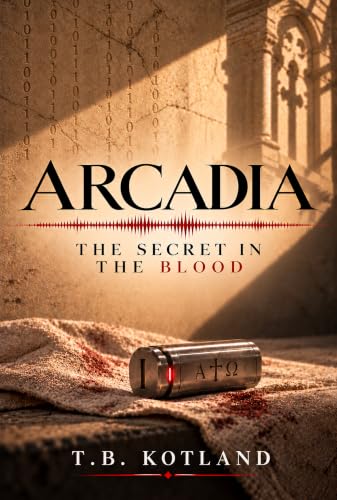
A seven-hundred-year-old secret. A voice that should not speak.
Bruce Nowland has been at his new job for exactly one day when he finds Senator Andrew Mainport dead in his office. Half an hour earlier, the old man had entrusted him with a small steel container that opens only to his voice. Minutes later, Bruce’s phone receives a message from the dead man.
Across Boston, Madrid, Oviedo and Geneva, Bruce and Gem Hannan, an archivist who accepts nothing as true until it is documented, follow the trail of a cloth cut in 1306, a box that crossed the ocean, and voices that someone has learned to forge. What is at stake is not only whose blood it is, but who has the right to decide what is done with the answer.
Find Arcadia: The Secret in the Blood on Goodreads
‘The First Page Is a Promise: Building the Opening of Arcadia‘ by T. B. Kotland
Twenty-two years ago I wrote a novel about the Templars. It began the way many historical thrillers began back then: slowly, with atmosphere, history and a long walk towards the first real event. When I decided to rewrite it as a contemporary tech thriller, the first thing I threw away was that walk.
A thriller’s opening is a promise. In the first few pages the reader decides, often without noticing, whether this book is going to ask something of them. So the question I kept asking myself was simple: what is the smallest scene that contains the whole novel?
The answer turned out to be a voice message.
In the opening of Arcadia: The Secret in the Blood, Bruce Nowland, a voice engineer, crosses the street to buy two coffees. When he comes back, the senator who invited him is dead at his desk, a pistol in his hand and the safe in the wall wide open. Bruce calls 911 from the corridor. He hangs up. His phone vibrates. It’s a voice message from an unknown Luxembourg number, and the voice is the dead man’s: “Don’t hand over the object. If you do, by tomorrow you’ll be dead.”
That scene does three jobs at once, and that’s what I learned to look for.
1. Start after the normal day has ended. I didn’t show Bruce’s life before the coffee run. The reader meets him at the exact moment his world stops making sense. Everything we need to know about him (he notices sounds, he doesn’t touch anything, he’s methodical) comes through what he does in those few minutes.
2. Make the impossible concrete. “A mystery” is abstract. A dead man’s voice on your phone is not. Because Bruce is a voice engineer, he knows better than anyone that voices can now be cloned. So the hook isn’t supernatural; it’s a question the reader can feel in their own pocket: who could do this, and why to me?
3. Plant the big question inside the small one. The scene asks who sent the message. Underneath, it asks something larger: what is “the object”, and why is it worth killing for? That second question carries the reader all the way to a relic kept for a thousand years in the cathedral of Oviedo, which, unlike almost everything else in the book, is real.
The hardest part was resisting explanation. Early drafts had paragraphs telling the reader who the senator was and why he mattered. Every one of them slowed the scene down. I moved that information later and let the reader feel what Bruce feels: alone in a corridor, with a phone that shouldn’t be ringing.
I’m a teacher by day, and I often tell my students that a good question is worth more than a good answer, because the question is what keeps you thinking. I think first pages work the same way. You don’t have to explain your story at the start. You just have to ask the right question, and ask it in a way the reader can’t ignore.
If the opening works, the reader turns the page not because you asked them to, but because they need to know.
About the Author
T. B. Kotland is the pen name of a Spanish secondary school teacher based in Madrid. Arcadia: The Secret in the Blood is his first novel, a tech thriller that blends voice-cloning technology with a centuries-old secret kept in a Spanish cathedral.
Connect with T. B. Kotland
Website | X/Twitter | Instagram | YouTube


