
I’m delighted to welcome author John Burt to What Cathy Read Next today to talk about his debut novel A Moment’s Surrender. A Moment’s Surrender won the Prize Americana in 2025 and is available to purchase in paperback or as an ebook from Amazon and other online retailers.
Reviewers have praised A Moment’s Surrender as a ‘psychologically rich and emotionally satisfying debut’ and ‘a novel that takes on the complexities of love with deep compassion’.
As you might expect from an author who is also a poet, one of the many things explored in A Moment’s Surrender is how a poem might have different meanings for its author at different stages of their life.
About the Book
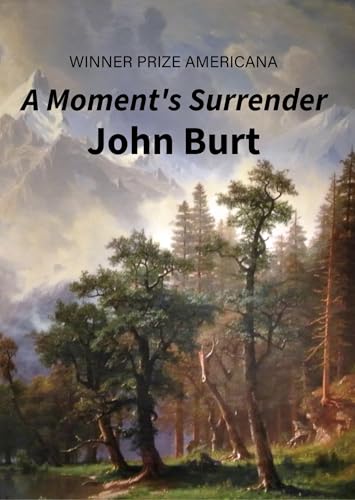
A Moment’s Surrender follows freshman writing instructor Paul Bishop in the aftermath of the murder of his former best friend, the renowned poet Tom Corbin.
Haunted by guilt and bound by a devastating secret, Paul takes it upon himself to care for Tom’s terminally ill widow, Susan. But the truth he withholds — that Tom had planned to leave Susan for another woman, Paul’s own long-ago lover Rachel Lake — draws Paul into a painful triangle of loyalty, betrayal, and unresolved desire.
Caught between the two women, Paul must navigate a web of grief and deception that threatens to undo them all.
Find A Moment’s Surrender on Goodreads
by John Burt
As graduate students at the University of Connecticut in 1969, Paul Bishop and Tom Corbin would have a weekly potluck supper with friends to talk about poetry.
Paul had a very exalted idea about poetry, arguing “A poem is an occasion to know something through the poem that you can’t know in any other way.” Whatever poetic knowledge is, it isn’t something one can easily summarize. “That he didn’t know exactly what it finally meant was part of the point: it was a call to a new way of holding a whole world in your hand, a world that would always refuse to hold still.”
Tom dismissed this otherworldly view, arguing poets play a role in this world but not often the role they think they play. Poets serve their interests but they don’t know those interests except in mystified ways. He imagined, given enough discipline and enough refusal to be fooled, he could see through a poet’s mystifications. Tom embraced a kind of poetic truth that hits you like a glass of cold water thrown in the face. “All you can know honestly is how little you know when you think you are in the know.”
Paul fails his oral examinations and winds up eking out a precarious living teaching first-year writing at the University of Nevada at Reno. Tom goes on to the University of California at Riverside where he becomes a well-known poet with radical political convictions – and becomes famous for taking girls he meets at poetry readings to bed. Tom ends every reading with a poem about the Virgin Mary he wrote as a graduate student, a poem the novel describes this way:
“In the poem, Mary, nursing the infant Jesus, wonders at how during her pregnancy her child had ridden at her heart like any other baby, dreaming in the wordless rush of his mother’s pulse. Even now he clings to her like any newborn: vulnerable, precious, speechless, bewildered, loving. The terrifying angel had told her she would bear the Son of God, whom earth and heaven will flee when he comes to reign, but the infant at her breast is a baby like any other. Why would the Son of God choose to be needy and dependent, when he could rule the world? Then she understood: what he wanted was to know what it is to be weak, to need love so deeply that he would die for lack of it, to have to rely utterly upon another person, to be a mother’s child, to know a mother’s love. What he wanted was to fear death and never to be free of the thought of death. What he wanted was to be mortal and to love as mortals love, knowing they have only the here and now to love in. What Mary had given him was the two things gods can’t have, the mysterious experience of death, the mysterious immortality of love.”
Hearing this poem, Paul reckons it shows his friend didn’t actually believe what he’d maintained in all their Friday night debates. Namely, that the poet cannot claim truth but only will to power, that the poem serves only worldly need, ambition and ideology, not otherworldly poetic knowledge.
Over the years, however, Tom’s sonnet had served another purpose. More than any of his other poems it had drawn young woman after young woman into his orbit – and into his arms. It had convinced them he understood them, that they were safe with him, although in fact whatever sympathy he professed for them was completely in the service of his desire. Was that sympathy entirely a pretence? Maybe it was worse if he really felt the sympathy, since it only made the young women more vulnerable to him, made him more successful at sympathizing them into bed.
Paul believes this use of his best poem corrupts Tom’s art and corrupts his nature. What is more debasing than recruiting what’s best about you to the service of what’s worst?
But in Tom’s last reading, the one he gives in Reno the day before he is killed by a hitchhiker on his way back to Riverside, California, where he plans to leave his wife, he reads that poem in a new tone of voice, one haunted with the tears of things, and Paul believes Tom is trying to fight his way back to something in his poetry he had lost sight of, even betrayed.
By the time Tom leaves Reno on the morning of his murder, he’s told Paul he will leave his wife for Paul’s own long-ago lover, the woman for whom Paul dropped out of graduate school over a decade earlier. But Tom also tells Paul he still loves his wife and feels ashamed about leaving her, and for a woman for whom he has mixed feelings. A woman who treats him harshly, in ways he feels he deserves given how he has long behaved towards his wife.
Yet the way Tom read his poem the previous night leaves Paul uncertain whether Tom would have gone through with his plan.
About the Author

John Burt is the Paul Prosswimmer Professor of American Literature at Brandeis University. He has published three volumes of poetry, The Way Down (Princeton UP, 1988), Work without Hope (Johns Hopkins UP, 1996), and Victory (Turning Point, 2007). His most recent scholarly book, Lincoln’s Tragic Pragmatism (Harvard UP 2013), appeared on the front page of The New York Times Book Review. John is also the literary executor of the novelist and poet Robert Penn Warren, and the editor of his Collected Poems. A Moment’s Surrender is his debut novel.
Connect with John
Website | Goodreads


