
About the Book
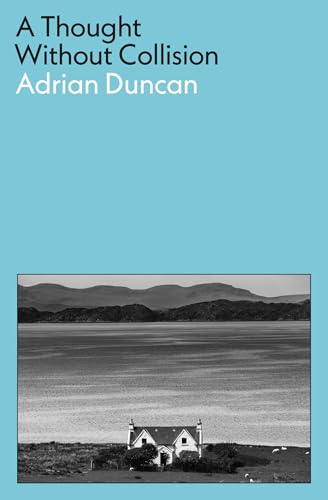
Summer, 1923. Six-year-old Catherine Carolan grows restless on her parents’ farm. It’s already clear that her intellect will soon outgrow the two-room schoolhouse across the fields. But in post-Civil War Ireland, an education is not an easy thing for a girl to access, and young Catherine is not the only one in her family who will come to tire of rural life.
Summer, 1951. To ease him through his final days, Dr. Josef Alois calls for someone from his past. Enter Catherine Carolan, now an Oxford professor. As Alois’s mind and body falter, Catherine must decide how far she will follow this man that she loves.
Format: Paperback (224 pages) Publisher: Tuskar Rock
Publication date: 13th August 2026 Genre: Historical Fiction
Find A Thought Without Collision on Goodreads
Purchase A Thought Without Collision from Bookshop.org [Disclosure: If you buy books linked to our site, we may earn a commission from Bookshop.org, whose fees support independent bookshops]
My Review
The book’s opening chapter positions this as a novel in two strands. The analogy used is that of a piano keyboard with the starting point as middle C and your right hand striking ascending notes and your left hand striking descending notes, alternately. (It probably helps if you’re familiar with a piano keyboard.)
The ‘ascending’ strand follows Catherine from the age of six growing up on her parents’ farm in rural Ireland. Her schoolteacher, Master Francis, quickly recognises she possesses extraordinary mathematical ability far beyond her years. Guiding her through increasingly complex concepts provides him with a sense of fulfilment, something lacking in his interactions with his other pupils many of whom struggle with simple tasks of reading and writing. As we discover, Catherine perceives numbers not just as things to be used to solve equations or calculations, but as objects that can possess different properties. Exploring such concepts will set the direction of her future academic career.
Catherine’s early years immerses the reader in the life of a rural Irish village, introducing some fascinating characters. As in the author’s previous book, The Geometer Lobachevsky, many of these possess obsessional traits. Austin, a local photographer, dreams of building a golf course (as it happens on the land currently owned by Catherine’s family) and has spent time drawing a design in meticulous detail, including calculations of degree of difficulty based on each hole’s topography, length and the effect of prevailing winds. It’s sight of this map that first prompts Catherine’s thoughts about the properties of numbers.
The descending strand takes place thirty years later and focuses on Catherine’s former university mentor, Dr. Josef Alois, as he lives out what we know to be the final weeks of his life in a house he built himself in a remote part of Scotland. ‘This man is more unwell than he believes and will perish in one month and eleven days.’ Alois’s story is one of mental and physical decline whereas Catherine’s story has been of intellectual progress and achievement.
Their relationship is based on shared intellectual curiosity about subjects such as mathematical probability, philosophy, logic and linguistics. Also by the nights they spent together in air raid shelters during the Blitz. Briefly perhaps there was the possibility their relationship may have moved beyond friendship, on Catherine’s part at least. For Alois, it’s more a case of admiration for Catherine’s exceptional intellect. Their bond remains strong enough that Catherine travels to Alois’s home to care for him through his illness. There are moving moments as Alois becomes frailer and less and less able to communicate his wishes clearly. The remote location of the house means there’s a claustrophobic feel to this strand of the story.
Catherine is a mathematical prodigy. I am not. This is where I struggled because many of the mathematical concepts went over my head and I found myself skipping sections that were just too abstruse. I think this prevented me forming a stronger connection with the story. Although I admired the wonderful writing, I was left with the feeling I was not quite clever enough to appreciate everything the author was trying to convey.
You can read an interview with Adrian about the book here which I found gave me a little more insight into its themes and inspiration.
In three words: Complex, intimate, elusive
About the Author

Adrian Duncan is an Irish artist and writer. His us the author of Love Notes from a German Building Site, which won the John McGahern Book Prize, A Sabbatical in Leipzig, The Geometer Lobachevsky, which was shortlisted for the Walter Scott Prize, and The Gorgeous Inertia of the Earth. (Photo: Publisher author page)
Connect with Adrian
Website


I clicked on your review essentially because of the title, but reading it I find this appeals to me very much. I’m no maths wiz but interested enough to pick up popular maths books (don’t understand everything, of course) from time to time. Will be looking this up, thank you :)
LikeLiked by 1 person
Happy to have made you aware of it. If you read the same paperback edition as I did I hope you’ll be able to make more sense of the diagram on page 52 than I did! It was not the only one that baffled me…
LikeLiked by 1 person
Let’s see–I’m not too confident of my abilities and have had to skip the more complex bits in some maths related books I’ve read like The Calculus of Friendship!
LikeLiked by 1 person
I was hopeless at maths at school and only just scraped through exams. I hope you enjoy the book nonetheless. From other comments, I’m not alone in finding those aspects of the book challenging.
LikeLike
I was hopeless at maths at school and only just scraped through exams. I hope you enjoy the book nonetheless. From other comments, I’m not alone in finding those aspects of the book challenging.
LikeLike
I loved both A Sabbatical in Leipzig and Love Notes From a German Building Site but struggled with The Geometer of Lobachevsky for similar reasons you describe, sadly.
LikeLiked by 1 person
I wish I’d read the interview with him BEFORE I read the book as I think that might have helped. It was in the bag for the charity shop but I’ve hung on to it for the time being in case it crops up on the Walter Scott Prize list in which case I might try to read it again.
LikeLiked by 1 person
You have piqued my interest in this book and author for sure, although I am pretty sure I will not get all the maths bits either!
Thanks for sharing your review with the Historical Fiction Reading Challenge!
LikeLike
Apparently the character Dr. Josef Alois is based on Ludwig Wittgenstein which I didn’t realise until I read another review. I don’t think it would have helped even if I had!
LikeLike