
About the Book
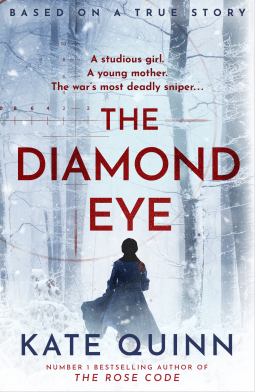
In 1937 in the snowbound city of Kyiv, wry and bookish history student Mila Pavlichenko organizes her life around her library job and her young son – but Hitler’s invasion of Ukraine and Russia sends her on a different path. Given a rifle and sent to join the fight, Mila must forge herself from studious girl to deadly sniper – a lethal hunter of Nazis known as Lady Death. When news of her three hundredth kill makes her a national heroine, Mila finds herself torn from the bloody battlefields of the eastern front and sent to America on a goodwill tour.
Still reeling from war wounds and devastated by loss, Mila finds herself isolated and lonely in the glittering world of Washington, DC – until an unexpected friendship with First Lady Eleanor Roosevelt and an even more unexpected connection with a silent fellow sniper offer the possibility of happiness. But when an old enemy from Mila’s past joins forces with a deadly new foe lurking in the shadows, Lady Death finds herself battling her own demons and enemy bullets in the deadliest duel of her life.
Format: Hardcover (448 pages) Publisher: HarperCollins
Publication date: 31st March 2022 Genre: Historical Fiction
Find The Diamond Eye on Goodreads
Purchase The Diamond Eye from Bookshop.org [Disclosure: If you buy books linked to our site, we may earn a commission from Bookshop.org, whose fees support independent bookshops]
My Review
A female sniper who became known as ‘Lady Death’ because of the number of authenticated ‘kills’ she made and who served in the Russian army on the frontline in World War 2. That’s got to be a work of the imagination, right? But it’s not because The Diamond Eye is based on the real life story of Lyudmila Pavlichenko. And if you think she must have be an exception then you’ll be fascinated to learn from the author’s Historical Note that over 800,000 woman served in the Soviet armed forces, many in non-frontline roles but also employed as tank drivers and snipers. The author’s earlier novel, The Huntress, revealed the role of a Russian all-female night bomber regiment known as the ‘Night Witches’.)
The story alternates between Lyudmila’s experiences on the front line from 1941 during the siege of Odessa and her visit to the United States in 1942 as part of a Soviet delegation attempting to obtain the intervention of America in the war in Europe. At that time, Soviet forces were under severe pressure from the German army. There is also a secondary plot involving an unnamed marksman seeking to use Lyudmila as a scapegoat for an assassination attempt on a high-profile figure (think Day of the Jackal) which is purely the product of the author’s imagination.
With the exception of the aforementioned subplot, the book closely follows events in Lyudmila’s life, including the strangely prurient questions she is asked by journalists during her time in the United States and the friendship that develops between her and the President’s wife, Eleanor Roosevelt. What the author adds is an insight into Lyudmila’s thoughts, fears and emotions, as well as filling in some of the gaps and inconsistencies in the historical record. Soviet propaganda sought to present Lyudmila in a particular light in order to further its aims. The author cleverly exposes this by including excerpts from two versions of Lyudmila’s memoirs at the start of certain chapters: one ‘official’ and one ‘unofficial’, the latter revealing her true thoughts about her experiences and her sparky humour.
The most compelling parts of the book for me were the section describing Lyudmila’s experiences on the front line. These scenes are vividly realisitic, demonstrating the visceral and brutal nature of war. ‘We lived fear, breathed fear, ate and drank and sweated fear.’ One minute a comrade is standing beside you, the next they’re blown to pieces. Lyudmila herself is seriously injured a number of times, as she was in real life. It’s no wonder that in such situations people seek an emotional connection with others even, as it often turns out, it is fleeting and destined to end in tragedy.
One of Lyudmila’s most important relationships is that with her fellow sniper, Kostia, who becomes her partner on missions. It’s a relationship that requires the utmost trust on both sides and Lyudmila discovers that Kostia shares her precise attention to detail, guile, relentless determination and superb markmanship. Their partnership becomes such that they instinctively know each other’s intentions. The descriptions of the long hours they spend staking out targets waiting for that perfect moment to strike are utterly compelling. The technical details of these missions is obviously the product of an immense amount of research by the author.
The fact that Lyudmila was a Ukranian fighting in the army of the Soviet Union in defence of its enemies (in this case Nazi Germany) is just one of the ironies about her story given current events in Ukraine.
The Diamond Eye is a completely absorbing story, punctuated by moments of drama and intense emotion.
I received a review copy courtesy of HarperCollins via NetGalley. (This was previously the oldest title on my NetGalley shelf. That honour now goes to The Belladonna Maze by Sinead Crowley.)
In three words: Powerful, moving, immersive
Try something similar: The Women by Kristin Hannah
About the Author

Kate Quinn is the New York Times and USA Today bestselling author of historical fiction. A native of southern California, she attended Boston University where she earned a Bachelor’s and Master’s degree in Classical Voice. She has written four novels in the Empress of Rome Saga, and two books in the Italian Renaissance, before turning to the 20th century with The Alice Network, The Huntress, The Rose Code and The Diamond Eye. All have been translated into multiple languages. Kate and her husband now live in San Diego with three rescue dogs. (Photo: Goodreads)
Connect with Kate
Website | Facebook | Instagram | Goodreads

 What Cathy Read Next...
Ooh I love this author, haven’t read this one!
LikeLike
Yes, completely absorbing is right. Plus, it’s release coincided with Russia’s attack on the Ukraine, which made it even more absorbing, because Mila was, technically, Ukrainian (even if she would never have called herself that).
LikeLike
I thought this was an excellent read 🙂 Thanks for sharing your thoughts
LikeLike
I still need to read this book! I loved Rose Code!
Thanks for sharing this review with the Historical Fiction Reading Challenge
LikeLike
Well, have just started reading the book The Diamond eye. Not sure I will finish it as the book is a complete rubbish. Mainly due to the fact that the author does not have a clue about Russian mentality. I understand it might be difficult to convey all the subtle nuance of a foreign language but true writers – if they dare to embark on the mission to write about some foreign culture – still get to know at list some basic distinctive features. Ideally, get deeper understanding of the language and the mentality. Kate failed. Why did she write the book in the first place? To write about a hero from the country that saved the whole world (including Kate’s)? I hope so, but I doubt.
So, in a nut shell: Kate failed to convey the way Russian people speak, the way we speak. Total disaster here. Our grandparents hardly called each other “malyshka” or “kroshka” (such a laugh). Where did Kate take that? At least she could have learnt typical ways of talking to each other among Russian people back then, in 1930-1950s. Let alone other details of manner of speech of Russian people that time.
What is complete nonsense is the way Lana and Mila try to protect themselves from men’s abuse. Mila takes a knife to banya (a place where you are supposed to wash): “I believed I need it, but only an idiot would strip naked in a camp full of men…” Dear Kate, for real? Where this rubbish comes from? are male soldiers in YOUR country hungry wild monsters? I believe, they are. In MY country, especially that time, soldiers had more important job to do: protect our country from fascism. Mind it, other countries too.
Kate could not be bothered to learn at least a little about Russian people of that time. So, the book is a disaster. False all along. Such a disgrace.
LikeLike
Definitely set it aside if it’s annoying you that much.
LikeLike