
About the Book
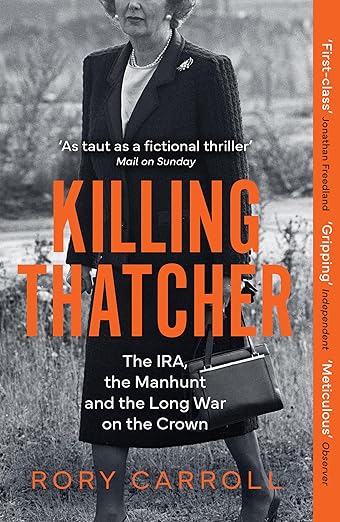
Killing Thatcher is the gripping account of how the IRA came astonishingly close to killing Margaret Thatcher and to wiping out the British Cabinet – the most daring conspiracy against the Crown since the Gunpowder Plot.
In this compelling story about a history-changing moment of violence, Rory Carroll documents the decades-long fight for Irish freedom, the shocking assassination of Lord Mounbatten, Thatcher’s dismissal of a hunger strike by republican prisoners, and the hide-and-seek drama between the IRA and the security services.
Format: Paperback (416 pages) Publisher: Mudlark
Publication date: 28th March 2024 Genre: Nonfiction, History
Find Killing Thatcher on Goodreads
Purchase Killing Thatcher from Bookshop.org [Disclosure: If you buy books linked to our site, we may earn a commission from Bookshop.org, whose fees support independent bookshops]
My Review
Whether you know very little or a lot about the history of the turbulent and often violent relationship between Ireland and England over the centuries, I think you will appreciate the lucid way the author explains a very complicated issue. As you’d expect from a journalist, he adopts a distinctly non-partisan approach, relying on a range of sources including interviews with participants on both sides. (Notably, the one person who refused to speak to him was Gerry Adams.)
I’m of an age where I can remember the period when IRA activity on the mainland of Britain was at its height but I had forgotten just how intense and all-pervading it was, or just how many casualties and fatalities it caused. These included police, members of the rescue services, bystanders and those whose job was to try to defuse the bombs.
I recall watching the coverage of people being rescued from The Grand Hotel in Brighton after the bombing on 12th October 1984, the penultimate day of the Conservative Party Conference. The photograph of Cabinet Minister Norman Tebbit being brought out of the debris which is included in the book, is a reminder of the destruction the bomb caused, some by falling masonry. Although Tebbit’s injuries were serious they were not as life-changing as those of his wife. There were five fatalities but not, through chance, Margaret Thatcher. Some may find her determination to carry on with the conference hard-hearted, others may think it a sign of defiance.
The description of Killing Thatcher as ‘the ultimate political thriller…the perfect blend of true crime and political history – propelled by a countdown to detonation’ is pretty much on the money. The most thrilling section – perhaps appropriately enough in Chapter 13 – is that depicting events in the hours and minutes before the bomb’s detonation. Who was doing what, where and with whom in the hotel as the minutes ticked by. And, in another part of the world, Patrick Magee, the man who placed the bomb on a long-delay timer, listening to the radio eager to find out if the device had detonated.
Another striking section of the book is that describing the 1981 hunger strikes by IRA prisoners in the Maze prison (also referred to as H-Block). Bobby Sands is probably the most well-known of the men (ten in all) who starved themselves to death as part of a campaign to be given the status of prisoners of war rather than criminals. The author describes how the hunger strikes became effectively a stand-off between the prisoners and Margaret Thatcher, and he doesn’t pull any punches when describing what starving yourself to death means in reality.
There was lots in the book I didn’t know (or had forgotten) such as the extent of the fundraising for the IRA in the United States and the involvement of Libya’s Colonel Qaddafi in providing weapons.
The hunt for the bomber that forms the final section of the book is full of fascinating information about fingerprints and other forensic techniques. It has the tension and detail of a police procedural. The investigation team were literally looking for a needle in a haystack and lacked many of the tools that are a commonplace part of detective work today. This was the days of paper records, manual cross-checking and only limited access to computers. The patient surveillence that eventually tracks down Magee and his associates has many of the hallmarks of an espionage thriller.
This was a book club pick and being focused on the assassination attempt of such a polarising figure as Margaret Thatcher made it difficult at times not to get drawn into a debate about her political views rather than the merits of the book. However, everyone thought it a very well-researched and readable account of the history of the conflict between Irish republicans and the British government.
In three words: Fascinating, comprehensive, authoritative
Try something similar: The Day of the Jackal by Frederick Forsyth (fiction) or (nonfiction) Case Closed:Lee Harvey Oswald and the Assassination of JFK by Gerald Posner
About the Author

Rory Carroll, currently the Guardian‘s Ireland correspondent, was a 12-year-old living in Dublin at the time of the Brighton bombing and remembers the scenes in its aftermath. He has had a long and highly successful career as a foreign correspondent reporting from Belfast in the 1990s, London, Baghdad after the American-led invasion of Iraq, sub-Saharan Africa, Latin America and Los Angeles. His first book, Comandante: Hugo Chavez’s Venezuela, was published in 2013. In 2018 Rory returned to Dublin and found himself spellbound by the memoirs, biographies, police reports, court records, testimonies and eyewitness accounts of a story that he had assumed was familiar but was anything but. Killing Thatcher is born from that fascination.

 What Cathy Read Next...
I remember being shocked by this despite having no liking for Thatcher and her policies.
LikeLike
Great review, I have this on my tbr x
LikeLike
One of the times when you wouldn’t have read a book if it hadn’t been a book club pick, especially as I don’t read a lot of nonfiction.
LikeLike