Book Review – The Correspondent by Virginia Evans

About the Book

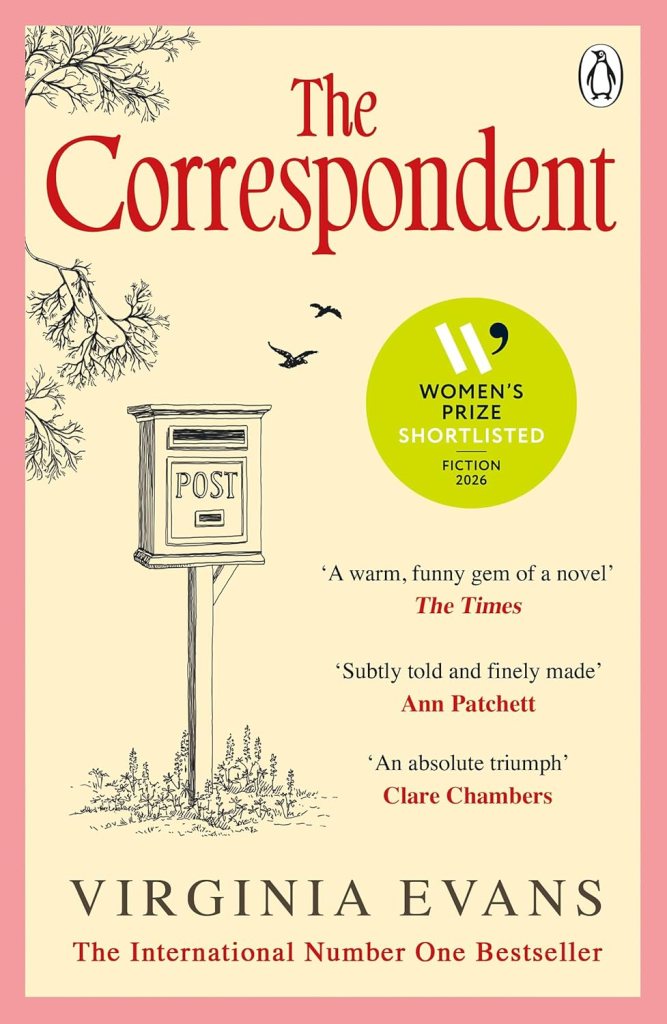
Sybil Van Antwerp is seventy-three, slowly losing her sight and always writing letters . . .

To her children. Her favourite authors. Her ex-sister-in-law. The journalist poking into her past.
Her doctor. Suitors. Kindly neighbours. The infuriating gardening club.

All receive Sybil’s witty, wise correspondence, rich with everyday concerns.

But there is one letter that she has never sent. It concerns the darkest period of her life. To post it, Sybil must find forgiveness within herself.

The hardest letter to write is the one you’d never dare to send.

Format: Paperback (320 pages) Publisher: Penguin
Publication date: 10th June 2026 Genre: Contemporary Fiction

Find The Correspondent on Goodreads

Purchase The Correspondent from Bookshop.org [Disclosure: If you buy books linked to our site, we may earn a commission from Bookshop.org, whose fees support independent bookshops]

My Review

If you’re part of the book world, or possibly even if you’re not, you’ll be aware of The Correspondent. It’s won literary prizes, topped bestseller lists and appeared again and again in readers’ ‘Books of the Year’ lists. What a disappointment then that my experience was rather different.

Inveterate letter writer Sybil Van Antwerp claims her letters are the story of who she is but in fact her letters are a carefully edited version of her life. The ‘real’ Sybil and her real story are contained within the unsent letter she adds to from time to time and that appears every so often between Sybil’s public letters. Despite a little camouflage, it wasn’t too difficult to guess the person to whom she was writing. I also worked out quite early on, thanks to an angry letter she sends to a newspaper editor, the true circumstances of the tragic event that occurred many years earlier and why it has overshadowed just about everything in her life ever since.

Sybil is a person of contradictions. She takes a personal interest in the lives of people she hardly knows, such as the customer service representative of a technology company, with sometimes unwelcome consequences for them, yet rarely communicates with her daughter. She can be obsessive, exemplified by her long campaign to continue to be permitted to audit a course in English Literature. Her letters to the Head of the Department become increasingly insistent but, ironically, when they meet face-to-face she gets on quite well with them.

I thought her preference for letters over telephone conversations showed a desire for control and to keep people at a distance. She even writes notes to her neighbour, the lovely Theodore.

From the blub I was expecting more humour. The bits that did make me laugh were Sybil’s tussles with her gardening club and her less than complimentary letter to author Kazuo Ishiguro informing him she felt Never Let Me Go wasn’t half as good as The Remains of the Day. Even here, there’s a sense of superiority. Perhaps others more generously would say chutzpah.

I struggled to feel any emotional connection with Sybil, although I was not without sympathy for the awful thing that happened to her. For me she was a rather sad, self-centred and embittered person. However, I appreciate I’m probably in the minority here and part of me feels bad for expressing negative thoughts about a book so many people have obviously loved.

This was a book club pick and it turned out members were pretty evenly divided between those who loved Sybil, those who didn’t and those with mixed feelings. So I wasn’t alone after all! The most common description of the book was ‘an easy read’. Personally, I expect a bit more literary ambition from a Women’s Prize-winning book although I admire the author’s bravery in trying to pull off an epistolary novel.

The book provoked an interesting debate about the demise of letter writing, or perhaps more specifically, of handwritten communication. The view was an email creates an expectation of an immediate response whereas letters do not. That letters require more thought and, as in Sybil’s case, may go undergo numerous drafts, whereas an email is often dashed off. Personally any email of importance I write undergoes plenty of redrafting so I’m not quite convinced it’s the format that makes the difference.

About the Author

Virginia Evans is from the East Coast of the United States. She attended James Madison University for her Bachelor’s in English literature. After starting a family, she went back to school for her Master’s of Philosophy in creative writing at Trinity College in Dublin, Ireland. She now lives in Winston-Salem, North Carolina, with her husband, Mark, two children, Jack and Mae, and her red Labrador, Brigid. (Photo: Amazon author page)

Connect with Virginia
Website | Instagram

Book Review – Flashlight by Susan Choi

About the Book

A moment is all it takes to shatter a family. The echoes last a lifetime…

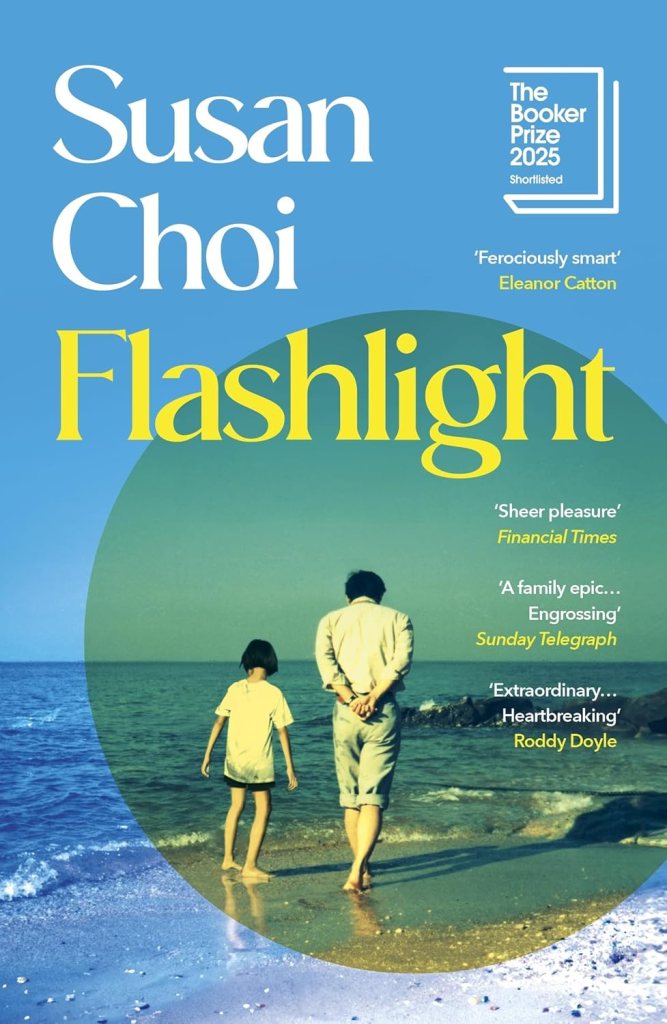
One evening, ten-year-old Louisa and her father, Serk, take a walk out on the breakwater. They are spending the summer in a coastal Japanese town. Hours later, Louisa wakes on the beach, soaked to the skin. Her father is missing: presumably drowned.

This sudden event shatters their small family. As Louisa and her American mother return to the US, Serk’s disappearance reverberates across time and space, and the mystery of what really happened that night slowly unravels.

Format: Papeback (528 pages) Publisher: Vintage
Publication date: 26th February 2026 Genre: Literary Fiction

Find Flashlight on Goodreads

Purchase Flashlight from Bookshop.org [Disclosure: If you buy books linked to our site, we may earn a commission from Bookshop.org, whose fees support independent bookshops]

My Review

Shortlisted for the Booker Prize and the Women’s Prize for Fiction, Flashlight was my book club’s pick for April. Had it not been, I suspect I might not ever have picked it up. Its size – over 500 pages – for one thing. However, I’m glad I did because, although I had some issues with it, I enjoyed it and learned things about the history of Korea I didn’t know before.

The book’s compelling opening scene is the starting point for a story that unfolds over decades. I enjoyed reading about Serk’s childhood in Japan. An excellent student, he embraces Japanese culture and language. His sudden discovery that his name is not Hiroshi but Seok and he is of Korean heritage, his parents having fled from the small island of Jeju to the Japanese mainland, turns his life upside down. There’s a particularly poignant scene in which he approaches his teacher with a request to look at a map so he can find the location of Jeju. With the defeat of Japan in 1945, external forces come into play. Korea is now free but divided in two – North and South Korea. When war breaks out between the two, Serk’s parents are lured by the promise of a better life in North Korea, something he fears will not be the case, while he moves to America to study.

There he meets and marries Anne, and they have a daughter, Louisa. Anne and Serk’s marriage is not a harmonious one. The only thing they really have in common is Louisa but even here they differ in approach with Serk being almost obsessively protective and Anne much more laidback.

Eventually the family return to Japan. Louisa quickly assimilates into her new surroundings, mastering the Japanese language, but Anne does not leaving her increasingly isolated. She starts to experience episodes of muscle weakness and intense fatigue, initially dismissed as psychosomatic, leaving her even more isolated and often completely incapacitated. It’s for this reason that, during a holiday on the coast, Anne is left behind when Serk and Louisa embark on their customary night-time walk on the beach, armed only with a flashlight. Serk disappears, presumed drowned, whilst Louisa is left with no memory of events of that night.

Anne and Louisa return to America. Louisa eventually leaves for college, their relationship reduced to infrequent letters and phone calls. A chance discovery forms a link with a campaign which I won’t say more about for fear of spoilers. Eventually in the final, very powerful and moving section of the book, we learn what really happened that night and its aftermath.

Condensed down like this it sounds more fast-paced than it does when you’re reading it. There were long sections during which my abiding thought was why do I need to know this? For example, a lengthy description of Anne’s method of preparing spaghetti bolognese. In other places there were big time jumps leaving gaps in the character’s lives, including quite significant events such as births, marriages and deaths. The glacial pace of some parts of the book I’m afraid made it more of a slog than it should have been. However, even the sections that felt superfluous were well-written. It just seemed as if the author having written them couldn’t bear to part with them even if they didn’t advance the plot, only flesh out the characters even more.

In case you’re wondering, there was a mixed reaction from book club members. A few really loved it but most felt a little as I did that it was an engrossing, well-written story let down by its uneven pace. Pretty much everyone agreed the final sections of the book were the most compelling and very moving. Like me, most people found Anne a very sympathetic figure. As you can tell, it was a good choice for a book club, provoking a lot of discussion and different opinions.

In three words: Fascinating, emotional, sweeping
Try something similar: Pachinko by Min Jin Lee or The Orphan Master’s Son by Adam Johnson

About the Author

Susan Choi is the author of the novels Flashlight, Trust Exercise, My Education, A Person of Interest, American Woman and The Foreign Student. She has won the National Book Award for Fiction, the Asian American Literary Award for Fiction, the PEN/W. G. Sebald Award and a Lambda Literary Award, and has been a finalist for the Booker Prize and the Pulitzer Prize. Flashlight began as a short story and received the Sunday Times Short Story Award.

Susan Choi lives in Brooklyn, New York, and teaches in the Writing Seminars at Johns Hopkins University.

Connect with Susan
Website