About the Book
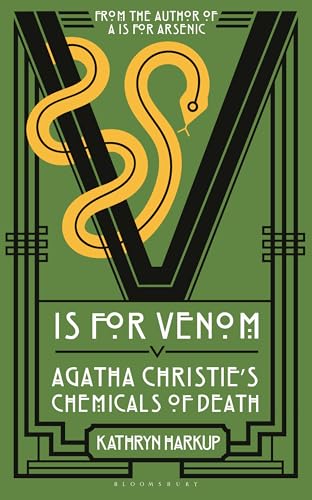
Fourteen stories. Fourteen more poisons. Just because it’s fiction doesn’t mean it’s all made-up …
Agatha Christie is renowned for her captivating plots and creative ways of killing off ill-fated victims. And what better way to add intrigue to a story than poison? The surreptitious ways they can be administered and the characteristic symptoms they produce make these killer chemicals the ideal method of murder in a ‘whodunit’.
Christie perfected the use of poisons in her plots; her deft and varied use of toxic substances is one of her great strengths as a writer. But how is it that some compounds prove so fatal, and in such tiny amounts?
Format: Paperback (320 pages) Publisher: Bloomsbury Sigma
Publication date: 24th September 2026 Genre: Nonfiction, Science
Find V is for Venom on Goodreads
Purchase V is for Venom from Bookshop.org [Disclosure: If you buy books linked to our site, we may earn a commission from Bookshop.org, whose fees support independent bookshops]
My Review
In V is for Venom, the follow-up to A is for Arsenic, Kathryn Harkup explores some more of the poisons used by Agatha Christie to kill off characters in her crime novels, everything from arrow poison to snake venom. The author is clearly an admirer of Christie both for her ingenuity and the scientific knowledge that underpinned her plots. Harkup goes out of her way to avoid spoilers for the benefit of those who’ve not read the novels she references, but where these are unavoidable they’re flagged well in advance.
The author identifies the source of each of the fourteen poisons, their effects on the human body, whether an antidote exists and real-life cases where the poison has been used. At the end of the book there’s a table listing all of Agatha Christie’s novels and stories along with the murder method(s) that feature in each one.
V for Venom is definitely not a handbook for would-be poisoners. As the author demonstrates many of the substances are incredibly difficult to come by, determining what is a lethal dose is often problematic, the availability of effective antidotes is greater than when Christie was writing her novels, there is increased knowledge of how poisons affect the body and the ability of scientific professionals to identify poisons is way more advanced. And, of course, you still have to ensure you get away with it.
As the author explains, a poison which kills instantly is rare. It’s more often the case that the administering of the poison is the start of a chain of effects on the body that will ultimately prove fatal if not treated promptly and in the correct way. For this reason, Christie’s plots often place the victim in a position where there will be a long delay before starting treatment and/or identification of the substance involved. And in some cases, which Harkup refers to as ‘hopeful’ murders, the administration of the lethal substance may be left to chance, just waiting for the victim to drink from a bottle containing a toxic substance that has been swapped for something else or to spread marmalade on their toast.
The sections of each chapter which deal with the effects of each chemical on the human body contain the greatest amount of scientific detail. Despite being rubbish at chemistry at school even I was able to understand this thanks to the author’s clear explanations and the accompanying diagrams.
There were many surprises in the book. For example, that the difference between a therapeutic and lethal dose can be small and that whether the substance proves fatal can depend on a number of other factors. For example, the age or health of the victim, the method by which the poison is administered or its interaction with other substances such as alcohol, the latter scotching the notion (no pun intended) that a glass of brandy is the best thing to give to a potential victim of poisoning.
I also learned some fascinating facts:
- Bacteria have been the dominant organisms on the planet for three billion years and can even survive in the vacuum of space
- Christie invented only one poison to kill off a character. It features in her 1962 novel The Mirror Crack’d from Side to Side
- Gas was the most common method of suicide in the UK up until the 1960s when so-called ‘town gas’ which contained carbon monoxide was replaced by natural gas
- There is a half-eaten Walnut Whip in a display case in a medical museum in London, a relic of a failed attempt to disguise the bitter taste of a poison with chocolate
- Christie’s story Three Blind Mice has never been published in the UK as it provides the basis for the plot of The Mousetrap and would reveal the identity of the murderer. Famously, the audience are asked not to reveal this information at the end of every performance.
Even if you’ve never read an Agatha Christie novel, I believe V for Venom can be enjoyed as a work of popular science. If you are a Christie fan, it’s probably going to make you want to reread some of the books mentioned just to see the mistakes the murderer made. For those new to Agatha Christie’s oeuvre, why not try two stories referenced in this book – A Pocket Full of Rye, featuring Miss Marple, and Death in the Clouds, featuring Hercule Poirot.
I came away from the book with an even higher regard for Agatha Christie’s creativity and ingenuity, a kind of awed admiration for scientists who have experimented on themselves as part of their research into poisons and, most of all, a renewed sense of wonder at the intricacies of the human body.
I received an advance reader copy courtesy of Bloomsbury Sigma.
In three words: Fascinating, well-researched, accessible
Try something similar: A Pocket Full of Rye or Death in the Clouds by Agatha Christie
About the Author
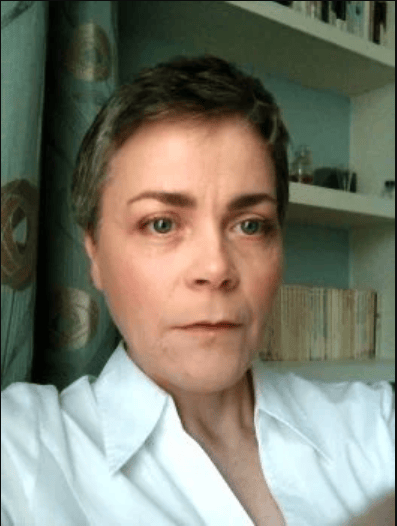
Kathryn Harkup is a former chemist turned author. She writes and gives regular public talks on the disgusting and dangerous side of science. Her first book was the international best-seller A is for Arsenic: The Poisons of Agatha Christie, which was shortlisted for a Mystery Readers International Macavity Award and a BMA Book Award. Her subsequent books include its follow-up, V is for Venom, Making the Monster: The Science of Mary Shelley’s Frankenstein, and Death by Shakespeare. (Photo: Author website)
Connect with Kathryn
Website