About the Book
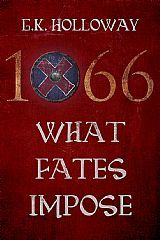
England is in crisis. King Edward has no heir and promises never to produce one. There are no obvious successors available to replace him, but quite a few claimants are eager to take the crown.
While power struggles break out between the various factions at court, enemies abroad plot to make England their own. There are raids across the borders with Wales and Scotland.
Harold Godwinson, Earl of Wessex, is seen by many as the one man who can bring stability to the kingdom. He has powerful friends and two women who love him, but he has enemies who will stop at nothing to gain power.
As 1066 begins, England heads for an uncertain future. It seems even the heavens are against Harold.
Intelligent and courageous, can Harold forge his own destiny – or does he have to bow to what fates impose?
Format: Paperback (448 pages) Publisher: Matador
Published: 2nd January 2014 Genre: Historical Fiction
Find 1066: What Fates Impose on Goodreads
Purchase 1066: What Fates Impose from Bookshop.org [Disclosure: If you buy books linked to our site, we may earn a commission from Bookshop.org, whose fees support independent bookshops]
My Review
The powerful opening chapter of the book places the reader by the bedside of the dying William the Conqueror, in 1087. What follows is a sort of book length flashback setting out the factional and political machinations that would lead inexorably – is the author’s suggestion based on the title – to the events of 1066 and the defeat of Harold at the Battle of Hastings.
Most students of English history will, I suspect, be familiar with the events of 1066 but like me know less about the events of the preceding 20 years. Starting in 1045 in the reign of Edward (the Confessor), the author takes the reader in detail through the rivalries, quarrels, battles for land, influence and power of the nobles close to the throne. There are a lot of characters to keep track of so a dramatis personae would have been a useful addition to the book. It’s probably the nature of the times that the female characters play a pretty shadowy role, their chief value being as diplomatic bargaining chips, marriage material or reproductive machines to provide the all-important male heirs.
I’ll be honest and say that half way through the book I was beginning to feel slightly overwhelmed with all the political machinations. Occasionally, the author’s obviously extensive research seemed a little obtrusive with sections on sword-making, dining customs, etc. feeling a little like they had been inserted from a text book. At times, the dialogue came across as rather stilted or included modern idioms that seemed out of place but you did get a sense of the characters from the way they interacted with each other. There were also a couple of nice succinct lines that drew my eye:
On the death by Count Conan by poison: ‘Brittany now had a new Count, Alan the Red, friend and ally of Duke William. Such is fate.’
On Earls Edwin and Morcar manoeuvring Harold into marrying their sister, Aldytha: ‘Harold had their sister but they had him.’
The pace really picked up for me in the final third of the book as events drew nearer to the decisive Battle of Hastings. The author does a great job of explaining all the factors that played a part in the outcome of that day; some a question of chance, the weather or a seemingly unimportant foolish decision. The battle scenes are absolutely gripping. Harold, although ruthless when needed, definitely comes out as the more likeable character and, although I feel a bit soppy for saying this since everyone knows the outcome of the battle, I couldn’t help wishing events had ended differently and he’d prevailed (if only for poor Edyth waiting under that tree).
This was a violent time in history when life was often short and death did not always come about by natural causes. In keeping with the period, there are some gruesome scenes (especially towards the end of the book where the reader encounters a particularly unpleasant character) although nothing worse I would say than you might find in Game of Thrones.
There was a lot I learnt from reading this book, such as the fact that William was able to use his influence to get the Pope to pronounce his campaign against Harold as a crusade, causing additional troops from across Europe to rally to the Norman standard. For historical fiction fans who like their history detailed and aren’t afraid of a large cast of characters, this would make a rewarding read.
I received a review copy courtesy of the author in return for an honest and unbiased review.
In three words: Detailed, well-researched, absorbing
Try something similar: The King’s Jew by Darius Stransky
About the Author

G.K. Holloway left university in 1980 with a degree in history and politics. After spending a year in Canada, he relocated to England’s West Country and began working in Secondary Education. Later he worked in Adult Education and then Further Education before finally working in Higher Education.
After reading a biography about Harold Godwinson, he became fascinated by the fall of Anglo Saxon England and spent several years researching events leading up to and beyond the Battle of Hastings. Eventually he decided he had enough material to make an engrossing novel, using characters from the Bayeux Tapestry, the Norse Sagas, the Domesday Book and many other sources. His debut novel 1066: What Fates Impose won the Gold Medal in the Wishing Shelf Independent Book Awards – Adult Fiction 2014.
He lives in Bristol with his wife and two children.
Connect with G.K. Holloway
Website ǀ Facebook ǀ X ǀ Goodreads


I cannot wait to read this! I know very little about this part of history (or, truthfully most of European History) so I am very excited. Great review!
LikeLiked by 1 person
Thanks, hope you enjoy it 😀
LikeLike