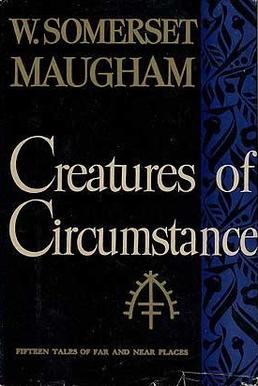
Book Review – Creatures of Circumstance by W. Somerset Maugham @ourclassicsclub

About the Book

Creatures of Circumstance is a collection of fifteen short stories by the British writer W. Somerset Maugham. It was his last collection of stories, all of which had been previously been published in magazines.

Format: Hardback (314 pages) Publisher: Heinemann
Publication date: January 1947 Genre: Fiction, Short Stories

Find Creatures of Circumstance on Goodreads

My Review

Creatures of Circumstance was the book chosen for me in the latest Classics Club spin. I did read it by the deadline (4th October) but didn’t get round to writing my review until now.

As is often the case with short story collections, it is a mixed bag. First published in 1947, some of the attitudes expressed, particularly towards women and people of other nationalities, have dated badly.

The collection’s title gives a clue to its overriding theme, an exploration of how people react to circumstances forced upon them and how the decisions they make as a result shape their lives.

Having enjoyed Maugham’s Ashenden, a collection of linked stories featuring a spy in the First World War (based on the author’s own experience working for British Intelligence), it was nice to see him pop up again in ‘The Sanatorium’ and also as an attentive listener in another couple of stories.

‘Winter Cruise’ is an amusing story about a woman’s experiences as the only passenger on a cruise. The crew tire of her incessant talking, which is actually born of her keen interest in other people, and come up with a solution to ensure peaceful meal times. It works but also ensures she has a most memorable cruise.

‘A Man from Glasgow’ is a creepy story, which might have been written by M. R. James, in which a man is so unnerved by the sound of laughter from a nearby empty house reputed to have been previously inhabited by a madman, he decides to flee the country. But it turns out he’s not yet put enough distance between him and the house.

The standout story in the collection is ‘The Unconquered’ set in occupied France in World War 2. Two German soldiers arrive at a farm where they threaten the farmer’s family, eat the family’s meagre supply of food and get drunk on the farmer’s wine. One of them, Hans, then rapes the farmer’s daughter. When she falls pregnant he is unprepared for the intensity of her hatred towards him.

About the Author

William Somerset Maugham (1874 – 1965) was born in Paris. He spoke French even before he spoke a word of English, a fact to which some critics attribute the purity of his style.

His parents died early and, after an unhappy boyhood, which he recorded poignantly in Of Human Bondage, Maugham became a qualified physician. But writing was his true vocation. For ten years before his first success, he almost literally starved while pouring out novels and plays.

During World War I, Maugham worked for the British Secret Service . He travelled all over the world, and made many visits to America. After World War II, Maugham made his home in south of France and continued to move between England and Nice till his death in 1965.

Book Review – What Remains After A Fire: Stories by Kanza Javed @dylanthomprize #SUDTP26

About the Book

In eight unflinching and stunningly crafted stories, Kanza Javed unspools the lives of characters desperately trying to forge a path for themselves on the margins of society. An addict teaches his young son to shoot feral dogs on the streets of Lahore. A Christian nurse gets drawn into a plan to trap the ghost of her patient’s former lover. A Pakistani student in a small Appalachian town grapples with a startling act of violence that shatters her illusions of safety and freedom. A lonely wife becomes increasingly obsessed with a cloth worry doll left behind by a previous tenant.

Written with sharp insight and remarkable empathy, these stories reach across divides of class, gender, and religion as Javed deftly examines questions of identity and agency, belonging and loss. What Remains After a Fire is a moving portrayal of fiercely resilient characters who desire more than what their circumstances can offer them—and what these desires ultimately cost them.

Format: Hardcover (240 pages) Publisher: W. W. Norton
Publication date: 28th October 2025 Genre: Contemporary Fiction, Short Stories

Find What Remains After A Fire on Goodreads

Purchase What Remains After A Fire from Bookshop.org [Disclosure: If you buy books linked to our site, we may earn a commission from Bookshop.org, whose fees support independent bookshops]

My Review

Longlisted for the Dylan Thomas Prize 2026, the description of What Remains After A Fire as ‘a haunting, powerful collection of stories’ is absolutely spot on. It’s a fantastically strong collection, each story containing something to admire, to move you or to make you think about things in a different way.

Recurring themes of the stories include motherhood, grief and loss, the weight of cultural expectation and family obligations, and the often unbearable burden of secrets. Many of the female characters (and they are predominately female) are struggling to keep things together or to move forward with their lives. Death and dying feature frequently, often associated with facing up to guilt about past actions, even the idea that current suffering is the price to be paid for wrongdoings. Past trauma is replayed in nightmares or the ghosts of departed loved ones. Misfortune is seen as evidence of evil spirits, a much more convenient explanation than the result of human actions.

The male characters are often predatory, or cowed by social pressure or purveyors of a toxic masculinity. For example, in ‘Stray Things Do Not Carry A Soul’, a boy begins to absorb his father’s negative attitude to the women of the household, the boy’s mother and sister. ‘Do you see how the witches are conspiring against us?’ When the boy suggests his sister should be married off, his father responds approvingly ‘Now you’re thinking like a man’.

Each story is beautifully crafted and I found myself frequently jotting down phrases that stood out for me. For example, in ‘Rani’, a young woman’s dying grandmother is described as existing ‘in fragments, in vapors’. And in ‘I Will Follow You Home’, the city of Lahore is ‘a mottled mess of vanishing history and new regimes.’ In ‘Carry It All’ a woman who has suffered multiple miscarriages imagines ‘a heavenly orphanage for ghostly, unborn children’. She’s made to feel a failure by her husband’s family for being unable to bear a son, her childhood dreams of marriage and motherhood recognised now as mere fantasy. ‘In the real world – bodies matter, and in some houses, fertility was the only currency.’ And in ‘My Bones Hold A Stillness’, a young student reflects, ‘Guilt wrecks people. It chews them right up.’

In What Remains After A Fire the author explores what is left behind after loss, betrayal and displacement. Sometimes it’s nothing, sometimes mere fragments of a previous life, sometimes it’s a seed of something that just might grow and flourish if nurtured.

My thanks to Henrietta at Midas for inviting me to join the blog tour celebrating the longlist and to W.W. Norton for my review copy.

In three words: Poignant, intimate, disquieting

About the Author

Kanza Javed is a Pakistani author with an MFA in Fiction from West Virginia University, where she received the Rebecca Mason Perry Award. She is also the winner of the 2020 Reynolds Price Prize for Fiction. Her writing has been published in the American Literary Review, Punch Magazine, Salamander and Greensboro Review, among other publications.

Connect with Kanza
X | Facebook | Instagram