Book Review – A Private Man by Stephanie Sy-Quia @picadorbooks

About the Book

Rome, 1953. David is young, handsome, charismatic and sworn to celibacy. He is freshly ordained, and about to return to England to begin life as a priest. Devotion to God is all he’s ever known.

In London, Margaret is entangled in an impossible love affair. Committed to living on her own terms without sacrificing her faith, she becomes drawn to a women’s movement challenging the archaic rules of the Church.

When their lives are thrown together at a Catholic college in a quiet village, an undeniable connection forms between them. And so begins a story of forbidden love, sacrifice and secrets, with consequences that will reverberate across the generations.

Decades later, she is being cared for by her grandson, who has just discovered the strange truth of his family history.

Format: Hardcover (288 pages) Publisher: Picador
Publication date: 19th February 2026 Genre: Historical Fiction

Find A Private Man on Goodreads

Purchase A Private Man from Bookshop.org [Disclosure: If you buy books linked to our site, we may earn a commission from Bookshop.org, whose fees support independent bookshops]

My Review

At the funeral of his great-uncle in 2018, Adrian learns something unexpected about his grandparents, namely that his grandfather David was once a Catholic priest. As he begins caring for his elderly grandmother who is suffering from dementia, he tries to draw out the story of his grandparents’ relationship and marriage, revealed in a series of flashbacks. We experience David’s childhood, his time at a seminary in Rome and the ritual of his ordination. It’s a life that seems likely to follow a prescribed path of absolute devotion to the Catholic faith and celibacy.

‘He liked being told what to do. He liked waking up knowing what he had to wear in the morning. He liked the awareness of himself as being in a hierarchy, with people above and below him. He liked all the secret codes and small rituals… He liked his presence being demanded in a particular place at a particular time, and the fact there would be consequences if you didn’t appear.’

It could not be more different from Margaret’s freer, more adventurous life including multiple sexual encounters.

David and Margaret first meet in the 1960s at a theology college where Margaret is a teacher and David the priest. They are both devoted to their Catholic faith but Margaret is not afraid to challenge the Church’s doctrine, specifically relating to the place of women in the Church. What starts as discussion, debate and a sharing of ideas – first in college rooms, then in David’s house – transforms into something much deeper. Before long though the romantic and physical attraction between them cannot be denied, leaving David with an agonising decision. To be with Margaret in the way he desires means leaving the Church. He is left in doubt about the brutality of the process of laicization.

I adored the way the author described the little details of their life together, the gentle give and take that occurs in a long, loving relationship.

‘She thought of the thousand ways they had shown their love to one another, and been unnoticed, else misapprehended. Cups of tea in their multitudes. Crooked inventions of his to ease her in her pastimes. The plank full of nails bent at an angle, for her spools of thread…. Sunday roasts. Drinks mixed and brought to her desk. Records played, and dancing. So much dancing. Long drives, late at night, to fetch one another from this or that place. Jumpers knitted. Quilts stitched, spread over both of their knees on winter evenings. Reading to one another.’

I found Margaret’s decline from the vibrant, articulate woman she once was to someone requiring help with the most intimate of tasks quite heartbreaking. And although I was saddened by how the once passionate relationship between David and Margaret changed over the years, I could also appreciate its realism.

To a certain extent David always remained for me the ‘private man’ of the book’s title. I didn’t feel I got to know him as completely as I did Margaret. However, I could completely understand how David would be attracted to the intelligent, uncompromising, forthright Margaret.

Based on the story of the author’s own grandparents, A Private Man is a tender, moving love story about two people who, despite the obstacles in their way, could not imagine a life without each other.

I received a advance review copy courtesy of Macmillan via NetGalley.

In three words: Tender, intimate, moving
Try something similar: Small Pleasures by Clare Chambers

About the Author

Stephanie Sy-Quia was born in 1995 and is based in London. Her writing and criticism have been published in The Guardian, The White Review, The Boston Review, Granta, The TLS, and others. She is a Ledbury Poetry Critic and has twice been shortlisted for the FT Bodley Head Essay Prize.

Her debut Amnion, published by Granta Poetry in 2021, received a Somerset Maugham Award and was a Poetry Book Society Winter Recommendation; was longlisted for the Rathbones Folio and RSL Ondaatje Prizes; and won the Forward Prize for Best First Collection. She is the recipient of an Eric Gregory Award.

Connect with Stephanie
Instagram | X

#WWWWednesday – 29th April 2026

Hosted by Taking on a World of Words, this meme is all about the three Ws:

  • What are you currently reading?
  • What did you recently finish reading?
  • What do you think you’ll read next?

Why not join in too?  Leave a comment with your link at Taking on a World of Words and then go blog hopping!


Flashlight by Susan Choi (Vintage)

A moment is all it takes to shatter a family. The echoes last a lifetime…

One evening, ten-year-old Louisa and her father, Serk, take a walk out on the breakwater. They are spending the summer in a coastal Japanese town. Hours later, Louisa wakes on the beach, soaked to the skin. Her father is missing: presumably drowned.

This sudden event shatters their small family. As Louisa and her American mother return to the US, Serk’s disappearance reverberates across time and space, and the mystery of what really happened that night slowly unravels.

Where the Shadows End by Louisa Bello (eARC, epoque press)

Sam, a 45-year-old Londoner of dual heritage, has lived his life accompanied by voices no one else can hear. Chief among them is the taunting echo of a childhood bully who refuses to let Sam forget the guilt he carries over his mother’s death.

When his elusive, dream-like girlfriend, known only as Boat Woman, disappears without warning, Sam’s fragile world begins to unravel, and he becomes convinced that only his death can protect those he loves.

As the past and present collide in Sam’s fractured mind, he is drawn into a labyrinth of memory and revelation that challenges everything he thought he knew. But the voices that haunt him may yet become his guides, if he can only find the courage to listen.

Dark is the Morning by Rupert Thomson (Apollo)

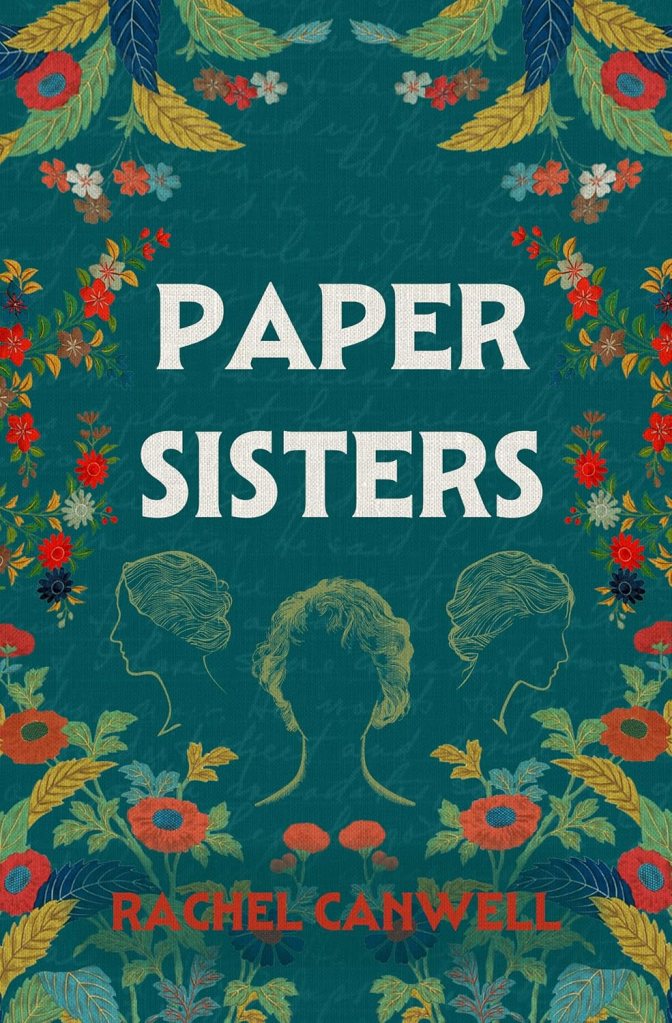
Paper Sisters by Rachel Canwell (Northodox Press)

Lincolnshire, 1914. As the First World War approaches, three women are living, trapped between the unforgiving marsh, the wide, relentless river, and the isolation of the fen.

Their lives are held fast by profound grief, haunted by the spectres of the past. Trapped by the looming presence and eerie stillness of a hospital that has never admitted a single patient.

Eleanor longs to escape. To make a life with the man she loves, leaving her sister, and all her ghosts behind. Clara’s marriage is crumbling and violent and she yearns for peace and security for both herself and her innocent children. Meanwhile, Lily, a formidable force of will, stands resolute against the relentless tide of change. She will stop at nothing, no matter the devastating cost, to ensure that life, and her family, remain frozen in an unyielding embrace of the past. (Review to follow)

Relative Failures: The Lives of Willie Wilde, Mabel Beardsley and Howard Sturgis by Matthew Sturgis (Apollo)

History remembers the greats – but what about those who lived alongside them?

In the cultural ferment of late nineteenth-century London, three fascinating but often overlooked figures navigated the world in the shadow of their celebrated brothers. Willie Wilde, the hapless yet charming older sibling of Oscar, never quite matched his brother’s literary genius. Mabel Beardsley, the striking and ambitious sister of Aubrey, played a crucial role in his artistic ascent before forging her own path on the stage. And Howard Sturgis, a minor novelist with a sharp wit, watched as his brother Julian achieved the success he himself never quite grasped.

Moving through bohemian clubland, West End theatres, literary salons, and the pages of The Yellow Book, these siblings were more than just footnotes to history. Their lives – filled with ambition, scandal, devotion, and missteps – offer a fresh perspective on the glittering world of the 1890s.

Drawing on family history, sharp storytelling, and original research, Matthew Sturgis reveals the vibrant, overlooked figures who shaped their era. For lovers of literary and cultural history, it is an invitation to explore the road less travelled – a sidelight that, as Mabel Beardsley knew well, can sometimes be the most illuminating.