#BookReview The Ghost Ship by Kate Mosse @MantleBooks

About the Book

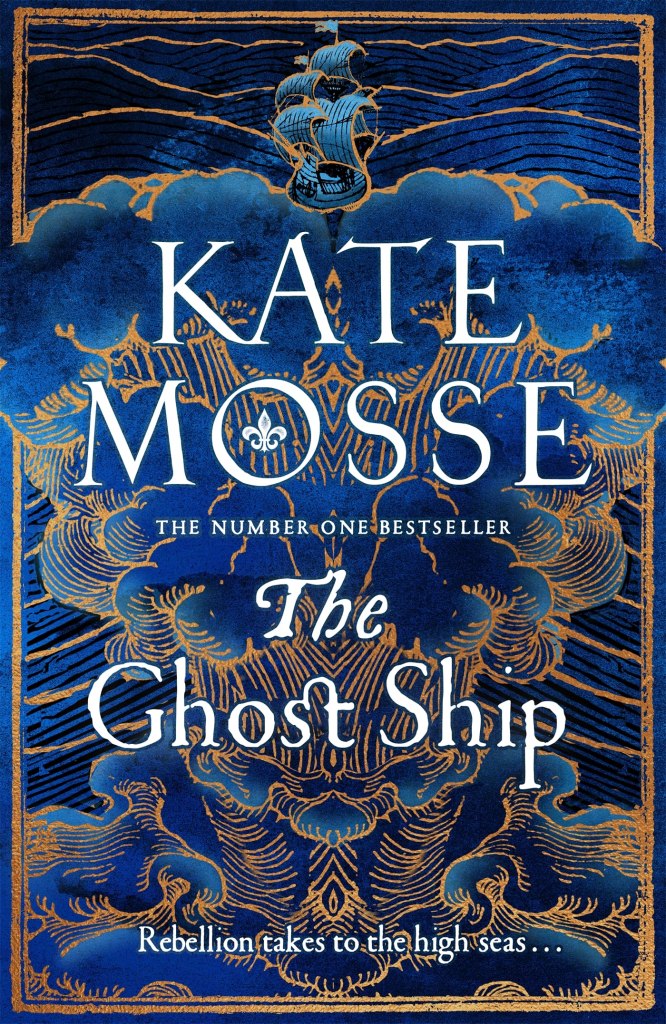
The Barbary Coast, 1621. A mysterious vessel floats silently on the water. It is known only as the Ghost Ship. For months, its captain – Louise Reydon-Joubert – and her courageous crew has hunted pirates to liberate those enslaved during the course of their merciless raids.

But now the Ghost Ship is under attack – its hull splintered, its sails tattered and burnt, and the crew at risk of capture. But the bravest among them are not who they seem. Louise is fleeing a miscarriage of justice; her lover, Gilles Barenton, is at risk of being exposed – she is forced to masquerade as her brother. The stakes could not be higher: if arrested, they will be hanged for their crimes.

Can they survive the journey and escape their fate?

Format: Hardback (496 pages) Publisher: Mantle
Publication date: 6th July 2023 Genre: Historical Fiction

Find The Ghost Ship (The Burning Chambers, #3) on Goodreads

Purchase links 
Bookshop.org 
Disclosure: If you buy a book via the above link, I may earn a commission from Bookshop.org, whose fees support independent bookshops

Hive | Amazon UK 
Links provided for convenience only, not as part of an affiliate programme


My Review

In The Ghost Ship the publishers promise us ‘piracy, romance, revenge’ and the book certainly delivers on all three. The Ghost Ship is the third book in the series following the fortunes – and misfortunes – of various generations of the Joubert family. I’ve read both the previous books in the series – The Burning Chambers and The City of Tears – as well as plenty more of Kate Mosse’s other books so I know she is a consummate storyteller and once again she doesn’t disappoint.

Although some characters make a return appearance, such as Marguerite ‘Minou’ Reydon-Joubert and her husband Piet, and the storyline involving a disputed inheritance and a desire for revenge continues from the earlier books, I would say The Ghost Ship is the easiest book in the series to read as a standalone because it moves quickly from historical saga to maritime adventure – and love story. For new readers, the author includes some recaps of events in earlier books and a helpful list of principal characters.

Historical detail has always been a strong point of Kate Mosse’s books so much so that you can easily imagine yourself walking the streets of Amsterdam or the quayside of La Rochelle, or later in the book, the Canary Islands. And, in this book, you can add to that what it would be like to be onboard a trading ship, one that at any moment might come under attack from corsairs.

Louise Reydon-Joubert makes a spirited protagonist, determined not to let her gender prevent her achieving her ambition to become captain of her own ship, an ambition she has harboured (if you’ll pardon the pun) ever since her first experience aboard a ship as a young girl. In this, Cornelia van Raay, the companion of Louise’s great-aunt, provides an example of a woman making her way in a man’s world, and one in an unconvential relationship. However, several things – and individuals – stand in Louise’s way and even when one of those is unexpectedly removed it doesn’t mean the end of her troubles, but in fact just the beginning.

An encounter with a corsair galley propelled by slaves chained to its oars sets Louise on a path that sees her and the crew of the Old Moon embark on a new and very dangerous mission. Horrified by the idea of a trade in human lives, she sets out to disrupt the corsairs’ activities. ‘She was determined to become not a pirate herself, but the scourge of pirates – a ‘she-captain’, the huntress and hellion of the high seas.’ Unfortunately, pirates are not the only opposition she faces because legitimate merchants are also starting to scent the possibility of profit from transporting human cargo rather than grain or other goods. And although Louise proves her worth to her crew there are people who simply cannot accept a woman as captain of a ship. (Cue the famous line from a Monty Python sketch, “Nobody expects the Spanish Inquisition!”)

Louise’s companion in her endeavours is Gilles Barenton who has his own reasons for wanting to escape his past. Their paths become entwined in the most dramatic way, triggering long buried memories of bloody events in Louise’s own childhood.

Kate Mosse doesn’t write short books but, despite its length, The Ghost Ship is a thrilling page-turner with a story that will sweep you along and some brilliant action scenes. (My one grumble is that I think the blurb gives too much of the story away.) As is her way, the author leaves us with a tantalising introduction to the next book in the series, set in Cape Town.

I received a digital review copy courtesy of Pan Macmillan via NetGalley.

In three words: Dramatic, immersive, compelling

Try something similar: Fled by Meg Keneally


About the Author

Kate Mosse is an award-winning novelist, playwright, essayist and non-fiction writer. The author of ten novels and short-story collections, her books have been translated into thirty-eight languages and published in more than forty countries. Fiction includes the multimillion-selling Languedoc Trilogy, the Joubert Family Chronicles (the number one bestseller The Burning Chambers, The City of Tears, and The Ghost Ship), and number one bestselling Gothic fiction. Her highly-acclaimed non-fiction includes An Extra Pair of Hands and Warrior Queens & Quiet Revolutionaries: How Women (Also) Built the World.

The Founder Director of the Women’s Prize for Fiction, she is the Founder of the global #WomanInHistory campaign and has her own monthly YouTube book show, Mosse on a Monday. A Fellow of the Royal Society of Literature, Kate is a Visiting Professor of Contemporary Fiction and Creative Writing at the University of Chichester and President of the Festival of Chichester.

Connect with Kate
Website | Twitter | Facebook | Instagram

#BookReview A Fenland Garden by Francis Pryor @HoZ_Books

About the Book

A Fenland Garden is the story of the creation of a garden in a complex and fragile English landscape – the Fens of southern Lincolnshire – by a writer who has a very particular relationship with landscape and the soil, thanks to his distinguished career as an archaeologist and discoverer of some of England’s earliest field systems. It describes the imagining, planning and building of a garden in an unfamiliar and sometimes hostile place, and the challenges, setbacks and joys these processes entail.

This is a narrative of the making of a garden, but it is also about reclaiming a patch of ground for nature and wildlife – of repairing the damage done to a small slice of Fenland landscape by decades of intensive farming.

A Fenland Garden is informed by the empirical wisdom of a practising gardener (and archaeologist) and by his deep understanding of the soil, landscape and weather of the region; Francis’s account of the development of the garden is counterpointed by fascinating nuggets of Fenland lore and history, as well as by vignettes of the plantsman’s trials and tribulations as he works an exceptionally demanding plot of land.

Above all, this is the story of bringing something beautiful into being; of embedding a garden in the local landscape; and thereby of deepening and broadening the idea of home.

Format: ebook (352 pages) Publisher: Head of Zeus
Publication date: 6th July 2023 Genre: Nonfiction, Gardening

Find A Fenland Garden on Goodreads

Purchase links 
Bookshop.org 
Disclosure: If you buy a book via the above link, I may earn a commission from Bookshop.org, whose fees support independent bookshops

Hive | Amazon UK 
Links provided for convenience only, not as part of an affiliate programme


My Review

As a fan of the TV programme Time Team, in which the author appeared for many years, and as a keen gardener who’s spent a fair amount of time trying to create a garden that’s both a haven for myself and my husband, and for wildlife, I was immediately drawn to this book. The beautiful cover was a definite draw as well.

The book details the process of transforming an area of neglected farmland into a garden, whilst also building a house. It’s a task that took patience, dedication, imagination, a few run-ins with the planning authorities and not a little hard graft by the author and his wife, Maisie. In the book the author describes the painstaking process of planning, setting out and planting. In particular, planting trees and hedges to protect parts of the garden from the vicious and potentially damaging winds experienced in their part of Lincolnshire. But whereas you or I might plant one, possibly two trees, if we had the space, the author planted hundreds, establishing an area of woodland and, later, creating an orchard.

At the same time as doing this, Francis and his wife were living in a barn in very basic conditions. And on top of that, they keep sheep. Their relationship is one of the wonderful things about the book. Both archaeologists, they are obviously kindred spirits in other ways as well, sharing a love of plants, a concern for wildlife but also a clear vision of how a garden should look and feel. At one point Francis says, ‘I like gardens that can retain their secrets’ and this principle has informed how they have set out their garden so that one section always leads to another. Keen visitors to other gardens, they also now open their own garden as part of the National Garden Scheme. You can find details of opening times here as well as a few photographs of the garden. (I’m green with envy of their long border.)

If I’m honest, at times there was a little too much detail – such as the process of setting out paths and resolving problems with drainage – but I attributed this to the author’s passion for the project and his satisfaction at what he and Maisie have created together. They’re definitely right to be proud and Francis makes it clear that the garden is very much a team effort. The final section of the book contains some wonderful colour photographs of the garden as it looks now, followed by the sort of detailed end notes you’d expect from a scientist.

A Fenland Garden is a fascinating book and a testament to what you can achieve if you put your mind to it. Much of the author’s philosophy chimes with my own thoughts about gardening. As he says, ‘Gardeners have to garden; that’s all there is to it.’

I received a digital review copy courtesy of Head of Zeus via NetGalley.

In three words: Informative, passionate, inspiring

Try something similar: Where the Hornbeam Grows by Beth Lynch


About the Author

Francis Pryor is one of Britain’s most distinguished living archaeologists, the excavator of Flag Fen and a sheep farmer. Based in Lincolnshire, he is the author of seventeen books including The Fens (a Radio 4 Book of the Week), Stonehenge, Flag Fen, Britain BC, Britain AD, The Making of the British Landscape and Scenes from Prehistoric Life. Francis lives in the South Lincolnshire Fens.

Connect with Francis
Website | Twitter | Facebook