
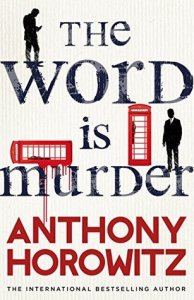
 About the Book
A wealthy woman strangled six hours after she’s arranged her own funeral. A very private detective uncovering secrets but hiding his own. A reluctant author drawn into a story he can’t control. What do they have in common? Unexpected death, an unsolved mystery and a trail of bloody clues lie at the heart of Anthony Horowitz’s page-turning new thriller. SPREAD THE WORD. THE WORD IS MURDER.
| Format: | Hardcover | Publisher: | Century | Pages: | 416 |
| Publication: | 24th Aug 2076 | Genre: | Crime, Mystery |
Purchase Links*
Amazon.co.uk ǀ Amazon.com
*links provided for convenience, not as part of any affiliate programme
Find The Word is Murder on Goodreads
My Review
Whilst reading this book, I imagined Anthony chuckling away as he wrote it and there were many times when I joined in, laughing out loud at his very funny comments – at times self-deprecating, at other times distinctly waspish. For example, visiting the scene of the crime, he observes in the victim’s living room:
‘..the thick-pile carpet with its floral pattern etched out in pink and grey…the crystal chandelier, the comfortable faux-antique furniture, the Coutry Life and Vanity Fair magazines spread out on the coffee table, the books (modern fiction, hardback, nothing by me)…’
And in her bedroom:
‘Only a week ago, a middle-aged woman would have undressed here, standing in front of the full-length mirror, sliding into the queen-sized bed with the copy of Stieg Larsson’s The Girl Who Played With Fire that was lying on the bedside table. Well, at least Mrs Cowper had been spared the slightly disappointing ending.’
Despite his protestation that ‘it worries me to be so very prominent in these pages’, Horowitz writes himself front and centre into the book, acting as a sort of Watson to ex-police detective, Hawthorne, a latter day Sherlock Holmes with all the deductive and observational powers of that literary giant and the same peculiarly limited knowledge of other aspects of life. A running joke is that Hawthorne never introduces Horowitz when they visit witnesses or explains why he’s there – and rarely does anyone ask.
In one of many playful themes, Horowitz constantly reminds the reader that he would have written the book differently if writing a work of fiction but, of course, since this is true crime, he has to stick to the facts.
‘I looked down and noticed a stain on the carpet, marked by two more police numbers. Her bowels had loosened just before she died, the sort of detail I would normally have spared an ITV audience.’
In particular, he’s troubled that he doesn’t know enough about Hawthorne’s back story, personal life and so on to make him an interesting character in the book. After all, Horowitz is the experienced best-selling author and screenwriter, isn’t he? Surely he knows what makes a book work better than anyone?
‘If I had sat down to write an original murder mystery story, I wouldn’t have chosen anyone like Hawthorne as its main protagonist.’
But Hawthorne insists what readers are really interested in isn’t the detective but the crime – ‘The word is murder. That’s what matters.’ (Oh look what he did there, that’s the book’s title.) In fact, as if trying to push his point to the limit Horowitz goes out of his way to make Hawthorne an unlikeable character, giving him some distinctly unpalatable views.
Horowitz revels in his role as unreliable narrator:
‘It occurred to me that I could make up my own rules. Who said that I had to write down everything exactly as it happened?‘
He cheerfully admits that he hasn’t included everything that was in the notes he took of the interviews he and Hawthorne conducted and that much of what he’s included is probably irrelevant. He also makes mischievous claims to have included vital clues in earlier scenes that will have you struggling to resist flipping back pages.
At times, the references to his other works – books, film & TV scripts – felt a little too frequent, even if a lot of these were self-deprecating. I did get the sense sometimes of being a witness to a huge in-joke. For example, his rant about literary agents directed at what appears to be his actual agent.
Having said that, the book is hugely enjoyable and proof, if it were needed, that Anthony Horowitz is a very clever man. The mystery itself is well-plotted and liberally dosed with red herrings and misdirection worthy of the author’s literary heroine, Agatha Christie.
I received an advance reader copy courtesy of NetGalley and publishers, Penguin UK, and chose to give an honest and unbiased review.
In three words: Clever, funny, self-referential
Try something similar…Moriarty by Anthony Horowitz
 About the Author
Anthony Horowitz, OBE is ranked alongside Enid Blyton and Mark A. Cooper as “The most original and best spy-kids authors of the century.” (New York Times). Anthony has been writing since the age of eight, and professionally since the age of twenty. In addition to the highly successful Alex Rider books, he is also the writer and creator of award winning detective series Foyle’s War, and more recently event drama Collision. Among his other television works he has written episodes for Poirot, Murder in Mind, Midsomer Murders and Murder Most Horrid. Anthony became patron to East Anglia Children’s Hospices in 2009.
On 19 January 2011, the estate of Arthur Conan Doyle announced that Horowitz was to be the writer of a new Sherlock Holmes novel, the first such effort to receive an official endorsement from them and to be entitled the House of Silk.
Connect with Anthony


