
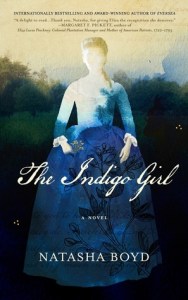
 About the Book
The year is 1739. Eliza Lucas is sixteen years old when her father leaves her in charge of their family’s three plantations in rural South Carolina and then proceeds to bleed the estates dry in pursuit of his military ambitions. Tensions with the British, and with the Spanish in Florida, just a short way down the coast, are rising, and slaves are starting to become restless. Her mother wants nothing more than for their South Carolina endeavour to fail so they can go back to England. Soon her family is in danger of losing everything. Upon hearing how much the French pay for indigo dye, Eliza believes it’s the key to their salvation. But everyone tells her it’s impossible, and no one will share the secret to making it. Thwarted at nearly every turn, even by her own family, Eliza finds that her only allies are an aging horticulturalist, an older and married gentleman lawyer, and a slave with whom she strikes a dangerous deal: teach her the intricate thousand-year-old secret process of making indigo dye and in return — against the laws of the day – she will teach the slaves to read. So begins an incredible story of love, dangerous and hidden friendships, ambition, betrayal, and sacrifice.
Format: Hardcover (346 pp.), ebook (pp.) Publisher: Blackstone Publishing
Published: 3rd October 2017 Genre: Historical Fiction
Purchase Links*
Amazon.co.uk ǀ Amazon.com ǀ Barnes & Noble
*links provided for convenience, not as part of any affiliate programme
Find The Indigo Girl on Goodreads
My Review
In her afterword, the author explains how a snippet of conversation overheard whilst visiting an exhibition about indigo became the inspiration for The Indigo Girl. I was reminded of a quote I read recently by Bernie McGill, author of The Watch House: ‘As a fiction writer, I am always looking for the gaps between recorded events, the spaces in between’. In this case, the author has taken the true story of Eliza Lucas and using historical documents, including Eliza’s own letters, filled the spaces in between to produce a fascinating book about life in 18th century America. The book includes excerpts from Eliza’s letters at relevant points in the narrative.
In case this is making it sound like The Indigo Girl is a dry treatise on the process of producing indigo dye, I can reassure potential readers that it’s much more than this. It’s also an enthralling story full of action, intrigue – even a hint of romance – with an engaging central character. In The Indigo Girl, Eliza emerges as a much more lively individual than the rather formal style of her actual letters would suggest. However, the letters give a hint of the determination and independence of spirit exhibited by the Eliza of the novel.
Given charge of running the family estate in South Carolina when her father is forced to return to their holdings in Antigua, Eliza sets out to transform the family’s fortunes by growing indigo, fuelled by her interest in botany. The only trouble is the cultivation of indigo and its transformation into high quality dye seems akin to a mystical process, the knowledge of which is held only by some of the slaves on the plantation: ‘The secret has been passed down through generations, perhaps even from ancient times.’
Gaining access to this knowledge brings Eliza into conflict with one of her father’s overseers because of his cruel treatment of the estate’s slaves. And her involvement in running the estate is looked at askance by Eliza’s mother, who is worried that it will ruin Eliza’s marriage prospects by going against the norms of polite society. Much to her mother’s horror, Eliza is more interested in the accounts and researching cultivation techniques than in tea drinking and embroidery.
In her heart, Eliza knows that she has only been placed in charge because both her brothers are at school in England. Her appointment is one of necessity not a sign of female emancipation. However, she clings to the vain hope that if she can make a success of it she can escape the inevitability of marriage.
‘Three crop seasons to get it right. If I didn’t succeed by then, marriage was my only option. A marriage not to save the family or our land – a wealthy man could buy himself a more biddable wife than I – but marriage so my family would not have to support me any longer.’
After several unsuccessful attempts to grow indigo, Eliza eventually persuades her father to hire a consultant. However, this sets off a chain of events that will ultimately end in tragedy for some, their just desserts for others and happiness for the people who matter.
I knew nothing about the growing of indigo or the production of indigo dye and its economic and political importance before reading this book so I found this aspect of the book particularly fascinating. As a keen gardener, I could also appreciate the challenges of experimenting with different sowing times, growing conditions and aftercare in an effort to achieve success.
I now know that the export of indigo dye from South Carolina laid the foundation for the wealth of many Southern families meaning Eliza’s accomplishments influenced the course of US history. Indeed, the author notes that, when Eliza died in 1793, President George Washington served as a pallbearer at her funeral. I’m so glad the author was able to celebrate the achievements of this remarkable woman and, at the same time, craft such an enjoyable novel. If it were needed, this reminds me why I enjoy reading historical fiction so much: entertainment and education in one lovely package.
I received an advance reader copy courtesy of NetGalley and publishers, Blackstone, in return for an honest review.
In three words: Engaging, fascinating, well-crafted
 About the Author
Natasha Boyd is an internationally bestselling and award-winning fiction author. Eversea, her debut novel, was a finalist for Contemporary Romance in the 2013 Winter Rose Contest, won the 2014 Digital Book Award for Adult Fiction and is a LIBRARY JOURNAL self-e selection 2015. She was born in Denmark, grew up in South Africa, Belgium and England and now lives and writes full-time in the USA. She lives with her husband, two sons and the cast of characters in her head. Her work is, so far, available in English, Italian, Turkish, German, and Indonesian
Connect with Natasha
Website ǀ Facebook ǀ Twitter ǀ Pinterest ǀ Instagram ǀ Goodreads

 About the Book
 About the Author

