Welcome to today’s stop on the blog tour for The Sea Gate by Jane Johnson, which is available now as an ebook and will be published in hardback on 3rd September 2020. My thanks to Vicky Joss at Head of Zeus for inviting me to take part in the tour and for my review copy via NetGalley. You can read my review below but do also check out the post by my tour buddy, Frankie at Chicks, Rogues and Scandals.
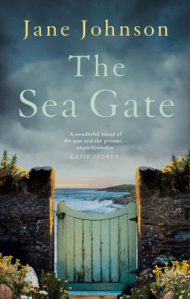 About the Book
One house, two women, a lifetime of secrets…
Following the death of her mother, Becky begins the sad task of sorting through her empty flat. Starting with the letters piling up on the doormat, she finds an envelope post-marked from Cornwall. In it is a letter that will change her life forever. A desperate plea from her mother’s elderly cousin, Olivia, to help save her beloved home.
Becky arrives at Chynalls to find the beautiful old house crumbling into the ground, and Olivia stuck in hospital with no hope of being discharged until her home is made habitable.
Though daunted by the enormity of the task, Becky sets to work. But as she peels back the layers of paint, plaster and grime, she uncovers secrets buried for more than seventy years. Secrets from a time when Olivia was young, the Second World War was raging, and danger and romance lurked round every corner…
The Sea Gate is a sweeping, spellbinding novel about the lives of two very different women, and the secrets that bind them together.
Format: ebook (448 pages) Publisher: Head of Zeus
Publication date: 4th June 2020 Genre: Historical Fiction
Find The Sea Gate on Goodreads
Pre-order/Purchase links*
Amazon UK| Hive (supporting UK bookshops)
*links provided for convenience not as part of an affiliate programme
My Review
I was first introduced to the writing of Jane Johnson when I read her book Court of Lions. That book’s setting (Granada) was a little different from the Cornwall of The Sea Gate but the two novels share similarities. For example, they both feature the interweaving of past and present story lines and a plot involving hidden secrets.
I recall finding the storyline of Court of Lions set in the present day slightly less engaging than that set in the past, although to be fair that was largely because the latter was so powerful. However, in The Sea Gate I had no such difficulty as the author gives the reader equally compelling stories and sympathetic characters in both time periods.
The Olivia the reader encounters in the present day initially appears a rather irascible and difficult old lady. However, as Becky soon discovers, she’s incredibly spirited and tougher than she seems. “There’s still so much fire in her, so much character, a sort of fierce, frail heroism. I wish I’d known Olivia when she was younger.” The reader is granted Becky’s wish as the story moves back to 1943 and Olivia’s wartime childhood at Chynalls. With her mother away in London and her father serving abroad, Olivia is left largely to fend for herself. Her life is changed through a chance meeting brought about, as she puts it, by “misunderstanding and xenophobia”. Despite being the “epitome of difference”, she and the other character form an unbreakable bond and a chain of events is set in motion that will have far-reaching consequences.
Becky’s discovery of the letter from Olivia in her mother’s belongings, gives her just the project she needs to distract her from recent events in her life, doubts about her relationship with partner Eddy, and worries about the future. She decides, “It’s time to take some responsibility for a change, to try to do some good in the world, to help my elderly cousin as I was never able to help my own mother.” The fact Olivia lives amid the glorious landscape of Cornwall helps Becky’s decision too. “Sea and sky fuse at the distant horizon. Spangles of light glitter like spilled treasure, undulating with the rolling of the waves… This is the Cornwall I have always imagined. The sense of wildness and isolation, of fairy tale and possibility.”
I particularly liked the way Becky’s renovation of Chynalls mirrors her own psychological and physical “renovation”. It was truly heart-warming to witness her growing self-confidence, independence of spirit and the reawakening of her creativity. As Becky admits herself, “Fear has trapped me, rendered me immobile and powerless…fear of everything, really. I’d forgotten I even had wings, let alone how to use them.” Becky’s inner strength doesn’t escape Olivia’s observant eyes though, recognising in Becky “That family gumption. The never-give-up look.” The nature of Becky’s gumption will become evident in the most satisfying way later in the book.
Alongside supervising the renovation of Chynalls by brothers, Mo and Reda, Becky becomes curious to find out more about Olivia’s past. Sorting through old letters and photograph albums, she concludes, “Cousin Olivia is, like Chynalls, stuffed with secrets, and I feel compelled to find out what I can.” What is the meaning of the symbols carved on the sea gate, for instance, or the identity of the artist whose paintings line the walls? Deliciously for the reader, Becky starts to feel “Little mysteries surround me, deliberately withholding themselves, trembling on the edge of revelation.”
I mentioned earlier the subtle connections between the stories of Olivia and Becky. These only increase as the book progresses. Echoes upon echoes, if you like. For example, both Olivia and Becky find themselves in need of guardian angels to protect them from those who would take advantage of them. And I must give a special mention to something else Olivia and Becky share – the gloriously foul-mouthed parrot, Gabriel, to whom it’s definitely worth paying attention.
In the second half of the book, as Becky gets closer to discovering the secret hidden for so long, the pace accelerates, the tension really ratchets up and there are moments of melodrama. The creaks of an old house, the sudden striking of a grandfather clock that has up until then been silent and a thunderstorm are just some of the ingredients that help to create a distinctly spine-tingling atmosphere. For Becky, “The house is full of secrets, and sometimes they come out and whisper together in the night.” However, secrets have a way of not remaining hidden and reading a book such as The Sea Gate wouldn’t be half so satisfying if they did, would it? Never fear, there’s a lot to be discovered before the full picture is revealed.
The Sea Gate is a skilfully crafted dual time story about two women from different generations who are nevertheless bound together by shared experiences and by a cliff-top house that has carefully guarded a shocking secret for decades.
In three words: Atmospheric, suspenseful, emotional
Try something similar: The Walls We Build by Jules Hayes
Follow this blog via Bloglovin
 About the Author
Jane Johnson is a British novelist and publisher. She is the UK editor for George R.R. Martin, Robin Hobb and Dean Koontz and was for many years publisher of the works of J.R.R. Tolkien. Married to a Berber chef she met while researching The Tenth Gift, she lives in Cornwall and Morocco.
Connect with Jane
Website | Twitter | Facebook


 About the Book
 About the Author