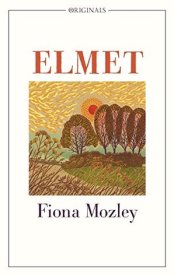
#BookReview Elmet by Fiona Mozley

ElmetAbout the Book

Daniel is heading north. He is looking for someone. The simplicity of his early life with Daddy and Cathy has turned sour and fearful. They lived apart in the house that Daddy built for them with his bare hands. They foraged and hunted. When they were younger, Daniel and Cathy had gone to school. But they were not like the other children then, and they were even less like them now. Sometimes Daddy disappeared, and would return with a rage in his eyes. But when he was at home he was at peace. He told them that the little copse in Elmet was theirs alone. But that wasn’t true. Local men, greedy and watchful, began to circle like vultures. All the while, the terrible violence in Daddy grew.

Format: ebook (320 pages)            Publisher: John Murray
Publication date: 27th July 2017 Genre: Contemporary Fiction, Literary Fiction

Find Elmet on Goodreads

Purchase links
Bookshop.org
Disclosure: If you buy a book via the above link, I may earn a commission from Bookshop.org, whose fees support independent bookshops

Hive | Amazon UK
Links provided for convenience only, not as part of an affiliate programme


My Review

Elmet is the story of two children – Daniel and Cathy – who live with their father in a house in a forest, largely apart from the rest of society.  It’s a strange, rather spartan life in which their father seeks to keep them separate from the world but also to protect them from some undisclosed danger. As fourteen-year-old Daniel, the book’s narrator, says, ‘Everything he did now was to toughen us up against something unseen. He wanted to strengthen us against the dark things in the world.’  Despite their very basic lifestyle and lack of creature comforts, the two children have a strong bond with their father.   ‘Cathy and I did not mind taking orders from Daddy. Sometimes we were more like an army than a family and he was not the type of leader to make you do anything for nothing.’

An interesting aspect of the children’s upbringing is the way it has blurred, even removed, gender distinctions.  As Daniel observes, ‘You have to appreciate that I never thought of myself as a man. I did not even think of myself as a boy… It is not as if I had ever actively rejected that designation. I just never thought about it. I lived with my sister and my father and they were my whole world. I did not think of Cathy as a girl nor a woman, I thought of her as Cathy. I did not think of Daddy as a man, though I knew that he was. I thought about him, likewise, as Daddy.’ 

Whilst an intense and, at times, disturbing read, I liked the way the author introduced themes such as concern for the environment.  In contrast to the local landowner, who regards the land merely as a source of profit, the children’s father carefully tends the forest and teaches his children the skills to do the same.  ‘In order to let new growth fight through, overhanging branches, crumbled bark and fallen trees must be cleared. Weeds in the undergrowth must be managed. The right shoots must be let through and the wrong ones discouraged.’  Much like indigenous people in other parts of the world, the children’s father cannot understand the concept of ownership of land. “It’s idea a person can write summat on a bit of paper about a piece of land that lives and breathes, and changes and quakes and floods and dries, and that that person can use it as he will, or not at all, and that he can keep others off it, all because of a piece of paper.”

When resistance grows to the landowners who wield power over the local community, the stakes are raised and events take a dark turn. As one of the leaders of the resistance, the children’s father becomes a target for retaliation of the most brutal kind and the children’s ability to respond to ‘the dark things in the world’ for which their father has prepared them is finally put to the test.

I received an advance review copy courtesy of John Murray via NetGalley.

In three words: Dark, chilling, unsettling

Try something similar: The Wanderers by Tim Pears

Follow this blog via Bloglovin


Fiona Mozley authorAbout the Author

Fiona Mozley grew up in York and lives in Edinburgh. Her first novel, Elmet, won a Somerset Maugham Award and the Polari Prize. It was shortlisted for the Man Booker Prize and the Royal Society of Literature Ondaatje Prize, and longlisted for the Women’s Prize for Fiction, the Dublin Literary Award and the International Dylan Thomas Prize. In 2018 Fiona Mozley was shortlisted for the Sunday Times/PFD Young Writer of the Year Award. (Photo/bio credit: Publisher author page)

Connect with Fiona
Twitter

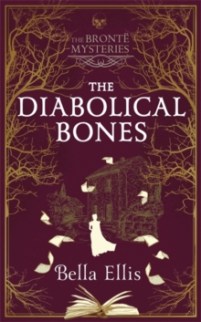
#BookReview The Diabolical Bones (The Bronte Mysteries #2) by Bella Ellis @HodderBooks

The Diabolical BonesAbout the Book

It’s Christmas 1845 and Haworth is in the grip of a freezing winter. Charlotte, Emily and Anne Brontë are rather losing interest in detecting until they hear of a shocking discovery: the bones of a child have been found interred within the walls of a local house, Top Withens Hall, home to the scandalous and brutish Bradshaw family.

When the sisters set off to find out more, they are confronted with an increasingly complex and sinister case, which leads them into the dark world of orphanages, and onto the trail of other lost, and likely murdered children. After another local boy goes missing, Charlotte, Emily and Anne vow to find him before it’s too late.

But in order to do so, they must face their most despicable and wicked adversary yet – one that would not hesitate to cause them the gravest of harm…

Format: Hardcover (352 pages)              Publisher: Hodder & Stoughton
Publication date: 5th November 2020 Genre: Historical Fiction, Crime, Mystery

Find The Diabolical Bones on Goodreads

Purchase links
Bookshop.org
Disclosure: If you buy a book via the above link, I may earn a commission from Bookshop.org, whose fees support independent bookshops

Hive | Amazon UK
Links provided for convenience only, not as part of an affiliate programme


My Review

As with the first book in the series The Vanished Bride, the prologue to The Diabolical Bones sees Charlotte, now the last surviving member of the Brontë family, looking back on her and her sisters’ lives before they became famous authors.  It underlines how tragically short those lives were, Emily having died in 1848 and Anne in 1849.  Charlotte herself was to die in 1855.

The book reprises the inventive premise of its predecessor, namely that the Brontë sisters were enterprising ‘detectors’ before they were novelists – with the assistance, from time to time of their brother, Branwell. The Diabolical Bones represents their second case, undertaken in 1846, (before the publication of Wuthering Heights in 1847, the relevance of which will become apparent).

The narrative alternates between the point of view of the three sisters, allowing the reader to appreciate their different strengths when it comes to the art of ‘detecting’. Together they make a formidable team. As Anne observes: “Charlotte, you have a gift for reading people and drawing them out of themselves. Emily, you see connections and clues that a mind inferior to yours would simply not be able to fathom… As for myself, I keep our minds focused on the reasons behind it all: the human reasons… Branwell allows us access into rooms where lone women might not otherwise go, and sometimes provides a fairly adequate distraction. When we are together, we are stronger and we are safer.”

They may be stronger together but are they safer? It soon becomes evident they are hunting an individual so convinced of their own superiority they are prepared to engage the sisters in ‘a battle of wits’, even leaving clues for them to find. Throughout the story there’s a sense of the Gothic from the ‘dense and sorrowful atmosphere’ of the Bradshaw house to local talk of evil stalking the neighbourhood when the moon is dark. The sisters’ investigation even includes a visit to a witch, although this does involve crossing the border from their beloved Yorkshire into Lancashire. “Oh well,” Emily said. “Needs must.”

The battle of wits eventually becomes a battle of a more deadly kind requiring the Brontës to draw on all their courage and ingenuity as they pit themselves against a formidable foe, whilst all the time the clock is ticking until the monster strikes again.

Admirers of the Brontës will enjoy the references to events in their lives and have fun spotting places said to have inspired locations in their novels. Indeed, returning from a visit to the house where the bones were discovered, Emily enthuses, “I had a vision of a story, and I wanted to write it all down before I forgot it. It is a marvellous, ferocious storm of a story. I shall set it at Top Withens…” The author also gives some of the secondary characters names reminiscent of those in the Brontë sisters’ novels. I spotted Wuthering Heights, Jane Eyre and The Tenant of Wildfell Hall but there may be more.

Readers who enjoyed the first Brontë mystery will be delighted to see the sisters return for a second foray into ‘detecting’. But you don’t need to be a fan of the Brontës to enjoy this skillfully crafted historical mystery. As Bella Ellis notes in her Acknowledgements, ‘We all need a good story in our lives now, more than ever.’ Amen to that.

I received an advance review copy courtesy of Hodder & Stoughton via NetGalley.

In three words: Engaging, suspenseful, atmospheric

Follow this blog via Bloglovin


Rowan ColemanAbout the Author

Bella Ellis is the Brontë-esque pseudonym of Rowan Coleman, an acclaimed author of numerous novels for adults and children. She first visited the former home of the Brontë sisters when she was ten years old. From the moment she stepped over the threshold she was hooked, and embarked on a lifelong love affair with Charlotte, Emily, and Anne; their life; their literature; and their remarkable legacy. (Photo credit: Goodreads author page)

Connect with Bella
Website | Twitter | Facebook | Instagram