
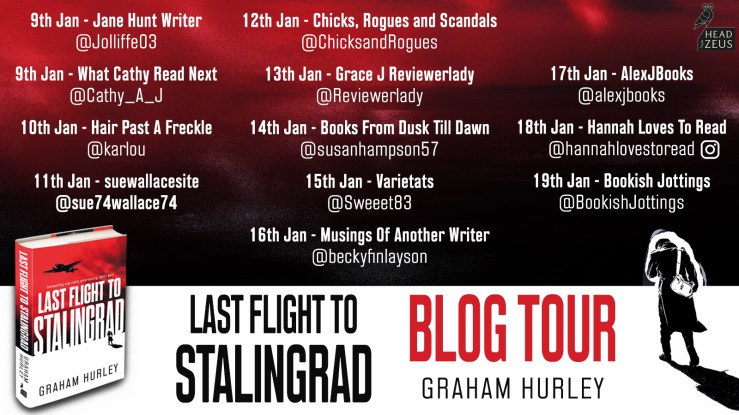
Welcome to the first day of the blog tour for Last Flight to Stalingrad by Graham Hurley. My thanks to Lauren at Head of Zeus for inviting me to take part in the tour and for my digital review copy via NetGalley.
 About the Book
Berlin, 1942. For four years, the men in field grey have helped themselves to country after country across Western Europe.
For Werner Nehmann, a journalist at the Promi – the Ministry of Propaganda – this dizzying series of victories has felt like a party without end. But now the Reich’s attention has turned towards the East, and as winter sets in, the mood is turning.
Werner’s boss, Joseph Goebbels, can sense it. A small man with a powerful voice and coal-black eyes, Goebbels has a deep understanding the dark arts of manipulation. His words, his newsreels, have shaken Germany awake, propelling it towards its greater destiny and he won’t let – he can’t let – morale falter now. But the Minister of Propaganda is uneasy and in his discomfort has pulled Werner into his close confidence.
And here, amid the power struggle between the Nazi Chieftains, Werner will make his mistake and begin his descent into the hell of Stalingrad.
Format: Hardcover (416 pages) Publisher: Head of Zeus
Publication date: 7th January 2021 Genre: Historical Fiction
Find Last Flight to Stalingrad on Goodreads
Purchase links
Hive | Amazon UK
Links provided for convenience only, not as part of an affiliate programme
My Review
Last Flight to Stalingrad is the fifth book in the author’s ‘Wars Within’ series. I read the first in the series, Finisterre, way back in 2016. In fact, it was one of the first books I reviewed on my blog after I discovered the delights of (or should I say temptations of) NetGalley. However, don’t worry if you haven’t read that or any of the other books in the series – Aurore, Estocada and Raid 42 – because each novel is set in a different period in the run-up to or during WW2 and, with a couple of exceptions, features different characters. Furthermore they don’t follow on chronologically making them perfect to read in any order.
Like previous books in the series, Last Flight to Stalingrad has two main protagonists – Werner Nehmann and Georg Messner. Both men occupy positions that place them close to powerful figures in the Third Reich. In Messner’s case, it’s Wolfram von Richthofen of the Luftwaffe, and in Nehmann’s case, it’s Joseph Goebbels, head of the Ministry of Propaganda. Whereas in Finisterre the two storylines took some time to come together, I had no such reservations about Last Flight to Stalingrad. How the two men meet is completely believable and, as they get to know each other, it’s clear they both recognize – based on their different experiences – how badly the war against the Russians is going. Not that the German people would know it from the propaganda they are fed.
One of the most fascinating aspects of the book for me was the light it shed on the manipulation of information and power of propaganda. This made Nehmann a particularly interesting character, especially given his proximity to someone so high up in the Reich. He knows his survival (and, it transpires, the survival of others close to him) depends on him continuing to prove useful to Goebbels and he has a clear-eyed view of what that involves.
“This was the age of the lie, big or small. Truth filleted for what might be useful and then tossed aside. Deception practiced on the grandest scale. Whole nations, millions of Volk, misled, manipulated, lied to. Nehmann was part of that. He understood the power of the lie, the artful sleight of hand, the dark sorcery that turned black into white, and good into evil. That’s how he’d made his reputation. That’s how he’d won the precious freedoms offered by – yes – the Minister of Lies himself.”
In a particularly compelling episode, Nehmann is tasked with demonstrating the success of German bomber raids on Stalingrad. Taking aerial photographs, he hunts “for the kind of trophy images that might please the author of this wrecked city: huge petroleum tanks on the riverbank, still aflame, their metal carcasses torn apart; a lake of blazing oil drifting slowly down the river, dragging thick coils of smoke that circled slowly upwards in the updraught from the water; a nearby building on the western shore that must have been a hospital, eviscerated by high explosive, dozens of beds plainly visible inside.”
Another memorable scene sees Nehmann and Goebbels working together on a speech Hitler is to give at Berlin’s Sportpalast:
“Nehmann had never liked the Sportpalast. Recently…he’d likened it to something you’d find in Goebbels’ kitchen. It was a cooking pot, he said. It was a favourite utensil you’d fetch out for those special occasions when you wanted to whip up something irresistible to keep everyone happy. You put together the recipe from what you knew and trusted. A little of that intimate frenzy from the Burgerbraukeller days in Munich. Plus a huge helping of spectacle and mass adoration from the Zeppelinfeld at Nuremburg: hanging banners, roving spotlights and a sound system that would put Hitler’s rasp and Goebbels’ chest-thumping roar into every German heart. When the national pulse showed signs of faltering, a couple of deafening hours in the Sportpalast always did the trick. The trick.”
During his work for Goebbels, Nehmann stumbles upon evidence of SS atrocities and in the process makes himself a truly formidable enemy. A thrilling – and chilling – game of cat and mouse ensues, provoking an uncharacteristically extreme and visceral response from Nehmann.
The author’s impeccable research is evident throughout the book but it never detracts from the pace of the story, instead adding a fantastic sense of authenticity to what is a compelling work of historical fiction.
In three words: Gripping, authentic, immersive
Follow this blog via Bloglovin
 About the Author
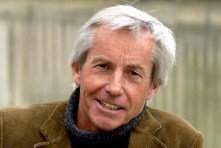
Graham Hurley is the author of the acclaimed Faraday and Winter crime novels and an award-winning TV documentary maker. Two of the critically lauded series have been shortlisted for the Theakston’s Old Peculier Award for Best Crime Novel. His French TV series, based on the Faraday and Winter novels, had won huge audiences. The first Wars Within novel, Finisterre, was shortlisted for the Wilbur Smith Adventure Writing Prize. Graham now writes full-time and lives with his wife, Lin, in Exmouth.
Connect with Graham
Website

 About the Book
 About the Author

