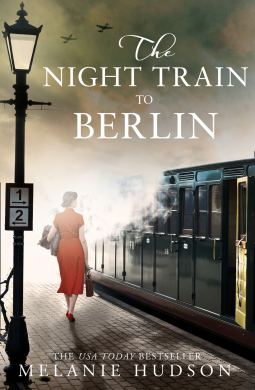
#BookReview The Night Train to Berlin by Melanie Hudson

The Night Train to BerlinAbout the Book

Two lost souls brought together by the chaos of war. A train journey into the past. A love that echoes through time.

Paddington Station, present day. A young woman boards the sleeper train to Cornwall with only a beautiful emerald silk evening dress and an old, well-read diary full of sketches. Ellie Nightingale is a shy violinist who plays like her heart is broken. But when she meets fellow passenger Joe she feels like she has been given that rarest of gifts…a second chance.

Paddington Station, 1944. Beneath the shadow of the war which rages across Europe, Alex and Eliza meet by chance. She is a gutsy painter desperate to get to the frontline as a war artist and he is a wounded RAF pilot now commissioned as a war correspondent. With time slipping away they make only one promise: to meet in Berlin when this is all over. But this is a time when promises are hard to keep, and hope is all you can hold in your heart.

Format: ebook (400 pages)            Publisher: One More Chapter
Publication date: 22nd April 2021 Genre: Historical Fiction, Romance, Dual Time

Find The Night Train to Berlin on Goodreads

Purchase links
Amazon UK
Link provided for convenience only, not as part of an affiliate programme


My Review

I was drawn to this book because of it’s partial World War 2 setting and, in particular, because elements of the story unfold en route to Cornwall.  I’m familiar with the line from London Paddington to Penzance on which Eliza and Ellie travel from my own holiday trips, although never on the sleeper service.

The story unfolds in chapters that alternate between Eliza in 1944 and Ellie in the present day. The plot relies on large helpings of coincidence, requiring a belief in fate or destiny, and bringing to mind the oft-quoted line, “Of all the gin joints in all the towns in all the world, she walks into mine” from the film Casablanca. As it happens, the film is referenced several times in the book.

The relationship between Eliza Grey and Alex Levine that begins after a chance encounter on a wartime train journey had a real fizz to it, even if Eliza’s initial reaction is less than promising. ‘She had never, in all of her life, met such an arrogant, self-opinionated, curt and, quite frankly, rude individual.’ As we learned from Pride and Prejudice, first impressions can be deceptive. On the other hand, Joe, whom Ellie meets in similar fashion, although pleasant enough, didn’t feel like a fully fleshed out character and I didn’t find myself as invested in their relationship as I did in that between Eliza and Alex.

I found it easy to imagine the glamour of the 1940s sleeper train to Cornwall; less so its modern day equivalent which, I suspect, would be considerably more utilitarian even when dressed in its costume of 1940s themed party train. And with all due respect to car attendant, Rihanna, she’s no match for her 1940s equivalent, the stately Jeffries.

I thought Eliza’s wartime story was by far the most successful element of the book so much so that, at times, the sections with Ellie felt like mere interludes. In fact, the main purpose of the modern storyline seemed to be to act as a framing device for telling Eliza’s story.  Even though the author injected some jeopardy into Ellie’s personal story, I felt the modern day timeline could have been shunted off to the sidings. Having said that, there were some neat parallels between the two timelines, such as the eavesdropping couple across the aisle of the railway carriage and Joe’s choice of costume. And was his fluffy canine companion a nod to WW2 RAF hero Wing Commander Guy Gibson, portrayed in the film The Dambusters by Richard Todd? 

The wartime sections of the book include some memorable scenes such as when Eliza, deployed as a nursing auxiliary to a hospital ship on the South coast, records in her sketchbook the preparations for D-Day. Or when she experiences the heady days following the Allied liberation of Paris. 

The author sheds a fascinating light on the role played by war artists and war correspondents in documenting conflict, and the risks they took in doing so. The hardships too, living alongside the troops in often spartan conditions. Eliza has conflicted feelings about her role as a war artist. Is she right to depict the truth of the atrocities she sees, or should she be mindful of their potential impact on morale back home and present a more ‘sanitized’ picture?

Although compelling in parts, I felt The Night Train to Berlin spent a little too much time travelling along branch lines rather than speeding to its destination.

I received an advance review copy courtesy of One More Chapter via NetGalley. The Night Train to Berlin is available as an ebook now and will be published in paperback on 27th July 2021.

In three words: Dramatic, romantic, dual-time

Try something similar: You Let Me Go by Eliza Graham

Follow this blog via Bloglovin


Melanie HudsonAbout the Author

Melanie Hudson was born in Yorkshire in 1971, the youngest of six children. Her earliest memory is of standing with her brother on the street corner selling her dad’s surplus vegetables (imagine The Good Life in Barnsley and you’re more or less there).

After running away to join the British armed forces in 1994, Melanie experienced a career that took her around the world on some exciting adventures. In 2010, when she returned to civilian life to look after her young son, on a whim, she moved to Dubai where she found the time to write women’s fiction. She now lives in Cornwall with her family.

Her debut, The Wedding Cake Tree, won the Romantic Novelists’ Association Contemporary Romance Novel of the Year 2016. (Photo credit: Goodreads author page)

Connect with Melanie
Twitter | Facebook


#BookReview The Metal Heart by Caroline Lea @MichaelJBooks

The Metal HeartAbout the Book

Orkney, 1940. On a remote island, a prisoner-of-war camp is constructed to house five hundred Italian soldiers. Upon arrival, a freezing Orkney winter and divided community greets them.

Orphaned sisters Dorothy and Constance volunteer to nurse the men. Dot is immediately drawn to Cesare, a young man fighting on the wrong side and broken by war and destruction.

The soldiers spend their days building a secret barricade between the islands. By night, however, they construct a reminder of their native land – an exquisite chapel.

As tensions between the islanders and outsiders grow, the sisters’ loyalty is tested. Will Dot choose love, or family?

Format: Hardcover (400 pages)    Publisher: Michael Joseph
Publication date: 29th April 2021 Genre: Historical Fiction, WW2

Find The Metal Heart on Goodreads 

Pre-order/Purchase links
Bookshop.org
Disclosure: If you buy a book via the above link, I may earn a commission from Bookshop.org, whose fees support independent bookshops

Hive | Amazon UK
Links provided for convenience only, not as part of an affiliate programme


My Review

I loved Caroline Lea’s first book, The Glass Woman, so I was delighted when I learned she had a new novel on the way. Set in the Orkney islands during World War 2, The Metal Heart is inspired by the true story of how Italian soldiers constructed a chapel on the island of Lamb Holm (Selkie Holm in the book) during the period it was used as a prisoner-of-war camp. You can find photographs of the chapel, the island and the surrounding landscape on Caroline’s Instagram feed.

Alongside the building of the chapel, the author has created a wonderful story involving twin sisters, Dorothy (known as Dot) and Constance (known as Con). Although identical in appearance, as the reader learns from the sections written from each sister’s point of view, they possess a very different outlook on life. For Constance, haunted by an experience that has made her distrustful of others, the dilapidated bothy on Selkie Holm which has become the sisters’ home is a refuge, a place she can feel safe. So the arrival of hundreds of male prisoners along with the often brutal men who guard them, reawakens disturbing memories.  These, and feelings of guilt about her role in the fate of their father and mother, makes Con determined to protect her sister from experiencing anything like the trauma she has undergone. In contrast, for Dorothy, bolder in spirit than her sister, the arrival of the prisoners to the island opens up the possibility of a different future. 

The arrival of the prisoners is initially greeted with suspicion by the Orcadians, the inhabitants of the Orkney islands. Fiercely independent, for them ‘mainland’ does not refer to Scotland but to the largest island in the group and the location of the centre of the community, Kirkwall.   Their reservations partly ease when some of the prisoners are deployed as much-needed labour on local farms. The rest of the prisoners remain employed on Selkie Holm quarrying rocks in order to build barriers that will prevent German U-boats attacking the British fleet anchored in Scapa Flow.  In one of the many interesting contradictions the book explores, the barriers eventually form causeways, making access between some of the islands easier than before for the local people.

I loved the way the author exposed the natural beauty of what could be viewed as a harsh, even bleak environment in  some wonderful descriptive writing. ‘The sky is clear, star-stamped and silvered by the waxing gibbous moon.’  The signs  of earlier inhabitants of the island – barrows and caves – combined with the myths associated with the island create a wonderful atmosphere.  (While reading The Metal Heart, I was reminded of Amy Liptrot’s book The Outrun also set on Orkney and was delighted to see it mentioned in the author’s bibliography.)  

The sections of the book describing the construction of the Catholic chapel are absolutely fascinating, with the prisoners making ingenious use of everyday objects and materials reclaimed from the damaged hulks of ships that surround the island.  For the prisoners, and Cesare in particular, the building of the chapel is both a connection with home and a way of distracting themselves from the daily hardships of life in the camp: the gruelling, dangerous work; the brutality of the guards; the cold; the sickness that sweeps through the prisoners. ‘He is, for a moment, no longer a prisoner. His muscles do not ache, his stomach does not gripe. He is a free man, standing in a church in his own country. War and death are things that happen to other people, in other places. The chapel will be a place of peace.’

The chapel may be a place of peace but there is danger on other fronts, forcing each sister to make a heartbreaking choice and risk everything to do what they believe is right. A fascinating blend of fact and fiction, The Metal Heart is a touching love story and a message of hope that beauty can emerge from unexpected places, even in time of war.  

I received an advance review copy courtesy of Michael Joseph via NetGalley.

In three words: Emotional, atmospheric, haunting

Try something similar: The Lost Lights of St Kilda by Elisabeth Gifford or Shelter by Sarah Franklin

Follow this blog via Bloglovin


Caroline LeaAbout the Author

Caroline Lea grew up in Jersey and gained a First in English Literature and Creative Writing from Warwick University, where she now teaches writing. Her fiction and poetry have been shortlisted for the Bridport Prize, and The Glass Woman was shortlisted for the HWA Debut Crown. (Photo credit: Twitter profile)

Connect with Caroline
Twitter | Facebook | Instagram