#BookReview Ariadne by Jennifer Saint @RandomTTours @Wildfirebks

Graphic 3

Welcome to today’s stop on the blog tour for Ariadne by Jennifer Saint. My thanks to Anne at Random Things Tours for inviting me to participate in the tour and to Wildfire for my digital review copy via NetGalley.

AriadneAbout the Book

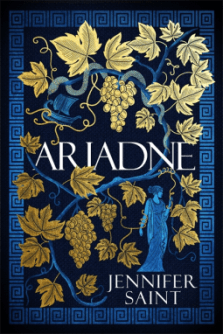
As Princesses of Crete and daughters of the fearsome King Minos, Ariadne and her sister Phaedra grow up hearing the hoofbeats and bellows of the Minotaur echo from the Labyrinth beneath the palace. The Minotaur – Minos’s greatest shame and Ariadne’s brother – demands blood every year.

When Theseus, Prince of Athens, arrives in Crete as a sacrifice to the beast, Ariadne falls in love with him. But helping Theseus kill the monster means betraying her family and country, and Ariadne knows only too well that in a world ruled by mercurial gods – drawing their attention can cost you everything.

In a world where women are nothing more than the pawns of powerful men, will Ariadne’s decision to betray Crete for Theseus ensure her happy ending? Or will she find herself sacrificed for her lover’s ambition?

Ariadne gives a voice to the forgotten women of one of the most famous Greek myths, and speaks to their strength in the face of angry, petulant Gods.

Format: Hardcover (400 pages)    Publisher: Wildfire
Publication date: 29th April 2021 Genre: Historical Fiction

Find Ariadne on Goodreads

Purchase links
Bookshop.org
Disclosure: If you buy a book via the above link, I may earn a commission from Bookshop.org, whose fees support independent bookshops

Hive | Amazon UK
Links provided for convenience only, not as part of an affiliate programme


My Review

The first thing that drew me to this book was that I was fortunate enough to visit the site of Knossos on a holiday to Crete many years ago. I was also intrigued by the idea of a book that puts its titular heroine, Ariadne, centre stage in the retelling of the myth of the Minotaur.

A recurring theme of the book is the male domination of society and the imbalance of power between men and women. As Ariadne observes, women – including her own mother, Pasiphaë – are blamed and punished for the actions of men, both mortal and divine.  In fact, it’s not quite as simple as that because, as the book shows, mortal women also suffer at the hands of female Gods.  For example, Ariadne ponders on Athena’s actions in punishing Medusa for her seduction by Poseidon: ‘She must punish the girl who was so shameless as to be overpowered by Poseidon… So Medusa had to pay for Poseidon’s act. It made no sense at all.’  

Arguably, the book illustrates the misuse of power per se. For example, Ariadne observes that her brother, the Minotaur, for whom she shows a touching pity when he’s a baby, becomes a display to the world of her father Minos’s dominance. Similarly Minos keeps Daedalus a virtual prisoner on Crete because of his genius for invention and to prevent his knowledge of the secrets of the labyrinth beneath the palace falling into the hands of others.

The author draws the reader into the stories of Ariadne and Phaedra, showing how each in their different way attempt to find their identity and gain some control over their lives.  For Phaedra, used as a political bargaining chip by her brother after the death of Minos in order to secure peace with Athens, it’s about gaining what knowledge she can of the workings of the Athenian state and using that to her advantage.  For Ariadne, living alone in exile on Naxos, it’s about finding the courage and determination to survive. As she says defiantly, ‘I was not Minos’ captive daughter; I was not Cinyras’s trade for copper; nor was I Theseus’s diversion between heroic feats of glory.  Somehow I had survived them all and here I was, free of them at last’.  She does survive, albeit with the help of the male God, Dionysus. In fact, both Ariadne and Phaedra are destined ultimately to be disillusioned, let down and deceived by men who don’t deserve them.

Alongside the stories of Ariadne and Phaedra, there are references to other characters from Greek mythology, such as Medea, Jason and Heracles. At nearly 400 pages, Ariadne is a chunky read but if some sections move at a rather leisurely pace, there are plenty of scenes that are full of energy and drama. For example, the description of a descent into the Underworld.

Although I was aware of the story of Ariadne up to the point of the slaying of the Minotaur and was vaguely aware that she spent time on Naxos, I knew nothing about events in her life thereafter. I had also never heard of her sister, Phaedra, or her mother, Pasiphae. (I obviously should have paid more attention during my Classical Studies lessons at school!) I think this lack of knowledge hampered my ability to fully judge what degree of imagination the author has brought to her retelling of the story of Ariadne. This may also explain why, whilst full of admiration for the superb quality of the writing, my feelings about Ariadne do not quite match the wild – dare I say, Dionysian – enthusiasm of other readers. However, for lovers of Greek mythology, Ariadne is a book I can definitely recommend. And wouldn’t it be great to be reading it on a beach in Crete?

In three words: Emotional, assured, immersive

Try something similar: The Silence of the Girls by Pat Barker

Follow this blog via Bloglovin


Jennifer Saint Author picAbout the Author

Jennifer Saint grew up reading Greek mythology and was always drawn to the untold stories hidden within the myths. After thirteen years as a high school English teacher, sharing a love of literature and creative writing with her students, she wrote Ariadne, her first novel, which tells the legend of Theseus and the Minotaur from the perspective of Ariadne – the woman who made it happen. Jennifer is now a full-time author, living in Yorkshire, England, with her husband and two children. She is working on her second novel, another retelling of ancient myth.

Connect with Jennifer
Website | Twitter | Facebook | Instagram

Ariadne Bt Poster

#BookReview Skelton’s Guide to Suitcase Murders by David Stafford @AllisonandBusby

Skelton's Guide to Suitcase Murders Twitter Graphic

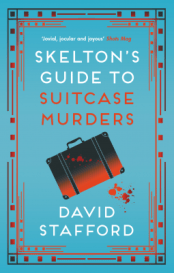
Welcome to today’s stop on the blog tour for Skelton’s Guide to Suitcase Murders by David Stafford, the second book in the historical crime series featuring barrister, Arthur Skelton. My thanks to Christina at Allison & Busby for inviting me to take part in the tour and for my digital review copy via NetGalley.


Skelton's Guide to Suitcase MurdersAbout the Book

A woman’s dismembered corpse is discovered in a suitcase, and police quickly identify her husband, Doctor Ibrahim Aziz, as their chief suspect. Incriminating evidence is discovered at his home and his wife was rumoured to be having an affair, giving him clear motive.

With his reputation for winning hopeless cases, barrister Arthur Skelton is asked to represent the accused. Though Aziz’s guilt does not seem to be in doubt, a question of diplomacy and misplaced larvae soon lead Skelton to suspect there may be more to the victim’s death.

Aided by his loyal clerk Edgar, Skelton soon finds himself seeking justice for both victim and defendant. But can he uncover the truth before an innocent man is put on trial and condemned to the gallows?

Format: Hardcover (352 pages)      Publisher: Allison & Busby
Publication date: 22nd April 2021 Genre: Historical Fiction, Crime, Mystery

Find Skelton’s Guide to Suitcase Murders (Arthur Skelton #2) on Goodreads

Purchase links
Bookshop.org
Disclosure: If you buy a book via the above link, I may earn a commission from Bookshop.org, whose fees support independent bookshops

Publisher | Hive | Amazon UK
Links provided for convenience only, not as part of an affiliate programme


My Review

It was an absolute pleasure to be reunited with barrister Arthur Skelton and his trusty clerk – and friend – Edgar Hobbes. I loved the scenes where Arthur and Edgar discuss the briefs that have been sent to him. By the way, if you want to discover the inspiration for the character of Arthur, read David’s blog post on how Arthur came to be. I should say at this point that it’s not necessary to have read the first book to enjoy this second one.

Having said that, for fans of the series Skelton’s Guide to Suitcase Murders sees the return of characters from the first book, including Arthur’s cousin, Alan, and his sister, Norah, who travel the country with their caravan spreading the word of God at meetings. Often they gather useful nuggets of information for Arthur’s cases along the way, relayed to him in Alan’s chatty letters.

Another returning characters is Rose Critchlow who helped Arthur with his previous case and is now working as an articled clerk in the solicitors who provide most of Arthur’s work. Once again, Rose makes a valuable contribution, one that leads to an important discovery and provides an insight into the emerging science of forensic entomology (the lifecycles of creepy crawlies) at the same time. Amongst her other attributes, the reader learns, are superb navigational skills. ‘Rose knew the way. Of course she did. Five minutes with a map and Rose would be able to take you straight to the green-eyed yellow idol to the north of Kathmandu or the lost kingdom of She-Who-Must-Be-Obeyed.‘ I was particularly delighted to come across the latter reference having already decided on my ‘Try Something Similar’ suggestion below.

As in the first book, the reader gets an insight into Skelton’s domestic life with wife, Mila, and children, Lawrence and Elizabeth. I particularly enjoyed the episode in which Arthur is entrusted with the Christmas shopping list, including purchasing gifts for the children and hits the busy streets of London. ‘He’d been told by many people that, if you value your health and sanity, you should never venture into a toyshop at Christmas time. Climb the Matterhorn by all means, take the waters in Moscow during a cholera epidemic, but stay away from toyshops.’ Does Arthur return with exactly what was specified on the list? Come on, he’s a man isn’t he?

Arthur’s wife, Mila, is a wonderful character and definitely nothing like the ‘She-Who-Must-Be-Obeyed’ of John Mortimer’s Rumpole series. Mila is an avid reader of the newspapers, teaches archery to local girls and has lately developed a rather grand ambition, keen to outdo her acquaintance, Cissy Pemberton.  Mila and Arthur have a touching relationship such that I found it hard to forgive the author for putting Arthur through the mill when there is a a sudden turn of events.

Alongside Arthur’s attempts to find the evidence needed to achieve the acquittal of his client, Doctor Aziz, are entertaining interludes where the reader witnesses Arthur’s court appearances in other cases in which he has been instructed. He frequently ponders on the small things that can turn a case and influence a jury.

The book is also enlivened by references to real life figures such as the renowned pathologist, Sir Bernard Spilsbury. And I especially enjoyed Arthur and Edgar’s memorable encounter with a star of stage and screen in their favourite eating place, Kembles. By the way, it’s here that Edgar, seeking to reduce his portly stature for reasons he is initially reluctant to reveal, eschews the delights of veal and ham pie for an egg salad that Arthur describes as looking like ‘the sort of thing that Mr Gandhi might have eaten as a form of protest‘.

Do Arthur and Edgar get to the bottom of the (suit)case? What do you think…?

Skelton’s Guide to Suitcase Murders is another delightful addition to the series. I loved its combination of period detail, ingenious mystery and amiable humour, and I’m already looking forward to Arthur’s next guide to dastardly deeds.

In three words: Engaging, lively, clever

Try something similar: Rumpole and the Penge Bungalow Murders by John Mortimer

Follow this blog via Bloglovin


David StaffordAbout the Author

David Stafford began his career in theatre. He has written countless dramas, comedies and documentaries including two TV films with Alexei Sayle, Dread Poets Society with Benjamin Zephaniah, and, with his wife, Caroline, a string of radio plays and comedies including The Brothers, The Day The Planes Came and The Year They Invented Sex as well as five biographies of musicians and showbusiness personalities. Fings Ain’t Wot They Use T’Be – The Life of Lionel Bart was chosen as Radio 4 Book of the Week and made into a BBC Four TV documentary.

Connect with David
Website  | Facebook | Twitter