#BlogTour #BookReview The Far Field by Madhuri Vijay @MidasPR @groveatlantic @dylanthomprize #SUDTP20

Blog-Tour-Begins

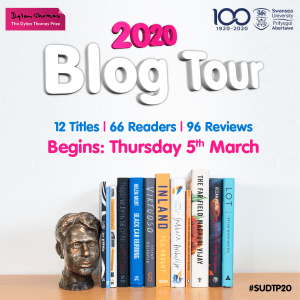
Welcome to today’s stop on the mega blog tour celebrating the authors on the longlist for the Dylan Thomas Prize 2020. I’m delighted to bring you my review of one of the longlisted books – The Far Field by Madhuri Vijay. My thanks to Martina at Midas PR for inviting me to take part in the tour and for my review copy.

Look out for the announcement of the shortlist on 7th April. Ensure you don’t miss a thing by following the hashtag #SUDTP20 on Twitter.

If you missed it, you can also read my review here of another of the longlisted books, On Earth We’re Briefly Gorgeous by Ocean Vuong.


Dylan Thomas Prize TimetableAbout the Dylan Thomas Prize

Launched in 2006, the annual Swansea University International Dylan Thomas Prizeis one of the most prestigious awards for young writers, aimed at encouraging raw creative talent worldwide. It celebrates and nurtures international literary excellence.

The £30,000 Prize is awarded to the best published literary work in the English language, written by an author aged 39 or under.


The Far FieldAbout the Book

In the wake of her mother’s death, Shalini, a privileged and restless young woman from Bangalore, sets out for a remote Himalayan village in the troubled northern region of Kashmir. Certain that the loss of her mother is somehow connected to the decade-old disappearance of Bashir Ahmed, a charming Kashmiri salesman who frequented her childhood home, she is determined to confront him.

But upon her arrival, Shalini is brought face to face with Kashmir’s politics, as well as the tangled history of the local family that takes her in. And when life in the village turns volatile and old hatreds threaten to erupt into violence, Shalini finds herself forced to make a series of choices that could hold dangerous repercussions for the very people she has come to love.

Format: Paperback (464 pages)          Publisher: Grove Press
Publication date: 2nd January 2020 Genre: Literary Fiction

Find The Far Field on Goodreads

Purchase links*
Amazon.co.uk | Amazon.com
*links provided for convenience not as part of an affiliate programme


My Review

The book switches back and forth in time between Shalini’s memories of her childhood and the visits of Bashir Ahmed, and her journey to Kashmir to try to track him down following her mother’s death. It’s skilfully plotted so there’s always more to be revealed and there is a tantalising sense of tension throughout. I expect I’m not the only reader who had a disturbing sense of history potentially repeating itself at certain moments.

The author brilliantly conveys the tensions within Shalini’s family, in particular her mercurial mother who can change from charming to disdainful in a moment, what Shalini refers to as her mother’s ‘lightning switch from one self to another.’ It’s something her father finds difficult to handle.  With Bashir Ahmed and her mother, it’s a different matter. Shalini recalls, ‘Looking back, I can see that something powerful occurred in that moment and it still astonishes me all these years later: Bashir Ahmed understood in about five minutes what took my father decades‘.

Like some three dimensional chess game, Shalini recalls her younger self’s struggle to make sense of ‘these shifting, traitorous pieces – mother, visitor, father – trying to keep track of their masked sentences, their mutable moods, waiting for a clear sign of what my next move should be.’ The burden of keeping secrets is also evident. Shalini reflects, ‘I thought of all the secrets I had carried as far back into my childhood as I could remember. I felt them pile one on top of another, suffocating me.’ However, perhaps some secrets are best left buried.

The author’s acute observation of the way in which people interact is memorably displayed in a scene depicting what must surely be the most ill-judged dinner party in history.

I loved the descriptions of the small Kashmiri village where Bashir Ahmed’s family live and the details of everyday life. ‘…The houses were flung wide upon the mountainside, like a handful of brightly coloured toys tossed by a careless hand, separated by narrow rocky ridges and terraced cornfields.’ The generous hospitality offered to Shalini both by Bashir Ahmed’s family, and earlier by Abdul Latief and his wife, Zoya, shows how this is embedded in Indian culture. However, the tension between the different religious communities and the shadow of past events are always in the background, as Shalini will discover as she faces difficult decisions about her future and comes face to face with the realities of life in Kashmir. The contrasts are stark: ‘...this place, these people, this life, with its secrets and its violence, its hardness and its beauty.’

One of the question the book poses is whether the impulse to act is always the wisest option, even for the best of intentions. “Isn’t that the important thing, to do something?” Shalini insists at one point. On the other hand, is the price of not acting just as high? Shalini’s experiences lead her to conclude that, in her family at least, ‘Ours has always been a story of cowardice, of things left unsaid.’ The book also reveals the unintended consequences on others of our actions. In Shalini’s case, this is manifested in a quite devastating way.

The Far Field is the sort of book I love: great writing, a compelling story that immerses me in the lives of its characters, and that gives me an insight into the culture and history of an area of the world about which I knew little. I am grateful to the Dylan Thomas Prize and Midas PR for the opportunity to read a book I might not otherwise have come across. It certainly deserves its place on the longlist, I hope it makes the shortlist and I would love to see it win.

In three words: Assured, acutely-observed, compelling

Try something similar: The Storyteller by Pierre Jarawan


Madhuri-VijayAbout the Author

Madhuri Vijay was born and raised in Bangalore. She is the recipient of a Pushcart Prize, and her writing has appeared in Best American Non-Required Reading, Narrative Magazine, and Elle India, among other publications.

The Far Field is her first book. She currently lives in Hawaii. [Photo credit: Dylan Thomas Prize/Manvi Rao]

Connect with Madhuri
Website

#BlogTour #BookReview On Earth We’re Briefly Gorgeous by Ocean Vuong #SUDTP20 @dylanthomprize @midaspr

Blog-Tour-Begins

Welcome to today’s stop on the mega blog tour celebrating the authors on the longlist for the Dylan Thomas Prize 2020. I’m delighted to bring you my review of one of the longlisted books – On Earth We’re Briefly Gorgeous by Ocean Vuong. My thanks to Martina at Midas PR for inviting me to take part in the tour and for organising my review copy.

Look out for my review of another of the books on the longlist – The Far Field by Madhuri Vijay – on 2nd April and for the announcement of the books that have made the shortlist on 7th April. To ensure you don’t miss a thing, follow the hashtag #SUDTP20 on Twitter.

CTA-Dylan-Thomas-Image-with-Dates-for-homepage-BLACK-ENGLISHAbout the Dylan Thomas Prize

Launched in 2006, the annual Swansea University International Dylan Thomas Prize is one of the most prestigious awards for young writers, aimed at encouraging raw creative talent worldwide. It celebrates and nurtures international literary excellence. The £30,000 Prize is awarded to the best published literary work in the English language, written by an author aged 39 or under.


20200214_125432-1_kindlephoto-138190928About the Book

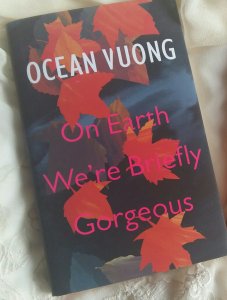
On Earth We’re Briefly Gorgeous is a letter from a son to a mother who cannot read. Written when the speaker, Little Dog, is in his late twenties, the letter unearths a family’s history that began before he was born – a history whose epicentre is rooted in Vietnam – and serves as a doorway into parts of his life his mother has never known, all of it leading to an unforgettable revelation.

At once a witness to the fraught yet undeniable love between a single mother and her son, it is also a brutally honest exploration of race, class, and masculinity. Asking questions central to our American moment, immersed as we are in addiction, violence, and trauma, but undergirded by compassion and tenderness, On Earth We’re Briefly Gorgeous is as much about the power of telling one’s own story as it is about the obliterating silence of not being heard.

With stunning urgency and grace, Ocean Vuong writes of people caught between disparate worlds, and asks how we heal and rescue one another without forsaking who we are. The question of how to survive, and how to make of it a kind of joy, powers the most important debut novel of many years.

Format: Hardcover (256 pages)      Publisher: Jonathan Cape
Publication date:  4th June 2019   Genre: Literary fiction

Find On Earth We’re Briefly Gorgeous on Goodreads

Purchase links*
Amazon.co.uk | Amazon.com | Hive (supporting UK bookshops)
*links provided for convenience, not as part of any affiliate programme


My Review

They say nothing lasts forever and I’m writing to you in the voice of an endangered species.’

As a letter written to someone who may never read it (his illiterate mother, Rose) the whole book has a confessional quality. It’s just as much an un-burdening as an attempt at communication. Indeed, at one point, Little Dog writes, ‘the very impossibility of your reading this is all that makes my telling it possible’.

Amongst Little Dog’s memories of his childhood are happy ones such as trips to the shopping mall with his mother but also her acts of occasional cruelty towards him. Both his mother and grandmother, Lan, bear the psychological scars of their experiences during the Vietnam War. In the case of his mother, this is manifested in a desire to make her son more American. Often her attempts to achieve this are quite bizarre such as her insistence that he consume large quantities of milk to build him up physically, ‘both of us hoping the whiteness vanishing into me would make more of a yellow boy’. Unfortunately, Little Dog still experiences bullying by his schoolmates because of his ethnicity and less than perfect knowledge of English.

In fact, Little Dog finds himself caught between two worlds as far as language is concerned. His English may be rudimentary to begin with but it is better than his mother’s, which is almost non-existent, and he appoints himself the family’s interpreter. At the same time, his knowledge of Vietnamese is limited by his mother’s poor education, interrupted by war. ‘Our mother tongue, then is no mother at all – but an orphan.’ He learns, however, that in Vietnam not everything that needs to be communicated has to be spoken. Non-verbal gestures can convey just as much. ‘Care and love, for us, are pronounced clearest through service.’ The reader sees this played out through Little Dog’s tending of his grandmother.

Readers should be aware the book contains graphic descriptions of a sexual nature and one scene involving animal cruelty. However, there are also poignant moments of tenderness such as Little Dog gathering flowers for his grandmother and his mother giving a pedicure to an old lady.

As the author is a poet, it’s no surprise the book contains some striking imagery. Travelling by Greyhound bus through the night, Little Dog observes the outside ‘surge by like sideways gravity’. Lying on the ground alongside a friend, he compares the stars in the night sky to ‘a vast smudge on a hastily-wiped chalkboard’.

A sort of literary kaleidoscope, the book embraces a number of different styles. One chapter near the end resembles poetry with paragraphs containing seemingly random thoughts. At the same time, there are sections in which Little Dog talks about events as if he was a witness to them rather than a participant, referring to himself as ‘the boy’. There are sections which impart information on subjects as diverse as the migration habits of butterflies, the golfer Tiger Woods and the scourge of painkiller addiction in the US.

As an aspiring writer, Little Dog spends quite a bit of time considering the nature of writing and language. (One suspects much of this reflects the author’s own point of view.) For example, pondering what it means to be a writer he protests, ‘I never wanted to build a “body” of work, but to preserve these, our bodies, breathing and unaccounted for, inside the work’. For Little Dog, even punctuation has meaning beyond merely its grammatical purpose. Learning of the death of a friend, he observes ‘the saddest thing in the world…a comma forced to be a period’ (or as we would say in the UK, a full stop).

Storytelling is another theme and the way in which tales are passed from one person to another, often changed in the retelling. The nail salon where his mother works, for example, is ‘a place where folklore, rumours, tall tales, and jokes from the old country are told, expanded…’.

As well as the story of a family, On Earth We’re Briefly Gorgeous is an exploration of identity, race, sexuality and the legacy of war. It contains some complex ideas (including references to the work of Roland Barthes which gave me flashbacks to my MA English study and my struggle to grasp the concept of intertextuality) meaning it is by no means an easy read. However, it’s a book of startling literary imagination and originality.

In three words: Reflective, complex, thought-provoking

Try something similar: The Long Take by Robin Robertson

Follow my blog via Bloglovin


Ocean-VuongAbout the Author

Ocean Vuong is the author of the critically acclaimed poetry collection Night Sky with Exit Wounds, winner of the Whiting Award and the T.S. Eliot Prize. His writings have also been featured in The AtlanticHarper’sThe NationNew Republic, The New Yorker, and The New York Times. In 2019 he was awarded a MacArthur Foundation Fellowship.

Born in Saigon, Vietnam, he currently lives in Northampton, Massachusetts, where he serves as an Assistant Professor of English at UMass-Amherst. On Earth We’re Briefly Gorgeous is his first novel. (Photo credit: Tom Hines/Dylan Thomas Prize website)