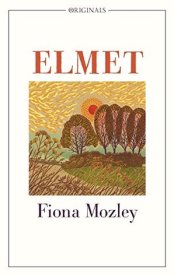
#BookReview Elmet by Fiona Mozley

ElmetAbout the Book

Daniel is heading north. He is looking for someone. The simplicity of his early life with Daddy and Cathy has turned sour and fearful. They lived apart in the house that Daddy built for them with his bare hands. They foraged and hunted. When they were younger, Daniel and Cathy had gone to school. But they were not like the other children then, and they were even less like them now. Sometimes Daddy disappeared, and would return with a rage in his eyes. But when he was at home he was at peace. He told them that the little copse in Elmet was theirs alone. But that wasn’t true. Local men, greedy and watchful, began to circle like vultures. All the while, the terrible violence in Daddy grew.

Format: ebook (320 pages)            Publisher: John Murray
Publication date: 27th July 2017 Genre: Contemporary Fiction, Literary Fiction

Find Elmet on Goodreads

Purchase links
Bookshop.org
Disclosure: If you buy a book via the above link, I may earn a commission from Bookshop.org, whose fees support independent bookshops

Hive | Amazon UK
Links provided for convenience only, not as part of an affiliate programme


My Review

Elmet is the story of two children – Daniel and Cathy – who live with their father in a house in a forest, largely apart from the rest of society.  It’s a strange, rather spartan life in which their father seeks to keep them separate from the world but also to protect them from some undisclosed danger. As fourteen-year-old Daniel, the book’s narrator, says, ‘Everything he did now was to toughen us up against something unseen. He wanted to strengthen us against the dark things in the world.’  Despite their very basic lifestyle and lack of creature comforts, the two children have a strong bond with their father.   ‘Cathy and I did not mind taking orders from Daddy. Sometimes we were more like an army than a family and he was not the type of leader to make you do anything for nothing.’

An interesting aspect of the children’s upbringing is the way it has blurred, even removed, gender distinctions.  As Daniel observes, ‘You have to appreciate that I never thought of myself as a man. I did not even think of myself as a boy… It is not as if I had ever actively rejected that designation. I just never thought about it. I lived with my sister and my father and they were my whole world. I did not think of Cathy as a girl nor a woman, I thought of her as Cathy. I did not think of Daddy as a man, though I knew that he was. I thought about him, likewise, as Daddy.’ 

Whilst an intense and, at times, disturbing read, I liked the way the author introduced themes such as concern for the environment.  In contrast to the local landowner, who regards the land merely as a source of profit, the children’s father carefully tends the forest and teaches his children the skills to do the same.  ‘In order to let new growth fight through, overhanging branches, crumbled bark and fallen trees must be cleared. Weeds in the undergrowth must be managed. The right shoots must be let through and the wrong ones discouraged.’  Much like indigenous people in other parts of the world, the children’s father cannot understand the concept of ownership of land. “It’s idea a person can write summat on a bit of paper about a piece of land that lives and breathes, and changes and quakes and floods and dries, and that that person can use it as he will, or not at all, and that he can keep others off it, all because of a piece of paper.”

When resistance grows to the landowners who wield power over the local community, the stakes are raised and events take a dark turn. As one of the leaders of the resistance, the children’s father becomes a target for retaliation of the most brutal kind and the children’s ability to respond to ‘the dark things in the world’ for which their father has prepared them is finally put to the test.

I received an advance review copy courtesy of John Murray via NetGalley.

In three words: Dark, chilling, unsettling

Try something similar: The Wanderers by Tim Pears

Follow this blog via Bloglovin


Fiona Mozley authorAbout the Author

Fiona Mozley grew up in York and lives in Edinburgh. Her first novel, Elmet, won a Somerset Maugham Award and the Polari Prize. It was shortlisted for the Man Booker Prize and the Royal Society of Literature Ondaatje Prize, and longlisted for the Women’s Prize for Fiction, the Dublin Literary Award and the International Dylan Thomas Prize. In 2018 Fiona Mozley was shortlisted for the Sunday Times/PFD Young Writer of the Year Award. (Photo/bio credit: Publisher author page)

Connect with Fiona
Twitter

#BookReview The Bitch by Pilar Quintana @WorldEdBooks

20200724_093255-1About the Book

Colombia’s Pacific coast, where everyday life entails warding off the brutal forces of nature. In this constant struggle, nothing is taken for granted. Damaris lives with her fisherman husband in a shack on a bluff overlooking the sea. Childless and at that age “when women dry up”, as her uncle puts it, she is eager to adopt an orphaned puppy. But this act may bring more than just affection into her home.

Beauty and dread live side by side in this poignant exploration of the many meanings of motherhood and love.

Format: Paperback (160 pages)       Publisher: World Editions
Publication date: 6th August 2020 Genre: Literary fiction, literature in translation

Find The Bitch on Goodreads

Purchase links*
Amazon UK | Hive (supporting UK bookshops)
*links provided for convenience not as part of an affiliate programme


My Review

The publishers describe The Bitch as being written in ‘terse prose’ and, in one of the cover quotations, Colombian writer Juan Gabriel Vasquez characterizes the prose as ‘no-nonsense’. I can only agree, as the writing in this slim novel, translated from the Spanish by Lisa Dillman, contains few literary flourishes. That doesn’t mean, however, that the writing lacks power.

I particularly liked the way the author makes the jungle that surrounds the shack in which Damaris and her husband live seem like a character in its own right. Damaris recalls a childhood journey alone through the jungle: ‘The treetops above her formed a solid canopy, and the roots below snarled together. Her feet sank into the dead leaves carpeting the ground and got buried in the mud, and she began to feel like the breathing she could hear was not her own but that of the jungle…’ Later in the book, she faces the prospect of venturing out at night. ‘Before her lay nothing but jungle, still as a beast that’s just swallowed its prey”. In truth, the jungle does indeed harbour very real dangers – venomous snakes and insects.

The Bitch is the third book I’ve read set in Colombia. The first two were The Existence of Pity by Jeannie Zokan and A Reluctant Warrior by Kelly Brooke Nicholls. The latter especially featured the drugs trade as part of its storyline. And, as it happens, later this week I’ll be taking part in the blog tour for Son of Escobar: First Born, a book by the son of notorious drug baron, Pablo Escobar, who controlled eighty per cent of the global cocaine trade before he was shot dead in 1993.

The Bitch portrays another side of Colombia, not necessarily a more attractive side, but one which probably challenges many commonly-held perceptions about the country. Through the experiences of Damaris, it provides an insight into the everyday lives of the ordinary people of Colombia. At times, it was only the mention of cell phones that reminded me the book is set in the present day, so basic are the conditions in which Damaris and her husband, Rogelio, live.

I was struck by the contrast between the ‘big, beautiful weekend homes with gardens, paved walkways and swimming pools’ which Damaris and Rogelio are employed to look after for their absent owners and their own home. ‘The shack where they lived was made of wood and in bad shape. When a storm hit, the whole place shook in the thunder and rocked in the wind, water leaked through the roof and came in through the gaps between wall slats.’

As the book reveals, there’s not just an economic divide but a social one as well. When Damaris and her relatives use the pool of one of the houses one afternoon, she thinks to herself, ‘Nobody would ever mistake them for the owners. A band of poor, badly dressed black folks using rich people’s things’.

It’s difficult not to feel sympathy for Damaris, despite some of the actions she takes towards the end of the book. Her inability to have a child leaves her feeling ‘crushed and inadequate, a disgrace as a woman, a freak of nature’. She also harbours a sense of guilt at her failure as a young girl to prevent a tragedy; so much so that she feels she somehow deserves the hardships and disappointments in her life. That, if anything, these are not punishment enough. When further misfortunes are visited on the same family, she fears they will see her as ‘a black crow, a sign of bad luck’.

Initially devoted to the dog she adopts, which she names Chirli for the daughter she never had, Damaris becomes frustrated and angry when the dog continually misbehaves and runs away. Having drifted apart in recent years, for a brief time the relationship between Rogelio and Damaris is rekindled when he joins her in the search for the dog. Sadly, this is short-lived. Later, the dog’s return acts as a troubling reminder of what has been missing from Damaris’s life. Her disappointment will eventually turn to horror and provoke a rather shocking act of despair and desperation.

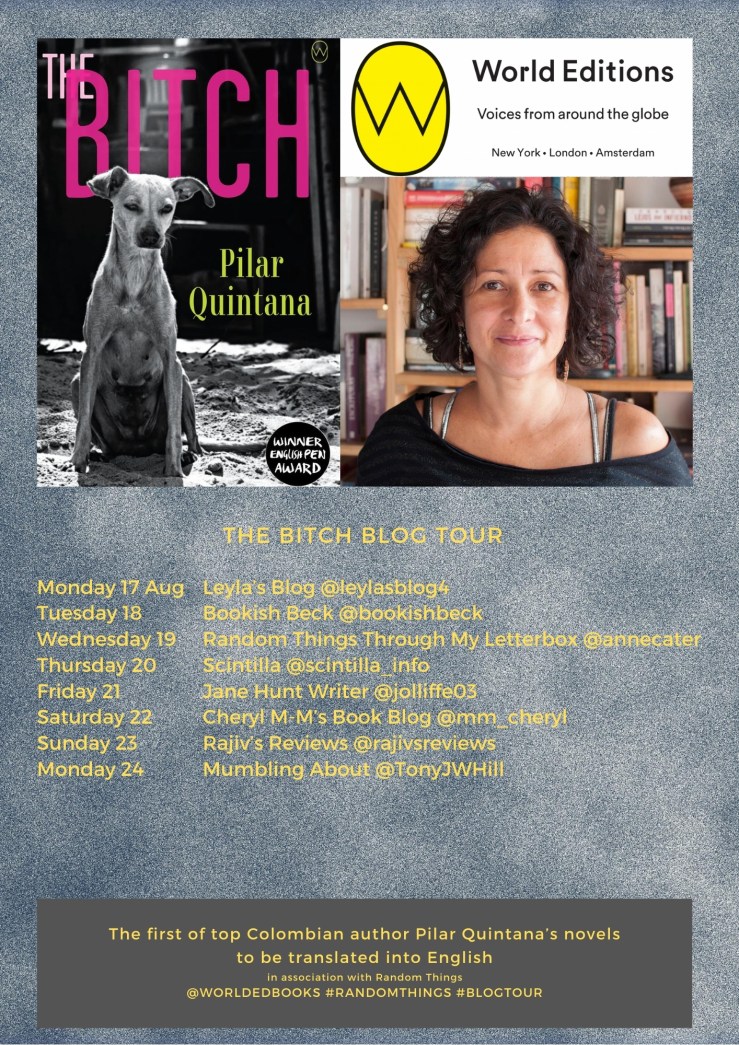
I can’t say I found The Bitch an easy read but it certainly provided an insight into a part of the world about which I knew very little. To mark its publication, the book has recently been on tour. Check out the banner at the bottom of this post to see the bloggers who took part.

A final word about the publishers, World Editions. Not only do I admire their championing of translated literature but also that, as well as providing biographical information about the authors and translators of the books they publish, they also include details about the typography and cover designs. Which means, for instance, you get to find out how the cover image for The Bitch came about.

My thanks to World Editions for my advance review copy.

In three words: Dark, atmospheric, unflinching

Follow this blog via Bloglovin


About the Author

Pilar Quintana is a Colombian author. She debuted with Cosquillas en la lengua in 2003, and published Coleccionistas de polvos raros in 2007, the same year the Hay Festival selected her as one of the most promising young authors in Latin America. Her latest novel, The Bitch, won the prestigious Colombian Biblioteca de Narrativa Prize, and was selected for several Best Books of 2017 lists, as well as being chosen as one of the most valuable objects to preserve for future generations in a marble time capsule in Bogotá. The Bitch is the first of her works to be translated into English.

Connect with Pilar
Website | Twitter

About the Translator

Lisa Dillman lives in Georgia, USA, where she translates Spanish, Catalan and Latin American writers and teaches at Emory University. Some of her recent translations include Such Small Hands (winner of the 2018 Oxford-Weidenfeld Translation Award) by Andrés Barba; Signs Preceding the End of the World (winner of the 2016 Best Translated Book Award), Kingdom Cons, and The Transmigration of Bodies (shortlisted for the 2018 Dublin Literary Award) by Yuri Herrera,; and Breathing Through the Wound and A Million Drops by Víctor del Árbol.

The-Bitch-Blog-Tour-Poster