
 Welcome to today’s stop on the blog tour for Late City by Robert Olen Butler. My thanks to Anne at Random Things Tours for inviting me to take part in the tour and to No Exit Press for my digital review copy.
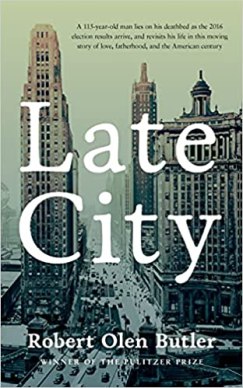 About the Book
A visionary and poignant novel centered around former newspaperman Sam Cunningham as he prepares to die, Late City covers much of the early twentieth century, unfurling as a conversation between the dying man and a surprising God.
As the two review Sam’s life, from his childhood in the American South and his time in the French trenches during World War I to his fledgling newspaper career in Chicago in the Roaring Twenties and the decades that follow, snippets of history are brought sharply into focus.
Sam grows up in Louisiana, with a harsh father, who he comes to resent both for his physical abuse and for what Sam eventually perceives as his flawed morality. Eager to escape and prove himself, Sam enlists in the army as a sniper while still underage. The hardness his father instilled in him helps him make it out of World War I alive, but, as he recounts these tales on his deathbed, we come to realize that it also prevents him from contending with the emotional wounds of war.
Back in the U.S., Sam moves to Chicago to begin a career as a newspaperman that will bring him close to all the major historical turns of the twentieth century. There he meets his wife and has a son, whose fate counters Sam’s at almost every turn.
As he contemplates his relationships – with his parents, his brothers in arms, his wife, his editor, and most importantly, his son – Sam is amazed at what he still has left to learn about himself after all these years in this heart-rending novel from the Pulitzer Prize winner.
Format: Paperback (256 pages) Publisher: No Exit Press
Publication date: 27th January 2022 Genre: Literary Fiction
Find Late City on Goodreads
Purchase links
Bookshop.org
Disclosure: If you buy a book via the above link, I may earn a commission from Bookshop.org, whose fees support independent bookshops
Publisher | Hive | Amazon UK
Links provided for convenience only, not as part of an affiliate programme
My Review
I read and thoroughly enjoyed Paris in the Dark, the fourth book in the author’s Christopher Marlowe Cobb historical crime series, in 2018. Late City is an entirely different kind of book but one I absolutely loved.
The book could have been a straightforward fictional story of a man’s life, albeit one that has spanned over a century, but what sets it apart is how the story is structured as a conversation between Sam and a figure representing God. The God of Late City is not only omniscient but understands sarcasm and can even take, or make, a joke. ‘Listen, Sam. A lot of stuff that tries to pass for my voice is just humans tweeting in all caps in the middle of the night.’ Offering Sam by turns sympathy, encouragement or gentle rebuke, God acts as a combination of guide, judge and therapist.
God’s stipulation is that Sam may not have foreknowledge so Sam’s experience is not so much reminiscence as a reliving of events in his life. It’s akin to real-time reporting, reflecting Sam’s career as a journalist. God refers to Sam’s reliving of events as the Cunningham Examiner, the late city edition of the title, explaining. ‘You put it all in the story by today’s deadline and tomorrow you wait for further developments.’ Occasionally events in Sam’s life are rendered in the form of newspaper headlines. One gets the sense that the purpose is not for Sam to obtain God’s forgiveness but to allow Sam a way to forgive himself for things he did, things he failed to do or things he failed to say.
As is evident from the book description, Sam is a participant in, or a Forrest Gump-like witness to, many significant historical events and has first-hand encounters with historical figures such as Al Capone. The book illustrates the malign influence that can be wielded by those in positions of power. (The author may have a modern day example in mind given the event that opens the book.) There’s also a message about the importance of standing up for causes you believe to be right, whatever the cost. As God says (and I never thought I’d write that!) ‘Just know that sometimes a bad thing can be shared by multitudes. While for a good thing, there might only be a few of you’.
There are some particularly tender moments between Sam and his son, Ryan, and between Sam and his wife, Colleen and I loved the way these relationships were explored. By the end of the book, Sam has come to understand what’s really important in life and also had revealed to him ‘untold stories’ about those close to him, things he never knew but perhaps should have done if he’d only listened more, been present more. As God explains, ‘There are some stories waiting for you, written for the Cunningham Examiner. But they never appeared. Never made it as far as your editor-in chief’s desk.’ Coming to terms with the revelations in these stories requires a tolerance that was sadly lacking in society when Sam was growing up but it results in him finally realising how a small act can bring solace to another human being when it really matters.
I thought Late City was a beautifully written and thought-provoking book and I’ll freely admit the ending moved me to tears.
In three words: Poignant, insightful, moving
Try something similar: Stoner by John Williams
Follow this blog via Bloglovin
 About the Author
Robert Olen Butler is the Pulitzer Prize-winning author of A Good Scent from a Strange Mountain, and seventeen other novels including Hell, A Small Hotel, Perfume River & the Christopher Marlowe Cobb series. He is also the author of six short story collections and a book on the creative process, From Where You Dream.
He has twice won a National Magazine Award in Fiction and received the 2013 F. Scott Fitzgerald Award for Outstanding Achievement in American Literature. He teaches creative writing at Florida State University.
Connect with Robert
Website | Twitter | Goodreads

 About the Book
 About the Author

