
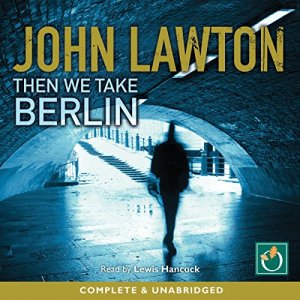
 About the Book
John Holderness, known to most as ‘Wilderness’, comes of age during World War II in Stepney, breaking into houses with his grandfather.
After the war, Wilderness is recruited as MI5’s resident ‘cat burglar’ and finds himself in Berlin, involved with schemes in the booming black market that put both him and his relationships in danger.
In 1963 it is a most unusual and lucrative request that persuades Wilderness to return – to smuggle someone under the Berlin Wall and out of East Germany. But this final scheme may prove to be one challenge too far…
Format: Audiobook (15h 16m) Publisher: Oakhill Publishing
Publication date: 2014 Genre: Historical Fiction, Thriller
Find Then We Take Berlin (Joe Wilderness, #1) on Goodreads
Purchase links*
Amazon UK| Hive (supporting UK bookshops)
*links provided for convenience not as part of an affiliate programme
My Review
I was first introduced to the books of John Lawton when I read Friends and Traitors, part of his Inspector Troy series. As seems to be my habit, I came to the series late (it is the eighth book in the series) and I’ve been meaning to catch up with earlier books ever since. So when I came across Hammer To Fall, the third book in his Joe Wilderness series, on Readers First and was fortunate enough to win a copy, I was determined not to make the same mistake. I spotted a copy of the second book, The Unfortunate Englishman, in my local Oxfam bookshop and used an Audible credit to purchase this book so I could start the series from the beginning.
The first thing I would say is I think the blurb on Goodreads reveals way too much of the plot so the book description above is a much shorter version from Amazon. And, although I enjoyed Then We Take Berlin, I wasn’t entirely a fan of its structure. At times, it seemed like (at least) three different books all rolled into one. (I see I made a similar comment in my review of Friends and Traitors.)
Then We Take Berlin opens in 1963 as Joe Holderness travels to New York to be offered a job by a colleague of Frank, a buddy from his days in Berlin after WW2. I enjoyed Joe’s wide-eyed reaction to seeing the sights of New York for the first time. The job he’s offered will involve him returning to Berlin and making use of his knowledge of that city. However, it will be a long time before the reader learns more about what Frank and Joe got up to in post-war Berlin and even longer until the mission Joe is offered takes place.
Instead the book goes back in time to 1941 to reveal Joe’s wartime childhood, including his experiences at the hands of a violent father. Events occur which mean Joe is brought up by his grandfather, Abner, and Abner’s girlfriend, Merle. It’s during this time that Joe is tutored in the dubious skills that will prove to be of such value in the future. Later, after the war has ended, he’s called up for National Service and Joe’s facility with languages is spotted by the British Secret Service. The result sees him embark upon an entirely different kind of education.
Then in what I thought was one of the most powerful sections of the book, the story moves to Germany and introduces a new character – Nell. Evacuated during the war from her home in Berlin to live with her uncle, the end of the war brings her by chance to the site of a wartime atrocity. Using her powers of persuasion and a few untruths, she gains work as an interpreter for the Allied forces and begins documenting the identities of survivors. She is nevertheless determined to return home to Berlin because, as she frequently says, “I am a Berliner”.
Eventually the story of Joe’s exploits in post-war Berlin takes centre stage as he and some comrades with connections in the right places take advantage of the flourishing black market. But have they got in over their heads? There’s an impressive amount of detail about the Berlin of the time which is clearly the product of a lot of research.
As the book reaches its climax we’re back in the year 1963 and Joe finally undertakes, albeit with reservations, the job he’s been contracted to do. Events move along at pace and woven into the story is an iconic moment in history that takes place in West Berlin. The author gives Nell a pivotal role in this, as signalled in the opening chapter. The last few chapters of the book are full of tension and the ending leaves enough loose ends to make a sequel irresistible.
Although only around 400 pages, the book has a lot of chapters, many of which are extremely short. Having taken a quick peek at my copy of The Unfortunate Englishman, I see that it also has many short chapters so this must be a deliberate style choice on the part of the author. The audiobook version has over two hundred chapters and I’m guessing its narrator, Lewis Hancock, must have been pleased when it was finally time to say “Chapter 206”. Talking of the narration, Lewis Hancock does a great job coping with the different accents required – Russian, German, American, etc. – although I did have difficulty at times recognising it was Nell speaking.
Then We Take Berlin is an entertaining spy thriller with a charismatic central character and, despite my reservations about its structure, I definitely intend to read the next two books in the series at some point.
In three words: Intricate, intriguing, atmospheric
Try something similar: The Swiss Spy by Alex Gerlis
Follow this blog via Bloglovin
About the Author
John Lawton is a producer/director in television who has spent much of his time interpreting the USA to the English, and occasionally vice versa. He has worked with Gore Vidal, Neil Simon, Scott Turow, Noam Chomsky, Fay Weldon, Harold Pinter and Kathy Acker. He thinks he may well be the only TV director ever to be named in a Parliamentary Bill in the British House of Lords as an offender against taste and balance. He has also been denounced from the pulpit in Mississippi as a `Communist,’ but thinks that less remarkable.
He spent most of the 90s in New York – among other things attending the writers’ sessions at The Actors’ Studio under Norman Mailer – and has visited or worked in more than half the 50 states. Since 2000 he has lived in the high, wet hills of Derbyshire England, with frequent excursions into the high, dry hills of Arizona and Italy.
He is the author of 1963, a social and political history of the Kennedy-Macmillan years, eight thrillers in the Troy series and a stand-alone novel, Sweet Sunday. In 1995 the first Troy novel, Black Out, won the WH Smith Fresh Talent Award. In 2006 Columbia Pictures bought the fourth Troy novel Riptide. In 2007 A Little White Death was a New York Times notable.
In 2008 he was one of only half a dozen living English writers to be named in the London Daily Telegraph‘s`50 Crime Writers to Read before You Die.’ He has also edited the poetry of DH Lawrence and the stories of Joseph Conrad. He is devoted to the work of Franz Schubert, Cormac McCarthy, Art Tatum and Barbara Gowdy. (Bio credit: Publisher author page)
Connect with John
Website | Goodreads

 About the Book
 What Cathy Read Next...