
 About the Book
A naive young woman at the mercy of her ambitious family.
At just nineteen, Katheryn Howard is quick to trust and fall in love. She comes to court. She sings, she dances. She captures the heart of the King. Henry declares she is his rose without a thorn. But Katheryn has a past of which he knows nothing. It comes back increasingly to haunt her. For those who share her secrets are waiting in the shadows, whispering words of love… and blackmail.
Format: ebook (478 pages) Publisher: Headline
Publication date: 6th August 2020 Genre: Historical Fiction
Find Katheryn Howard: The Tainted Queen (Six Tudor Queens, #5) on Goodreads
Purchase links*
Amazon UK | Hive (supporting UK bookshops)
*links provided for convenience not as part of an affiliate programme
My Review
Katheryn Howard: The Tainted Queen is the fifth book in Alison Weir’s Six Tudor Queens series. I’ve read all the previous books with the exception of Anna of Kleve which is patiently waiting on my bookshelf. Perhaps conscious of previous criticism, Alison Weir writes in her Author’s Note, “Apart from fictionalising the historical record, I have invented very little.” The result is a convincing account of the character traits and events that led to Katheryn Howard’s tragic end.
Written in the first person, the reader gets a picture of a naive young woman who lacks the awareness or guidance to realise how the foolish mistakes she makes whilst in the household of the Duchess of Norfolk will come back to haunt her. The author depicts a surprisingly licentious atmosphere amongst the young men and women of the household with frequent midnight “feasts” that don’t only involve food. Katheryn is drawn into this activity, conducting affairs with firstly her music tutor and then with Francis Dereham. If the book is an accurate reflection of the amount of sexual activity taking place, given the primitive methods of contraception available it’s surprising no pregnancies ensued.
I confess I struggled to maintain my interest in this section of the book with its accounts of nightly youthful indiscretions. And I found some of the writing rather laughable. Examples such as “Pulling down his hose, he entered her and rode her like a stallion” or “For answer, he took her hand and guided it inside his codpiece”. However, during this period an important exchange takes place between Katheryn and Francis, the effect of which will prove pivotal later.
Because of her youth and beauty, Katheryn becomes a valuable pawn in the hands of her Howard relatives, who seek both power and the restoration of the Catholic faith. She is dangled in front of the King in an effort to encourage him to divorce Anna of Kleve. Katheryn goes along with this out of gratitude to them for rescuing her from a life of relative poverty and because she is dazzled by the thought of becoming queen. “The prospect thrilled her, colouring everything else.” The idea of being shown deference, wearing gorgeous clothes and jewellery, living in splendid palaces, having servants dancing attendance on her and obeying her every whim is irresistible. I could actually see how the opulence of court life would turn a young girl’s head. Despite her disappointment at her first sight of the now ageing and obese Henry, she concludes: “She could do it if she had to. For the first time, she knew herself to be as ambitious as the rest of her family. If submitting to the King’s desires was the price of her elevation, she would pay it.”
Although Henry’s eagerness to marry Katheryn is undoubtedly driven by lust and the need to secure the succession, in the author’s hands the reader sees a real tenderness develop between the two. For me, this part of the book, describing the relationship between Katheryn and Henry, and detailing daily life at Court or whilst on progress around the country was one of the most fascinating and compelling.
Despite everything she has achieved, the King’s obvious devotion to her and the example set by the demise of Anne Boleyn, Katheryn foolishly sets out on a course of action that will ultimately result in her downfall and death. It left me thinking “You silly, silly girl” especially when she fails to see how she is being manipulated or, at best, being given extremely poor advice.
This is the point where the limitations of the author’s decision to write in the first person become evident. As she herself admits in her Author’s Note, because the reader is never privy to the thoughts of Henry, it is impossible to explore the possibility that he did not want Katheryn to be condemned to death. The author points to signs of his initial leniency, such as the fact she was not sent directly to the Tower of London, arguing that he may have been influenced by reformers on his Council who seized the opportunity to remove a Catholic queen and bring down the Howards in one fell swoop.
One very interesting point Alison Weir makes, which is unknown to Katheryn and therefore to the reader as well – because we only know what she knows – is that she might have saved her life if she had admitted to a pre-contract with Dereham. As Alison explains, “If she had never been the King’s legal wife, she could not be accused of adultery, only bigamy, with the second marriage being rendered invalid. Bigamy was seen as a spiritual offence…it did not become a felony until 1604.” For me, this made the final chapters all the more poignant.
I received an advance review copy courtesy of Headline via NetGalley.
In three words: Detailed, dramatic, moving
Try something similar: Innocent Traitor by Alison Weir
Follow this blog via Bloglovin
 About the Author
Alison Weir is the biggest-selling female historian (and the fifth best-selling historian) in the United Kingdom since records began in 1997. She has published twenty-three titles and sold more than 3 million books – over a million in the UK and 2.2 million in the USA. She is now working on two concurrent series of books: Six Tudor Queens, comprising six novels on the wives of Henry VIII and England’s Medieval Queens, a quartet of historical works of non-fiction.
Connect with Alison
Website | Twitter | Facebook

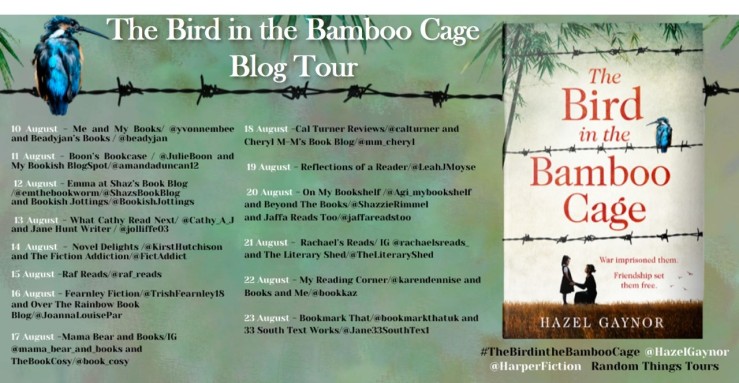 Welcome to today’s stop on the blog tour for The Bird in the Bamboo Cage by Hazel Gaynor. My thanks to Anne at Random Things Tours for inviting me to take part and to HarperCollins for my digital review copy via NetGalley. Do check out the
  About the Book
 About the Author


