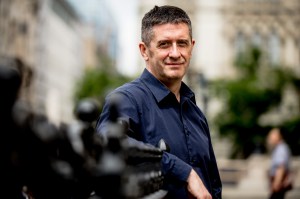
Interview: Zenka by Alison Brodie

In advance of the publication of Zenka on 6th November, I’d hoped to bring you an interview with the lady herself, surely now the most famous Hungarian pole-dancer on the planet. Unfortunately, she declined to be interviewed as did gangland boss, Jack Murray. Luckily, Alison Brodie (who has some influence in these matters) was able to intercede and I’m pleased to say Trevor Stockman, Jack’s accountant and right-hand man, has agreed to give us the unvarnished truth about Zenka.

You can read his exclusive interview below.

Follow my blog with Bloglovin


Zenka_FinalAbout the Book

Ruthless, stubborn and loyal. Zenka is a Hungarian pole-dancer with a dark past.

When cranky London mob boss, Jack Murray, saves her life she vows to become his guardian angel – whether he likes it or not. Happily, she now has easy access to pistols, knuckle-dusters and shotguns.

Jack learns he has a son, Nicholas, a community nurse with a heart of gold. Problem is, Nicholas is a wimp. Zenka takes charge. Using her feminine wiles and gangland contacts, she aims to turn Nicholas into a son any self-respecting crime boss would be proud of. And she succeeds! Nicholas transforms from pussycat to mad dog, falls in love with Zenka, and finds out where the bodies are buried – because he buries them. He’s learning fast that sometimes you have to kill, or be killed.

As his life becomes more terrifying, questions have to be asked: How do you tell a crime boss you don’t want to be his son? And is Zenka really who she says she is?

Praise for Zenka:
‘A riveting read. Powerful. Spicy.’ Midwest Book Review
5* ‘To say I loved this story would be a massive understatement’ Bloggers from Down Under
5* ‘Will warm your heart and chill your bones’ Tome Tender BlogSpot
5* ‘Top of my list for best fiction this year’ Lauren Sapala, WriteCity
5* ‘You won’t be able to put this book down’ Laura Reading
5* ‘Brodie nails it again. Intelligent wit and outstanding writing’ Charlie Elliott, author of Life Unbothered

Format: eBook (299 pp.)                Publisher:
Published: 6th November 2017    Genre: Suspense, Crime, Comedy

Pre-order/Purchase Links*
Amazon.co.uk ǀ Amazon.com
*links provided for convenience, not as part of any affiliate programme

Find Zenka on Goodreads


Interview with Trevor Stockman (as told to Alison Brodie)

Welcome, Trevor. How would you describe the relationship between Jack and Zenka?

Explosive.

Could you elaborate?

They are equally hot-headed and tend to whip each other up into a state of Shakespearian melodrama. When they reach boiling point they slip into their native tongue. Luckily Jack cannot understand Hungarian, and Zenka cannot understand Cockney, or there would be tragedy.

I’m surprised that Jack wanted to be in her company if they were always arguing.

He admires the way she stands up to him. There is no-one else in his life who would dare argue with him. He also takes her advice. He wore rainbow-striped ties until she told him he looked like a pimp. But they also laugh together. I have found them in near hysterics, clutching their stomachs with tears streaming down their faces. Jack makes this strange hooting noise; Zenka squeals. Rather amusing to watch.

Jack was a father figure to Zenka, is that right?

Yes. Zenka made sexual overtures but Jack ignored them. He prefers woman closer to his own age.

How did Jack and Zenka meet?

Zenka’s neighbour sold her to the Romanians.   Jack hates the Romanians and the terrible things they do to girls. When he heard there was a new shipment in, he stormed the place and rescued ten girls, including Zenka.   Jack found jobs for the girls in supermarkets and bakeries. Zenka, though, would not leave Jack’s side and told him she would be his guardian angel.

What was Jack’s response?

He laughed and said to her: “You are only five foot two. How can you guard me?” She replied: “I might be small, but a grenade is also small.”

How would you describe Zenka?

She is the typical stereotype of a Slav. Driven to suicide one moment, deliriously happy the next. And, of course, passionate.

Where did Zenka learn to pole-dance?

She didn’t.

She claims she is the star performer in the Gentlemen’s Room?

She isn’t.

She wears wigs on stage, is that correct?

Yes. She has an inexhaustible supply, all in the most bizarre colours.

She plays the violin. That must be wonderful, listening to all those passionate Hungarian folk tunes.

No comment.

Why do you think Jack and Zenka refused to be interviewed today?

I think they must have had a falling out. But I don’t know why.

Well, that’s it from me. Thank you for coming in, Trevor.


AlisonBrodieAbout the Author

Alison Brodie is a Scot, with French Huguenot ancestors on her mother’s side. She is a writer and animal rights activist. Her books have been published in hardback and paperback by Hodder & Stoughton (UK), Heyne (Germany) and Unieboek (Holland). Alison is now a self-publisher.

Connect with Alison

Website ǀ Facebook ǀ Twitter ǀ Goodreads

Guest Post: ‘History Won The Day’ by Apple Gidley, author of Fireburn

What an exciting day your book’s birthday must be – especially when it’s your first novel! So I’m thrilled to help celebrate the publication today of Fireburn and to welcome its author, Apple Gidley, to What Cathy Read Next.  

When Apple contacted me about adding her book to my review stack, she only had to mention ‘historical fiction’ and ‘set in the Caribbean’ before I was sold.  Regrettably, I haven’t yet been able to read Fireburn. In the meantime, I’m delighted that Apple has agreed to talk about the book – its inspiration, and the process of research and character development. You can find her guest post, ‘History Won The Day’, below.

Follow my blog with Bloglovin


FireburnAbout the Book

The Danish-owned island of 1870s Saint Croix vibrates with passion and tension as Anna Clausen, a young Anglo-Danish woman, returns to her childhood home after her mother’s death. Her heart sinks at what she finds on arrival. Her father is ailing and desolate and her beloved plantation, Anna’s Fancy, which has been in the Clausen family for three generations, is in shambles. The unwelcome lust of one man and forbidden love for another makes Anna’s return to Saint Croix even more turbulent. Despite the decline in the sugar industry, she is determined to retain Anna’s Fancy but must first win the trust of her field workers, of Sampson the foreman, and the grudging respect of Emiline the cook and local weed woman.

Fireburn tells of the horrors of a little-known, bloody period of Caribbean history. Anna weathers personal heartache as she challenges the conventions of the day, the hostility of the predominantly male landowners and survives the worker rebellion of 1878, 30 years after Emancipation.

Praise for Fireburn

“Rich in description, Fireburn is a well-researched novel that shines a light on a historic period in St. Croix that has received little attention in literature until now.” (Gillian Royes, author of The Goat Woman of Largo Bay)

“Gidley is a skilful and assured story-teller, unafraid to take on complexities of race, class and gender, while at the same time creating unforgettable characters and a story that kept me reading deep into the night.” (Matthew Parker, author of The Sugar Barons)

Format: ebook (309 pp.), Paperback (354 pp.)     Publisher: Author
Published: 1st October 2017                                     Genre: Historical Fiction

Purchase Links*
Amazon.co.uk ǀ Amazon.com ǀ Kobo
*links provided for convenience, not as part of any affiliate programme

Find Fireburn on Goodreads


 Guest Post: ‘History Won The Day’ by Apple Gidley, author of Fireburn

Job descriptions over the years have been a nebulous affair. A few have been self explanatory – secretary, interior designer, honorary consul – but most have involved a myriad of roles which defied one definition. Then about ten years ago I started filling in those inquisitive government forms asking for job title with the word ‘writer’. I felt a fraud until my first book was published in 2012. Expat Life Slice by Slice was just that – a memoir of a global life.  Fiction though has always tempted me – whether reading or writing. To be taken out of our day-to-day life and invited into someone else’s is escapism of the most reverent kind.

Fireburn is an historical novel set in the Danish West Indies, now the US Virgin Islands. The seed of the story was sown as I listened to local dignitaries talk about the then upcoming celebrations for the centennial of American rule in 2017. What, I wondered, was life like on St Croix in the lead up to the sale?  I would write about the 20 or so years prior to the transfer in 1917. It would be a story about life on a plantation dealing with the by then less-than-lucrative sugar industry. It would be told in a couple of voices and would catalogue the changing times on an island whose lingua franca has been predominantly English despite having flown under seven flags. The main character would be a white landowner, with the secondary voice being a black foreman.

Then I started the research.

I studied the architecture, the food, the clothing, speech and living habits. Glimpsing life through the eyes of Danes stationed on the island – school teachers, soldiers and sailors, planters and businessmen – as they wrote to their families and superiors back in Denmark, sent me further back in time. I read old accounts and modern takes on history, pored over records of slave ownership.  I learnt Governor Von Scholten might have emancipated the slaves in 1848 but life did not improve for the newly free, and in some ways worsened.

Then I came across ‘fireburn’ – a violent though short-lived worker rebellion in 1878, also known as the Great Trashing.  And there it was – the event around which my timeline would revolve, with the actual transfer from Danish to US ownership being the full stop on the story.

Women are traditionally the glue in the family, on an estate, in a village, and the more I researched the more I wanted strong female characters. Anna was born: an Anglo-Danish woman returning to the island to rejoin her ailing father on the family sugar plantation after an absence of ten years. No woman in those days would travel without a companion/chaperone, so Ivy, her English lady’s maid, insinuated herself into the picture and became instrumental in discussing issues of race and class. I needed a black voice as counterbalance and Emiline, the cantankerous estate cook and local weed woman, was introduced and quickly became a favourite. Who doesn’t like a bolshy woman?

But a story needs tension, so death, an unpleasant man and, of course, ‘fireburn’ were woven in. Writing proceeded apace, with good days and bad days and worse days, though the characters saw me through. Anna, Ivy and Emiline lived with me. They talked and I listened. How, Anna asked, could I properly describe the terror invoked by inflamed workers as they stormed the fort in Frederiksted if she was not there to witness it? Regurgitated stories are not nearly so dramatic as first-hand accounts. I needed a man.

Sampson, the black foreman, was given his voice back. And, as so often happens when someone is given a role, he became ever-more important until he was writing his own script. ‘Fireburn’, the event, was integral to a change in Danish policy, but it had just as much impact on the day-to-day lives of those living at Anna’s Fancy.  In the interests of brevity and cohesion, the timeline was abruptly cut to the early 1890s when a natural ending occurred to the characters. ‘Fireburn’ became the focus and the transfer could wait for the sequel.

History had won.

Thank you, Apple.  I love learning about the evolution of a book from initial idea to finished work and this has made me even more impatient for Fireburn to reach the top of my review pile.  Plus, now I’m excited that there might be a sequel as well.   


AppleGidleyAbout the Author

Apple Gidley is an Anglo-Australian author whose life has been spent absorbing countries and cultures so considers herself a global nomad. She currently divides her time between Houston, Texas and St Croix, in the US Virgin Islands. She has moved 26 times and has called twelve countries home (Nigeria, England, Malaysia, Singapore, Australia, Papua New Guinea, The Netherlands, Trinidad and Tobago, Thailand, Scotland, USA, Equatorial Guinea). Her experiences are described in her first book, Expat Life Slice by Slice.

Her roles have been varied – from magazine editor to intercultural trainer, from interior designer to Her Britannic Majesty’s Honorary Consul. Now writing full time, Apple evocatively portrays peoples and places with empathy and humour, whether writing travel articles, blogs, short stories or full-length fiction. Her first novel, Fireburn, set in the Danish West Indies of the 1870s, will be launched on October 1st, 2017 (OC Publishing).

Connect with Apple

Website ǀ Facebook ǀ Blog ǀ Twitter ǀ Goodreads