

I’m delighted to host today’s stop on the blog tour for District VIII, by Adam LeBor and to bring you a fascinating article by Adam about the inspiration for the book, the first volume in his ‘Budapest noir’ crime series.
 About the Book
Life’s tough for a Gypsy cop in Budapest. The cops don’t trust you because you’re a Gypsy. Your fellow Gypsies, even your own family, shun you because you’re a cop.
The dead, however, don’t care.
Balthazar Kovacs of the Budapest murder squad is in the middle of his first cup of coffee when a mysterious text message arrives. There were three words: ’26, Republic Square’, and a photograph. The photo shows a man in his early thirties, lying on his back with his eyes open, half-covered by bricks and dust. The address, the former Communist Party headquarters, was once the most feared building in the country. But when Kovacs arrives at Republic Square, the body has gone and his only lead is the word of a Gypsy kid who saw the corpse bundled into an unmarked van…
Kovacs’ investigation will take him deep into Budapest’s shadows, an underworld visitors never get to see: the gritty back-alleys of District VIII; the people smuggling networks around Keleti Station; the endemic corruption of a country still haunted by the ghosts of history. And when the leads point to the involvement of his brother Gaspar, the city’s most powerful pimp, Kovacs will be forced to choose between the law and family loyalty.
Format: eBook (305pp.), Hardcover (400pp.) Publisher: Head of Zeus
Published: 2nd November 2017 Genre: Thriller, Crime
Pre-order/Purchase Links*
Amazon.co.uk ǀ Amazon.com
*links provided for convenience, not as part of any affiliate programme
Find District VIII on Goodreads
Guest Post: ‘The roots of District VIII’ by Adam LeBor
I started writing District VIII, the first volume of my Budapest noir crime series featuring Balthazar Kovacs, a Gypsy detective, a couple of years ago. But the book’s roots go much deeper. I have reported on Hungary and its neighbours since 1990 when Communism collapsed across central and Eastern Europe. I have always been fascinated by the Roma and the near parallel society in which many live, alongside wider society but not fully part of it. Centuries of prejudice and exclusion have forged fierce bonds of blood and family that united them against a frequently hostile outside world.
Hungary and its neighbours are now part of the European Union and theoretically committed to providing equal rights and opportunities for all their citizens. But from the Baltics to the Balkans, many Roma families live in extreme poverty, in settlements on the outskirts of towns and villages with no proper water or electricity or sewage systems. Roma children are often wrongly classified as being mentally handicapped and so are deprived of a proper education. I reported on a wall in a town in the Czech Republic that served no purpose other than to divide Roma people from their neighbours. I travelled to a remote area in eastern Slovakia and interviewed young Roma women who told their heart-rending stories of being sterilised against their will. I reported on the horrific series of murders in Hungary in 2008 and 2009, while six Roma people, including a five year old child, were killed in a series of highly organised and planned racist attacks. I learnt Roma history and how, during the Second World War, the Roma too suffered a Holocaust which they call the ‘Poraymus’ or ‘Devouring’. In the camps parents refused to be separated from their children. They fought so hard to stay together that the Nazis allowed them their own section at Auschwitz, called the ‘Zigeuner Lager’, or Gypsy camp. The Gypsy camp existed for seventeen months until 1944 when its residents were gassed.
Nowadays there is good news as well. A new generation of young Roma people is passing through the education system, finding its voice as activists and politicians or simply as professionals – including the police. The Balthazar Kovacs series was also inspired in part by a reception I attended some years ago at the British embassy in Budapest, in honour of the Hungarian Roma Police Union. There I met several Roma police officers who told me their personal stories. It’s not easy being a Gypsy police officer. Friends and relatives – especially those who live on the margins of legality – are suspicious of the authorities. Other police officers can be wary of their Roma colleagues.
District VIII opens in the summer of 2015 when Hungary was the epicentre of the refugee crisis. District VIII is the area of Budapest with the city’s largest Gypsy quarter. A Syrian refugee is murdered at Keleti station and his body disappears. As Balthazar investigates, and discovers that his brother Gaspar is somehow connected to the killing, he is soon pulled between two worlds: his duty as a police officer and his loyalty to his family. Those bonds of family and of blood, Balthazar realises, may have to be broken. Unless he can find a way out.
 About the Author
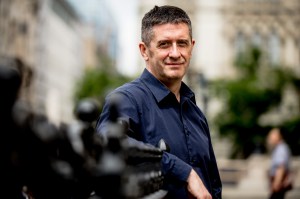
Adam LeBor is a veteran foreign correspondent who has covered Hungary and Eastern Europe since 1990. He is the author of thirteen books, including Hitler’s Secret Bankers, which was shortlisted for the Orwell Prize and City of Oranges. He writes for the Economist, Financial Times and Monocle. He divides his time between Budapest and London.
Connect with Adam
Website ǀ Facebook ǀ Twitter ǀ Goodreads


 About the Book
 About the Author
 What Cathy Read Next...