
Book Review: Gothic Tales by Elizabeth Gaskell

Gothic TalesAbout the Book

‘Such whispered tales, such old temptations and hauntings, and devilish terrors’

Elizabeth Gaskell’s chilling Gothic tales blend the real and the supernatural to eerie, compelling effect. Whether in ‘Disappearances’, inspired by local legends of mysterious vanishings which mixes gossip and fact, or in ‘Curious, if True’, a playful reworking of fairy tales, all the pieces in this volume form a stark contrast to the social realism of Gaskell’s novels, revealing a darker and more unsettling style of writing.

Format: ebook (347 pp.)    Publisher: Shandon Press
Published: 11th October 2016      Genre: Fiction, Short Stories, Horror, Classics

Purchase Links*
Amazon.co.uk  ǀ  Amazon.com 
*links provided for convenience, not as part of any affiliate programme

Find Gothic Tales on Goodreads


My Review

Better known now for her novels, such as Mary Barton and Cranford, Elizabeth Gaskell became popular in her own time for her ghost stories, aided by Charles Dickens, who published her work in his magazine Household Words.  The stories in this collection date from 1851 to 1861.

Like many short story collections, some of the stories are stronger than others.  I wouldn’t say any of them are particularly scary but in the best of them there is certainly an unsettling air and a sense of the Gothic.  Common features include mysterious disappearances, revenge in the form of curses inherited down through generations, family rifts, ghostly visitations, heroines in peril and gloomy manor houses or chateaux.

Stories I particularly enjoyed were:

‘Lois the Witch’ – in which the reader gets a bad feeling for the fortunes of the heroine, Lois, as soon as it becomes clear she’s headed for 17th century Salem and that not everyone is pleased to see her.

‘The Old Nurse’s Story’ – in which a ghostly presence roams the freezing Northumberland moors

‘The Poor Clare’ – in which an evil double, the result of a woman’s bitter curse, haunts future generations

‘The Grey Woman’ – featuring a full-on Gothic chateau, complete with dark passages and sealed off wings, and a husband of dubious moral character

Gothic Tales is a book on my Classics Club list and my book for the Classic Club’s October Dare which involved reading a book from your list that classified as thrilling, a mystery, Gothic or a book or author that SCARED you (because of its length, it’s topic, it’s reputation etc).

Follow my blog with Bloglovin

In three words: Spooky, mysterious, Gothic

Try something similar…Collected Ghost Stories by M. R. James


Elizabeth GaskellAbout the Author

Elizabeth Cleghorn Gaskell, née Stevenson (29 September 1810 – 12 November 1865), often referred to simply as Mrs. Gaskell, was an English novelist and short story writer during the Victorian era. She is perhaps best known for her biography of Charlotte Brontë.

Her novels offer a detailed portrait of the lives of many strata of society, including the very poor, and as such are of interest to social historians as well as lovers of literature.

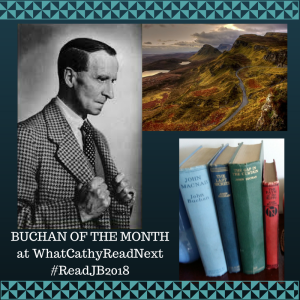
Buchan of the Month: Introducing…Witch Wood

Buchan of the Month

Witch Wood is the tenth book in my John Buchan reading project – Buchan of the Month. To find out more about the project and my reading list for 2018, click here.  If you would like to read along with me you will be very welcome – leave a comment on this post or on my original challenge post.   Witch Wood is also a book on my Classics Club list.

According to his first biographer, Janet Adam Smith, Buchan seldom read reviews of his novels.  She reports him telling his wife, “If writers mind bad reviews, they shouldn’t write books.”   I’ll be sharing my review later this month.  What follows is an introduction to the book (no spoilers!).  However, Witch Wood was reputedly John Buchan’s own favourite of his many novels.  It is dedicated to his brother, Walter Buchan.

Witch Wood was published in the UK in July 1927 by Hodder & Stoughton and in the US in August 1927 by The Riverside Press imprint of Houghton Mifflin.  Like many of Buchan’s earlier novels, Witch Wood first appeared in serial form in the British Weekly magazine between 20th January and 27th July 1927, although under the title ‘The High Places’.

According to his first biographer, Janet Adam Smith, Buchan used much of the reading he did whilst researching his biography of Montrose (published the following year) for Witch Wood.  David Daniell, author of The Interpreter’s House: A Critical Assessment of the Work of John Buchan, describes Witch Wood as ‘the greatest by-product’ of Buchan’s research for Montrose.  Montrose does in fact make a brief appearance in Witch Wood.

Adam Smith sees in the book’s exploration of the survival of pagan rites in a supposedly Christian society echoes of earlier works by Buchan such as the story ‘The Outgoing of the Tide’, the short story collection The Watcher by the Threshold and his novel The Dancing Floor (1926).    She records one appreciative reader of Witch Wood was author C.S. Lewis who remarked: ‘For Witch Wood specially I am always grateful; all that devilment sprouting up out of a beginning like Galt’s Annals of the Parish.  That’s the way to do it.’

David Daniell speculates about what a modern reader’s view of Buchan might be if only exposed to his historical fiction and not his thrillers.  Daniell’s own view is robustly stated: ‘All the modern impositions on to Buchan of perverted attitudes of mind would shrivel for lack of sustenance, and we would be left looking clearly at a writer of great gifts.’   He describes Witch Wood as ‘tightly enclosed’, because of its setting in the Black Wood and the parish of Woodilee, observing that there are ‘no great distances, wild escapades, miracles of chance’.

Although Buchan’s historical novels tended to sell less well than his thrillers, Witch Wood at 28,000 copies sold outstandingly well in its first year.  Having said that, Janet Adam Smith reports that by 1960 combined sales of Witch Wood were only 98,000 (compared with 355,000 for The Thirty-Nine Steps).

Sources:

David Daniell, The Interpreter’s House: A Critical Assessment of the Work of John Buchan (Nelson, 1975)

Janet Adam Smith, John Buchan: A Biography (OUP, 1985 [1965])