

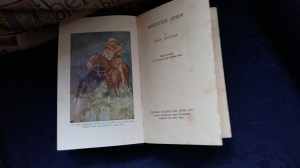
 About the Book
Nineteen-year-old David Crawfurd travels from Scotland to South Africa to work as a storekeeper. On the voyage he encounters again John Laputa, the celebrated Zulu minister, of whom he has strange memories. In his remote store David finds himself with the key to a massive uprising led by the minister, who has taken the title of the mythical priest-king, Prester John. David’s courage and his understanding of this man take him to the heart of the uprising, a secret cave in the Rooirand.
Format: Hardcover (245 pp.) Publisher: Hodder & Stoughton
Published: 1910 Genre: Fiction
Purchase Links*
Amazon.co.uk ǀ Amazon.com ǀ Hive.co.uk (supporting UK bookshops)
*links provided for convenience, not as part of any affiliate programme
Find Prester John on Goodreads
My Review
Prester John is the first book in my Buchan of the Month reading project for 2019. You can find out more about the project and my reading list for 2019 here. You can also read my spoiler-free introduction to Prester John.
Prester John was John Buchan’s sixth novel, written seven years after he returned from South Africa where he served as as one of Lord Alfred Milner’s ‘Young Men’. It’s described as ‘a boys’ story’ and certainly fits the bill as a tale of adventure and daring deeds. There are narrow escapes, breathless chases, clever disguises, secret allies, a dastardly villain and coded messages. As the Literary Innkeeper from The Thirty-Nine Steps remarks on hearing of Richard Hannay’s adventures, “By God!…it is all pure Rider Haggard and Conan Doyle.”
John Buchan endows his hero, David Crawfurd, with a young person’s sense of adventure and seemingly tireless energy along with some of his own interests, such as hiking and mountaineering (the latter proving useful for a perilous escape at the end of the book). They also share an appreciation for the landscape of Scotland and South Africa and, as you would expect from Buchan, there are some glorious descriptions of the scenery. ‘As the sun rose above the horizon, the black masses changed to emerald and rich umber, and the fleecy mists of the summits opened and revealed beyond shining spaces of green.’ One of Buchan’s favourite books, The Pilgrim’s Progress by John Bunyan, also makes an appearance, as it would again later in Mr. Standfast and Sick Heart River.
So far, so good. However, it is difficult for a modern day reader – even a John Buchan admirer like myself – to overlook the racial stereotyping, colonialism and outdated paternalism that pervades Prester John. This becomes even more problematic when one considers Prester John was a book aimed at young people (more likely than not, boys).
As I noted in my previous introduction piece about the book, Janet Adam Smith, Buchan’s first biographer, attempts to argue that, in Buchan’s portrayal of African leader, John Laputa, he is depicting ‘a battle not so much between black and white but as between civilisation and savagery’. Unfortunately it seems fairly obvious that the book associates the savagery as emanating from the native people and the civilizing influence as the ‘white man’s duty’. At the end of the book, David Crawfurd reflects: ‘That is the difference between white and black, the gift of responsibility, the power of being a little king; and so long as we know this and practice it, we will rule not in Africa alone but wherever there are dark men who live only for the day and their own bellies.’ I appreciate these words were written in earlier times but still they rather turned my belly.
David Daniell describes Buchan’s representation of John Laputa in Prester John as being like ‘a black Montrose’ with his ‘military skill, high charisma and religious vision’. It is true that David Crawfurd develops a curious admiration for Laputa as a specimen of a leader, whilst at the same time feeling it his duty to try to prevent what Laputa is seeking to achieve. In fact, David’s admiration seems to stem partly from the fact that a black man could possess such leadership qualities. As events play out, David remarks, ‘I had no exultation of triumph, still less any fear of my own fate. I stood silent, the half-remorseful spectator of a fall like the fall of Lucifer.’
Even writing in 1965, Janet Adam Smith concedes that the references to ‘blacks’ and ‘n*****s’ in Prester John will be found offensive today. I’m not sure that pointing out, as David Daniell does, that the terms are used only twice and three times respectively makes the situation much better. Therefore, whilst Prester John is, in one respect, an exciting, well-told adventure story, on this rereading I found myself less able to overlook the problematic attitudes in the book.
Sources:
David Daniell, The Interpreter’s House: A Critical Assessment of the Work of John Buchan (Nelson, 1975)
Janet Adam Smith, John Buchan: A Biography (OUP, 1985 [1965])
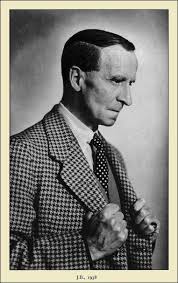 About the Author
John Buchan (1875 – 1940) was an author, poet, lawyer, publisher, journalist, war correspondent, Member of Parliament, University Chancellor, keen angler and family man. He was ennobled and, as Lord Tweedsmuir, became Governor-General of Canada. In this role, he signed Canada’s entry into the Second World War. Nowadays he is probably best known – maybe only known – as the author of The Thirty-Nine Steps. However, in his lifetime he published over 100 books: fiction, poetry, short stories, biographies, memoirs and history.
You can find out more about John Buchan, his life and literary output by visiting The John Buchan Society website.

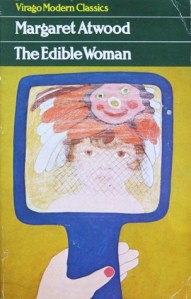 About the Book
 The Edible Woman is the book from my
  About the Author

