About the Book

It is 1965, and the Cold War has never been colder. The Circus – the secret centre of British intelligence – has one prize asset left in Moscow: a senior Red Army officer with access to the enemy’s deepest secrets. But when a British agent is shot in Helsinki, George Smiley uncovers a Soviet operation that imperils this irreplaceable source.
The trail leads Smiley not to Berlin or Vienna, but Los Angeles – the most foreign place he has ever known. There, in the murky heart of US intelligence, a Communist sleeper agent – a ‘Taper Man’ – is poised to expose Britain’s operative in Moscow. To save him, Smiley must navigate an America riven by divisions over race, loyalty and belonging, all while his spy in Leningrad, Roy Bland, risks everything in pursuit of a Russian defector who holds the final piece of the puzzle.
Format: Hardcover (416 pages) Publisher: Viking
Publication date: 5th November 2026 Genre: Historical Fiction, Thriller
Find The Taper Man on Goodreads
Purchase The Taper Man from Bookshop.org [Disclosure: If you buy books linked to our site, we may earn a commission from Bookshop.org, whose fees support independent bookshops]
My Review
The Taper Man reads like it was written by someone else. Fortunately that someone else is John le Carré, the author’s father. In this pitch perfect follow-up to Karla’s Choice, Nick Harkaway once again takes advantage of the ten year gap in George Smiley’s fictional life between the events in The Spy Who Came in from the Cold and Tinker Tailor Soldier Spy.
There’s a sense of continuity about the way characters are represented, foreshadowing events in Tinker, Tailor, Soldier Spy. Control is showing the first signs of ill-health and of paranoia about the security of the Circus being compromised. His policy of ‘compartmentalisation’ of intelligence material is aimed at ensuring no-one in the Circus has the full picture. The mission that went so disastrously wrong and resulted in the death of British agent Alec Leamas (the subject of The Spy Who Came in from the Cold) still looms large in the collective memory.
The author once again brilliantly evokes the atmosphere of the Circus. Its unprepossessing exterior, shabby interior, and labyrinth of corridors and basements, its public school like quality, and its specialist departments presided over by idiosyncratic individuals. For example, the redoubtable Connie Sachs with her encyclopedic memory and extraordinary ability to marshal information.
If you’re familiar with Tinker, Tailor, Soldier, Spy you’ll recognise many of the characters, some of whom are still early in their Circus careers. (Personally, I can never see the names Percy Alleline, Toby Esterhase, and so on without picturing the actors who played them in the 1979 TV adaptation. And Alec Guiness is and always will be George Smiley.)
Smiley’s quiet devotion to his wife Ann remains undiminished. He loves her but perhaps not in the way she needs. Aware of this but not capable of bridging the gap his intelligence role has created between them, he tolerates her infidelities with a quiet, melancholy understanding. I found this intensely moving.
I loved the central role given to Roy Bland, the ‘Soldier’ of Tinker, Tailor, Soldier, Spy, and the fact we learn more about his back story. His authentic Communist sympathies provide him with the ideal cover but it’s not without risk. He finds himself more than once in a situation where every option seems a bad one and it’s a case of going with the one that’s least bad but is still bad.
Smiley’s mission to reveal the identity of the ‘Taper Man’ (an agent whose job is to stay behind and remain undetected, possibly for many years, when a network is ‘burned’) takes him to America where, as he was warned, he feels like a ‘man on the moon’. Everything is different there – the food, the cars, and especially the way the ‘Cousins’ (the Circus’s term for the US intelligence service) operate, very different from the Circus’s instincts and modus operandi.
‘The Circus was primarily a listening entity: it existed to hear, to collect and to anticipate… The more aggressive type of clandestine endeavour – the toppling of governments, the assassination of enemies, the sabotage of infrastructure – was at the very edge of its scope. […] The Cousins were not so reticent… They were not watchers; they existed to unpick, to unravel, and even to burn away the tapestry of the growing Soviet bloc.’
As in so many other times in his career, Smiley finds himself painstakingly following a trail back in time. Sometimes it’s a paper trail involving meticulously leafing through reports. At other times it’s through direct engagement with people involved at the time, in the run-up to or after the discovery of the network. It’s a case of patient listening, letting others fill the silences, testing facts and assumptions. And all the time thinking, are they telling me the truth? If not, why not? And who are they protecting – themselves or others?
I’m not going to attempt to summarise the plot for fear of spoilers or give you any clue to the identity of the ‘Taper Man’, you’ll just have to follow the twists and turns for yourself. For those who love spycraft, there is plenty on show – brush passes, dead letter boxes, code names, fallbacks and, an old favourite, blue chalk.
There are also moments of high tension. As we discover, being an agent on the run is a lonely and bewildering place. Maintaining your cover story is an art. ‘You want a lie you can land on the runway in a storm. Practise it, fly with it, land it. Don’t improvise until there’s no other choice.’ And an exfiltration that has not been planned in the utmost detail is one that can easily, in fact probably likely, to go wrong. I was holding my breath at that point.
The Taper Man is a superlative spy thriller. I enjoyed every moment I spent reading it.
I received a proof copy courtesy of Viking.
In three words: Gripping, intricate, assured
Try something similar: London Match by Len Deighton
About the Author
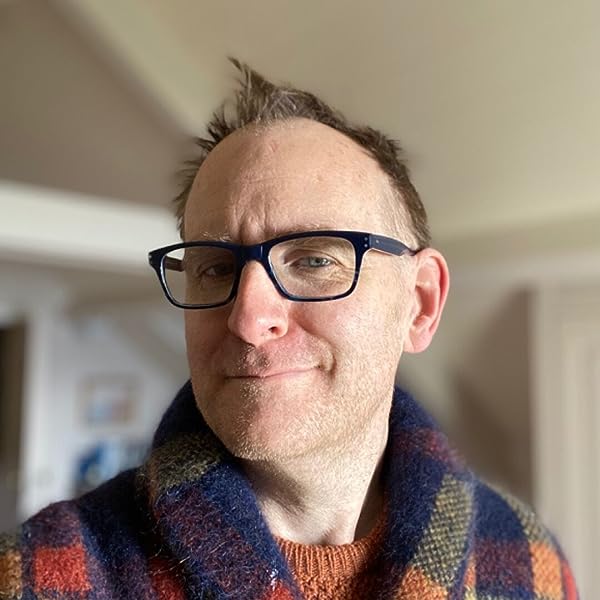
Nick Harkaway is the author of eight novels, including: The Gone-Away World, Angelmaker, Tigerman, Gnomon, Titanium Noir and Karla’s Choice.
He is the son of John le Carré and has an unique insight into his father’s work. He lives in London with his wife and two children.
Connect with Nick
Website | Bluesky | Instagram