
About the Book
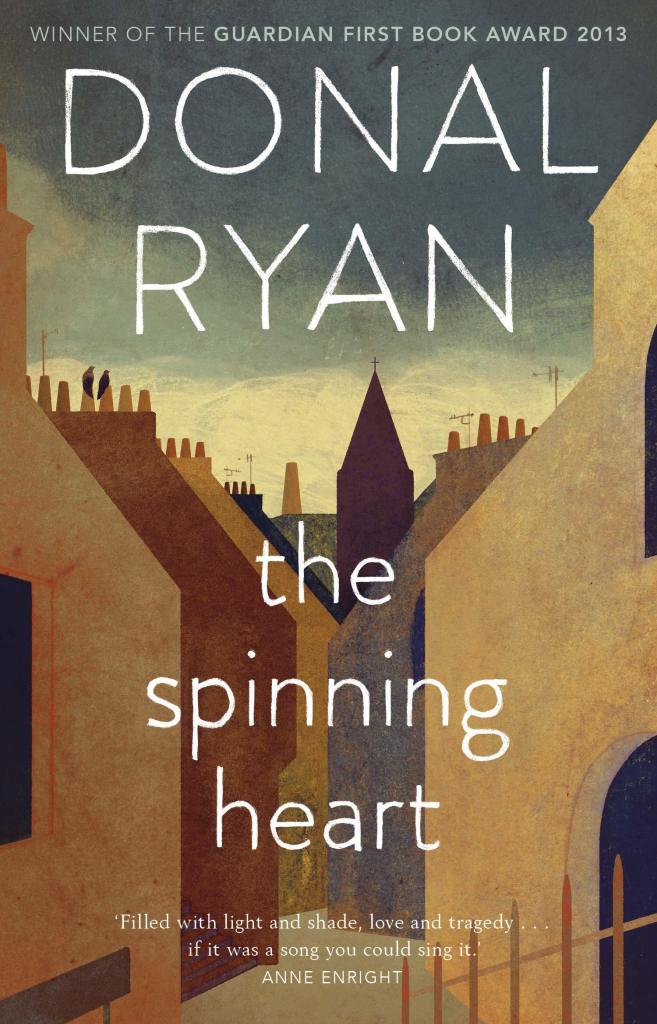
In the aftermath of Ireland’s financial collapse, dangerous tensions surface in an Irish town. As violence flares, the characters face a battle between public persona and inner desires.
Through a chorus of unique voices, each struggling to tell their own kind of truth, a single authentic tale unfolds.
Format: Paperback (160 pages) Publisher: Black Swan Ireland
Publication date: 25th April 2019 Genre: Contemporary Fiction
Find The Spinning Heart on Goodreads
Purchase links
Bookshop.org
Disclosure: If you buy a book via the above link, I may earn a commission from Bookshop.org, whose fees support independent bookshops
Hive | Amazon UK
Links provided for convenience only, not as part of an affiliate programme
My Review
The Spinning Heart was the book chosen for the December edition of BBC Radio 4’s Bookclub, hosted by broadcaster and author, Jim Naughtie. I was fortunate enough to be invited to attend the recording of the programme for which the book’s author, Donal Ryan, had travelled specially from Limerick. It will be transmitted on Sunday 3rd December. My review is a combination of my own thoughts about the book and my recollections of the conversation that took place during the recording.
The book is made up of a series of internal monologues by twenty-one different characters – men and women – each with a distinctive voice. Donal said it was always his intention that the book should have this structure. In fact, initially there were even more characters and he had to regretfully discard some.
In a way each chapter is a mini short story that reveal events in the lives of the characters, their relationships with other characters and their general attitudes. The only dialogue between characters is what they themselves recount in their respective monologues. We learn, little by little, about events following the collapse of a local building company, the owner of which – Pokey Burke – has absconded leaving mayhem in his wake: half-completed ‘ghosts’ estates, employees without the pensions or entitlement to benefits they expected. Some of the characters are directly affected, others indirectly affected by the downturn of the local economy. For example, Brian has plans to ‘go foreign’, following other unemployed men to Australia to find work. Vasya, an illegal foreign worker, faces the prospect of returning home.
Asked about his favourite character, Donal mentioned Lily, a single mother of five children possibly all by different fathers, as a character that came to him almost fully formed. But he always intended that Bobby, the former foreman of Pokey’s building company, should be the ‘hero’ of the book. Bobby feels a responsibility to do something to help those let down by Pokey. Many of the male characters look up to him or wish to emulate him.
The phrase ‘a proper man’ occurs a couple of times and it seemed to me that what it means to be ‘a proper man’ is one of the themes of the book. At one point, Bobby remembers attending a play with his wife, Triona, and observes, ‘Imagine it being found out, that you went to see a play, on your own! With a woman, you have an excuse for every kind of soft thing.’ On the other hand Pokey’s father, Josie, wonders whether, if he had played more of a role in his son’s upbringing, things might have turned out differently.
The stories the characters recount often involve dark themes, such as domestic violence, and at times the book feels quite bleak. Many of the characters feel shame – at being duped, at things they’ve done or haven’t done. Troubled relationships abound, especially between fathers and sons. Indeed, the book opens: ‘My father still lives back the road past the weir in the cottage I was reared in. I go there every day to see is he dead and every day he lets me down.’ However, despite the difficult situations in which some characters find themselves, I felt the book finished on a hopeful note.
Although this wasn’t my experience, at the end of the book some readers found themselves uncertain about Bobby’s fate. Donal said he hadn’t intended there to be any uncertainty but reading the closing chapters back now he could understand why some readers felt that way. He revealed the book’s sequel, set ten years after this one and due to be published next year, should provide reassurance!
As is often the case, hearing the author talk about the book only increased my admiration for it. There were definitely themes and nuances I hadn’t fully appreciated, meaning The Spinning Heart is a book I will certainly re-read. I also enjoyed listening to the author’s answers to the interesting and insightful questions asked by other attendees.
It was fascinating to attend the recording in BBC Broadcasting House. The hour simply flew by and I don’t envy the task of editing down the discussion to 25 minutes. After the recording there was an brief opportunity to chat to the author and have your book signed.
If you live in or near London, I can definitely recommend attending a recording. You can find the details of how to do this on the programme’s webpage. There are also over 300 previous episodes available to listen to. (You do not need a TV licence to do this.) If it’s not practical for you to travel to a recording, can I suggest as an alternative the BBC World Service’s World Book Club. You can email questions to future guests and may be invited to phone in and put them to the author directly, as I was for the edition discussing The Bitch by Pilar Quintana.
In three words: Immersive, authentic, moving
Try something similar: Reservoir 13 by Jon McGregor
About the Author

Donal Ryan is an award-winning author from Nenagh, County Tipperary, whose work has been published in over twenty languages to major critical acclaim. The Spinning Heart won the Guardian First Book Award, the EU Prize for Literature (Ireland), and Book of the Year at the Irish Book Awards; it was shortlisted for the International IMPAC Dublin Literary Award, longlisted for the Man Booker Prize and the Desmond Elliott Prize, and was voted ‘Irish Book of the Decade’. His fourth novel, From a Low and Quiet Sea, was longlisted for the Man Booker Prize, shortlisted for the Costa Novel Award 2018, and won the Jean Monnet Prize for European Literature. His most recent novel, Strange Flowers, was voted Novel of the Year at the Irish Book Awards, and was a number one bestseller. Donal lectures in Creative Writing at the University of Limerick. He lives with his wife Anne Marie and their two children just outside Limerick City.

 About the Book
 About the Author

