
Book Review – The Wager: A Tale of Shipwreck, Mutiny and Murder by David Grann

About the Book

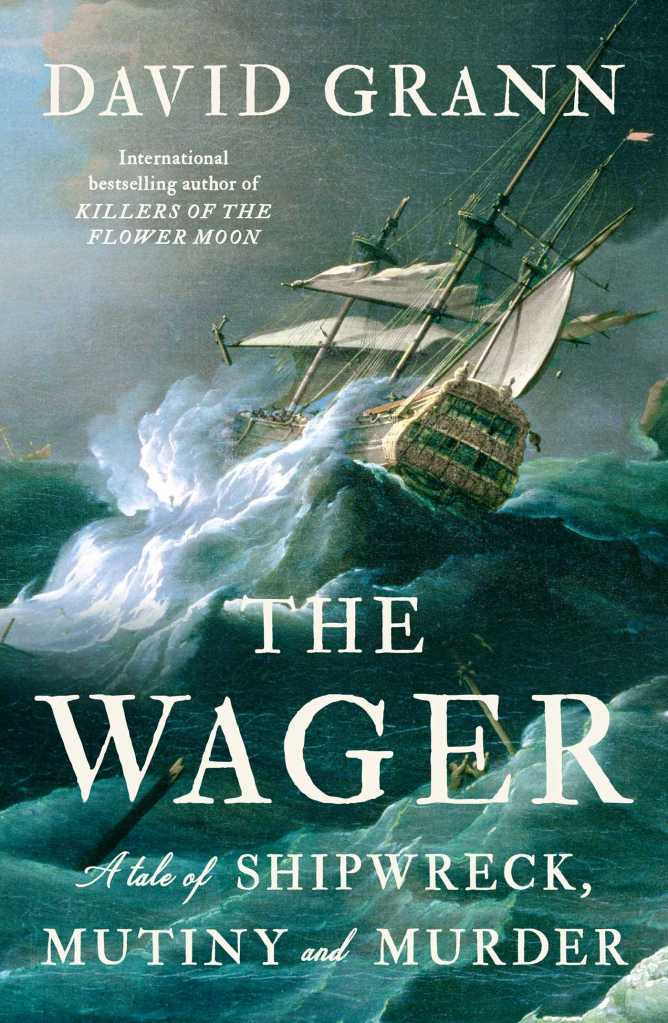
Book cover of The Wager by David Grann

1742: A ramshackle vessel of patched-together wood and cloth washes up on the coast of Brazil. Inside are thirty emaciated men, barely alive. Survivors from the Wager, a British vessel wrecked while on a secret mission to raid a Spanish treasure-filled galleon, they have an extraordinary tale to tell.

Six months later, an even more decrepit boat comes ashore on the coast of Chile, containing just three castaways with their own, very different account of what happened. The thirty sailors who landed in Brazil, they maintain, were not heroes – they were mutineers.

As accusations of treachery and murder fly, who is telling the truth? The stakes are life-and-death – for whoever is guilty could hang.

Format: Paperback (368 pages) Publisher: Simon & Schuster
Publication date: 18th April 2023 Genre: Nonfiction, History

Find The Wager on Goodreads

Purchase The Wager from Bookshop.org [Disclosure: If you buy books linked to our site, we may earn a commission from Bookshop.org, whose fees support independent bookshops.]


My Review

This was a book club pick and a rare non-fiction read for me. I really enjoyed it, as did the majority of my fellow readers. It’s a thrilling story of endurance and the will to survive with, it has to be said, some harrowing scenes in parts. It’s also a thought-provoking exploration of human behaviour under extreme circumstances.

The author’s meticulous research is obvious; you only have to look at the extensive notes and bibliography which make up nearly one hundred pages of the book to see that. Although the book is overflowing with maritime facts, including the origin of some commonly used phrases, it’s not a dry read. For example, this description of the toll on the Wager‘s structure of the rough seas they encounter: ‘Every day she was being devoured… She was pelted and gouged. She pitched, she heaved, she groaned, she splintered.’ Or this, when the ship is finally pitched onto the rocks of what will come to be known as Wager Island: ‘The bowsprit cleaved, windows burst, treenails popped, planks shattered, cabins collapsed, decks caved in.’

It has to be said that on the voyage the Wager’s crew experienced just about everything nature could throw at them as well as outbreaks of typhus and scurvy that cut a deadly swathe over the ship’s crew. I actually found it surprising that anyone survived the voyage, let along the shipwreck and the period as castaways on an island that provided very little in the way of food or shelter. Only salvaging items from the Wager ensured their survival and, at a crucial moment, assistance from an indigenous tribe much better suited to their environment than the crew.

One other thing that surprised me was the extent of the contemporaneous documents that survived, including the journals kept by sixteen year old midshipman John Byron (grandfather of the poet Lord Byron) and gunner, John Bulkeley.

The Wager is a story based on fact. If it wasn’t the author might have been tempted to create a more exciting ending but he stuck rigidly to the actual events which reveal something of a cover-up by those in power who didn’t care to advertise the breakdown of naval discipline or the parlous state of the country’s fleet.

By way of an afterword, Martin Scorcese (who brought to the screen David Grann’s previous book, Killers of the Flower Moon) and Leonard DiCaprio have acquired the screen rights to The Wager.

In three words: Well-researched, detailed, authentic
Try something similar: Erebus: The Story of a Ship by Michael Palin


About the Author

David Grann is the author of the international bestsellers Killers of the Flower Moon and The Lost City of ZKillers of the Flower Moon was a finalist for The National Book Award and won an Edgar Allan Poe Award. He is also the author of The White Darkness and the collection The Devil and Sherlock Holmes. Grann’s investigative reporting has garnered several honours, including a George Polk Award. He lives with his wife and children in New York. (Photo: Goodreads author page)

Book Review – Our Souls at Night by Kent Haruf

About the Book

This is a love story. A story about growing old with grace.

Addie Moore and Louis Waters have been neighbours for years. Now they both live alone, their houses empty of family, their quiet nights solitary. Then one evening Addie pays Louis a visit.

Their brave adventures form the beating heart of Our Souls at Night.

Format: ebook (194 pages) Publisher: Picador
Publication date: 4th June 2015 Genre: Contemporary Fiction

Find Our Souls at Night on Goodreads

Purchase Our Souls at Night from Amazon (link provided for convenience not as part of an affiliate programme)


My Review

Our Souls at Night was the February pick for the Waterstones Reading book club. It’s fair to say that some members struggled with the absence of quotation marks and found the book a little too slow-paced for their taste. ‘Monotonous’ was one word used, although I would disagree with that.

Addie’s unexpected suggestion that Louis spend his nights with her sets in train a relationship that progresses from quiet conversation about everyday topics to revealing exchanges about events in their lives. Lying side by side at night it’s almost like a confessional allowing them to disclose things they may not have shared before: regrets, feelings of guilt, things they should have done differently. It brings them both comfort.

‘So life hasn’t turned out right for either of us, not the way we expected, he said.
Except it feels good now, at this moment.
Better than I have reason to believe I deserve, he said.’

Gradually their relationship moves from simple companionship to something much deeper.

Our Souls at Night is a quiet, gentle book but no less emotionally powerful for that. I loved the way the author includes little details, such as Louis’s careful preparations for his nightly visits, that reveal so much about the characters.

I really loved Addie for her courage and her determination to ignore what others think about her relationship with Louis. It turns out small town America is not the most forgiving place when it comes to unconventional relationships but I loved Addie’s and Louis’s bold response to the gossipmongers. And when Addie’s grandson Jamie, a troubled child, comes to stay, Louis proves a natural, instinctively knowing how to draw the boy out and bolster his confidence.

I wasn’t alone in finding the behaviour of Gene, Addie’s son, reprehensible. Forcing her to choose between her relationship with Louis and continued contact with her grandson was horrid, if not downright cruel. Gene’s own experiences – a failing marriage, a failed business and spiralling debts – seemed to have made him capable of seeing only mercenary motives in Louis’s friendship with his mother. A bit rich, if you’ll pardon the pun, since it’s Gene who expects his mother to bail him out.

Although sad in some ways, I felt the conclusion of the book left open the possibility that all was not lost, just that it might have to happen in a different way.

I really enjoyed this tender story of love in later life. I was sad to learn that it was the author’s last novel and was published posthumously.

In three words: Intimate, emotional, perceptive


About the Author

Author Kent Haruf

Kent Haruf was born in eastern Colorado. He received his Bachelors of Arts in literature from Nebraska Wesleyan University in 1965 and his Masters of Fine Arts from the Iowa Writers’ Workshop at the University of Iowa in 1973. For two years, he taught English in Turkey with the Peace Corps and his other jobs included a chicken farm in Colorado, a construction site in Wyoming, a rehabilitation hospital in Colorado, a hospital in Arizona, a library in Iowa, an alternative high school in Wisconsin, and universities in Nebraska and Illinois.

Haruf is the author of Plainsong, which received the Mountains and Plains Booksellers Award, the Los Angeles Times Book Prize, the Maria Thomas Award in Fiction, and The New Yorker Book Award. Plainsong was also a finalist for the 1999 National Book Award. His novel, The Tie That Binds, received a Whiting Foundation Award and a special citation from the Pen/Hemingway Foundation. In 2006, Haruf was awarded the Dos Passos Prize for Literature. All of his novels are set in the fictional town of Holt, Colorado. Holt is loosely based on Yuma, Colorado, an early residence of Haruf in the 1980s.

Haruf lived with his wife, Cathy, in Salida, Colorado, with their three daughters. He died of cancer on November 30, 2014.