

Throwback Thursday is a weekly meme hosted by Renee at It’s Book Talk. It’s designed as an opportunity to share old favourites as well as books that we’ve finally got around to reading that were published over a year ago. If you decide to take part, please link back to It’s Book Talk.
I’ve decided to delve back into the earliest days of my blog (not that it’s that old) and share one of my first reviews. It’s for a collection of short stories by Katherine Mansfield, an author I was introduced to whilst studying for my Masters with The Open University. If you like your short stories a little dark, then give this collection a try.
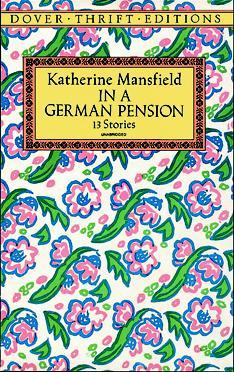
In A German Pension: 13 Stories by Katherine Mansfield
 About the Book
In A German Pension was Katherine Mansfield’s first published collection of short stories. The stories were inspired by her stay at the Villa Pension Müller in the Bavarian spa of Bad Wörishofen in 1909.
Purchase Links*
Amazon.co.uk ǀ
*links provided for convenience, not as part of any affiliate programme
Find In A German Pension: 13 Stories on Goodreads
My Review
The stories in this collection are divided between vignettes of guests staying at the Pension, which are gently mocking in tone, and much darker stories that often have a sting in the tail. A frequent theme of the latter is the social and sexual oppression of women.
In “German Meat”, the female English narrator is a sardonic commentator on the coarseness of the German guests who are constantly eating, perspiring and discussing their ailments and bodily functions. They, however, believe themselves superior to the English, particularly when they learn the narrator does not know what kind of meat her husband likes and, worse still, admits to being vegetarian. Mansfield deftly conveys the guests’ greed and grotesque habits in a few short sentences.
‘A glass dish of stewed apricots was placed upon the table. “Ah , fruit!” said Fraulein Stiegelauer, “that is so necessary to health. The doctor told me this morning that the more fruit I could eat the better.” She very obviously followed the advice.’
In “The Sister of the Baroness”, Mansfield exposes the snobbery of the other guests who cannot contain their excitement at the prospect of a relative of a wealthy member of the nobility staying at the Pension.
‘Coffee and rolls took on the nature of an orgy. We positively scintillated. Anecdotes of the High Born were poured out, sweetened and sipped: we gorged on scandals of High Birth generously buttered.’
Unfortunately their fawning regard for the new arrival turns out to be misplaced when it is revealed she is merely the daughter of the Baroness’s dressmaker.
In “The Advanced Lady”, the pretensions to intellectual superiority of a lady writer are lampooned.
‘“But Love is not a question of lavishing,” said the Advanced Lady. “It is the lamp carried in the bosom touching with serene rays all the heights and depths of…” “Darkest Africa,” I murmured flippantly. She did not hear.’
Amongst the darkest of the stories is “The Child Who Was Tired”, which recounts the unrelenting toil of a young girl and the dreadful act she is driven to by despair and exhaustion. Another notable story is “Frau Brechenmacher Attends a Wedding” in which the conventions of domestic bliss are satirised both in the descriptions of the pompous Herr Brechenmacher and the events of the wedding breakfast. The bride is described as having the appearance of “an iced cake, all ready to be cut and served in neat little pieces to the bridegroom beside her”. There is a sense of violence underpinning the story which is realised in the final sentence.
Although Mansfield later came to regard this early collection of stories as having little merit, I enjoyed the precision of the writing and their dark humour.
 About the Author
Katherine Mansfield was born in New Zealand in 1888 and is widely considered the best short story writer of the modernist period. She left New Zealand for the UK when she was 19 and then travelled for a time in Europe. She was associated with a “new dawn” in English literature and together with T.S. Eliot, James Joyce and Virginia Woolf made the London of the period the centre of the literary world. Mansfield’s stories were written without a conventional plot but concentrated on one moment, a crisis or turning point rather than a sequence of events. Often very dark, common themes of her stories include human isolation, the conflict between love and disillusionment, idealism and reality. Katherine Mansfield died in 1923 at the age of only 34.


 About the Author
 What Cathy Read Next...