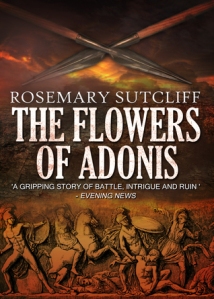
The Flowers of Adonis by Rosemary Sutcliff #BookReview #ccspin

adonisAbout the Book

The 5th Century BC. The Greek city-states are engaged in perpetual war. But one man towers above the chaos. His name is Alkibiades. He is at once a pirate, statesman and seducer whose adventures rival those of Odysseus himself.

Citizen of Athens, friend of Socrates, sailor, warrior and inveterate lover, Alkibiades flees persecution in his native city to join the Spartan cause.

However, his brilliant naval and diplomatic victories on their behalf do not save him from the consequences of impregnating the Spartan queen, and once more he takes up the outcast’s mantle.

Format: ebook (384 pages)       Publisher: Endeavour Press
Publication date: 2014 [1969] Genre: Historical Fiction, Classics

Find The Flowers of Adonis on Goodreads


My Review
The Classics ClubThe Flowers of Adonis is the book from my Classics Club list chosen for me in the latest Classics Club Spin.  Having devoured Rosemary Sutcliff’s books, such as The Eagle of the Ninth, when I was younger I was delighted when the spin result was announced.  The book also fulfils one of the categories for the When Are You Reading? Challenge 2020hosted by Sam at Taking on a World of Words.

The Flower of Adonis is a fictionalized account of the life of Alkibiades, an Athenian General. In her Author’s note Rosemary Sutcliff describes her protagonist as “an enigma”, going on to remark, “Even allowing that no man is all black and white, few men can ever have been more wildly and magnificently piebald”. Well, that’s one way to put it!

I know some readers have struggled with the multiple narrators and the frequent switching between them, sometimes within the same chapter. Personally, I didn’t find that any barrier to my enjoyment of the book. In fact, I felt it helped to provide insights into the different facets of Alkibiades’ character whether from the point of view of those who were his close companions, those who served with him in a military capacity or those who knew him only as a public figure. What did slightly grate for me was that the narrators continued to be referred to in the section headings by their occupations or status – The Soldier, The Seaman, The Citizen, and so on – even after the reader learns the names of the main ones (Arkadius, Antiochus and Timotheus respectively). I appreciate this may have been an editorial decision for consistency or perhaps it was to emphasise their role as representatives of different strands of society.

I found myself most uncomfortable with the way the sections from the point of view of Timandra, the slave girl who becomes the long-time companion of Alkibiades, are headed ‘The Whore’. Perhaps it’s because I found those sections the most affecting that it rankled so much. If Timandra is ever a ‘whore’ it’s because she was captured and sold into slavery but she is always utterly faithful to Alkibiades. The same cannot be said of him. And as for his treatment of the Spartan Queen…!

The Alkibiades portrayed by Rosemary Sutcliff is indeed an enigmatic figure. He’s bold, resourceful, courageous in battle, a skilful negotiator and an accomplished tactician who inspires devotion in those who serve with him. He’s also mercurial, ruthless, impetuous, easily bored and possesses a supreme belief in his own ability. Of one bold plan, he observes, “It’s a gamble – a glorious gamble, but I can pull it off for you, and there’s not another man who can!”

With promises such as that, to begin with he is viewed as the saviour of an Athens desperate for a victory after a series of defeats. However, as we have seen in modern times, having the hopes of a population riding on you can be a heavy burden and the fall from grace if success is not delivered can be even swifter than the rise. As Timotheus observes sadly at the end of the book, ‘Something that was in Athens when I was a boy will not be there for my sons’. Or in the words of the song, “Don’t it always seem to go, That you don’t know what you’ve got, Till it’s gone’.

I’ll confess that much of the forming and breaking of alliances, the political intrigue and the conquest, loss and often re-conquest of cities and territory left me slightly confused. However, I enjoyed the exciting battle scenes and the wealth of fascinating historical detail about life at that time. Apart from Timandra, my favourite character was Antiochus, Alkibiades’ trusted and loyal right hand man. Alkibiades himself I found intriguing but difficult to like.

The Flowers of Adonis (the title refers to a religious celebration that features at the beginning of the book and is cleverly echoed at its moving ending) is an accomplished piece of historical fiction by a writer who knew how to bring the past alive. Reading the book reminded me I have Rosemary Sutcliff partly to thank for my enduring love of historical fiction.

In three words: Epic, action-packed, detailed

Try something similar: The New Achilles by Christian Cameron

Follow this blog via Bloglovin


239432About the Author

Rosemary Sutcliff (1920-1992) wrote dozens of books for young readers, including her award-winning Roman Britain trilogy, The Eagle of the Ninth, The Silver Branch, and The Lantern Bearers, which won the Carnegie Medal. The Eagle of the Ninth is now a major motion picture, The Eagle, directed by Kevin MacDonald and starring Channing Tatum. Born in Surrey, Sutcliff spent her childhood in Malta and on various other naval bases where her father was stationed. At a young age, she contracted Still’s Disease, which confined her to a wheelchair for most of her life. Shortly before her death, she was named Commander of the British Empire (CBE) one of Britain’s most prestigious honours. She died in West Sussex, England, in 1992.

Connect with fans of Rosemary
Website | Twitter | Facebook | Goodreads


#WWWWednesday – 27th May 2020

WWWWednesdays

Hosted by Taking on a World of Words, this meme is all about the three Ws:

  • What are you currently reading?
  • What did you recently finish reading?
  • What do you think you’ll read next?

Why not join in too?  Leave a comment with your link at Taking on a World of Words and then go blog hopping!


Currently reading

My Buchan of the Month, a book from my NetGalley shelf, a review copy and an audiobook (yes, it is the same one as last week, and the week before…).  

Buchan of the Month Banner 2020.jpgThe Last Secretsby John Buchan (hardcover)

A detailed record of some of the main explorative achievements of the first two decades of the twentieth century and a fascinating glimpse into one the most exciting epochs for exploration.

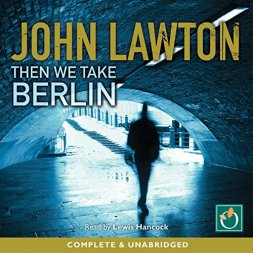
Then We Take Berlin AudioThen We Take Berlin (Joe Wilderness #1) by John Lawton (audiobook)

Joe Wilderness is a World War II orphan, a condition that he thinks excuses him from common morality. Cat burglar, card sharp, and Cockney wide boy, the last thing he wants is to get drafted. But in 1946 he finds himself in the Royal Air Force, facing a stretch in military prison . . . when along comes Lt Colonel Burne-Jones to tell him MI6 has better use for his talents.

Posted to occupied Berlin, interrogating ex-Nazis, and burgling the odd apartment for MI6, Wilderness finds himself with time on his hands and the devil making work. He falls in with Frank, a US Army captain, with Eddie, a British artilleryman and with Yuri, a major in the NKVD and together they lift the black market scam to a new level. Coffee never tasted so sweet. And he falls for Nell Breakheart, a German girl who has witnessed the worst that Germany could do and is driven by all the scruples that Wilderness lacks.

Fifteen years later, June 1963. Wilderness is free-lance and down on his luck. A gumshoe scraping by on divorce cases. Frank is a big shot on Madison Avenue, cooking up one last Berlin scam . . . for which he needs Wilderness once more. Only now they’re not smuggling coffee, they’re smuggling people. And Nell? Nell is on the staff of West Berlin’s mayor Willy Brandt, planning for the state visit of the most powerful man in the world: “Ich bin ein Berliner!”

Then We Take Berlin is a gripping, meticulously researched and richly detailed historical thriller – a moving story of espionage and war, and people caught up in the most tumultuous events of the twenty-first century.

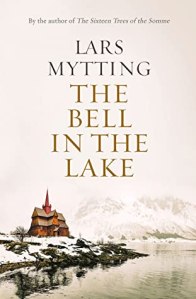
The Bell in the LakeThe Bell in the Lake by Lars Mytting, trans. by Deborah Dawkin (e-book, courtesy of MacLehose Press and NetGalley)

Norway, 1880. Winter is hard in Butangen, a village secluded at the end of a valley. The lake has frozen, and for months the ground is too hard to bury the dead. Astrid Hekne dreams of a life beyond all this, beyond marriage, children, and working the land to the end of her days. Then Pastor Kai Schweigaard takes over the small parish, with its 700-year-old stave church carved with pagan deities. The two bells in the tower were forged by Astrid’s forefather in the sixteenth century, in memory of conjoined twins Halfrid and Gunhild Hekne. They are said to hold supernatural powers.

The villagers are wary of the pastor and his resolve to do away with their centuries-old traditions, though Astrid also finds herself drawn to him. And then a stranger arrives from Dresden, with grand plans for the church itself. For headstrong Astrid this may be a provocation too far.

Talented architecture student Gerhard Schönauer is an improbable figure in this rugged community. Astrid has never met anyone like him; he seems so different, so sensitive. She finds that she must make a choice: for her homeland and the pastor, or for an uncertain future in Germany.

Then the bells begin to ring…

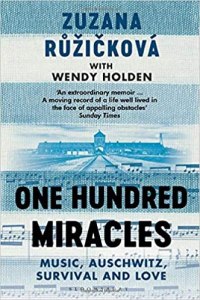
One Hundred MiraclesOne Hundred Miracles by Zuzana Ruzicková with Wendy Holden (review copy, courtesy of Bloomsbury)

Zuzana Ruzicková grew up in 1930s Czechoslovakia dreaming of two things: Johann Sebastian Bach and the piano. But her melodic childhood was torn apart when, in 1939, the Nazis invaded. Uprooted from her home and transported from Auschwitz to Hamburg to Bergen-Belsen, Zuzana endured the unimaginable. Through it all, a slip of paper printed with her favourite piece of Bach’s music became her talisman.

Reborn through the unwavering power of music, Zuzana would go on to become one of the twentieth century’s most renowned musicians and the only harpsichordist to record the entirety of Bach’s keyboard works. bereaved , starved, and afflicted with crippling injuries to her musician’s hands, the teenage Zuzana faced a series of devastating losses. Yet with every truck and train ride,

Armed with this ‘proof that beauty still existed’, Zuzana’s fierce bravery and passion ensured her survival of the greatest human atrocities of all time, and would continue to sustain her through the brutalities of post-war Communist rule. Harnessing her talent and dedication, and fortified by the love of her husband, the Czech composer Viktor Kalabis,

Zuzana’s story, told here in her own words before her death in 2017, is a profound and powerful testimony of the horrors of the Holocaust, and a testament in itself to the importance of amplifying the voices of its survivors today. It is also a joyful celebration of art and resistance that defined the life of the ‘first lady of the harpsichord’- a woman who spent her life being ceaselessly reborn through her music.


Recently finished

Links from the title will take you to my review.

Lionheart by Ben Kane

The Flowers of Adonis by Rosemary Sutcliff (e-book)

The 5th Century BC. The Greek city-states are engaged in perpetual war. But one man towers above the chaos. His name is Alkibiades. He is at once a pirate, statesman and seducer whose adventures rival those of Odysseus himself.

Citizen of Athens, friend of Socrates, sailor, warrior and inveterate lover, Alkibiades flees persecution in his native city to join the Spartan cause.

However, his brilliant naval and diplomatic victories on their behalf do not save him from the consequences of impregnating the Spartan queen, and once more he takes up the outcast’s mantle. (Review to follow)


What Cathy (will) Read Next

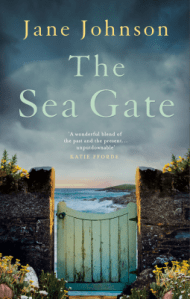
cover181972-mediumThe Sea Gate by Jane Johnson (eARC, courtesy of Head of Zeus and NetGalley)

A broken family, a house of secret – an entrancing tale of love and courage set during the Second World War.

After Rebecca’s mother dies, she must sort through her empty flat and come to terms with her loss. As she goes through her mother’s mail, she finds a handwritten envelope. In it is a letter that will change her life forever.

Olivia, her mother’s elderly cousin, needs help to save her beloved home. Rebecca immediately goes to visit Olivia in Cornwall only to find a house full of secrets—treasures in the attic and a mysterious tunnel leading from the cellar to the sea, and Olivia, nowhere to be found.

As it turns out, the old woman is stuck in hospital with no hope of being discharged until her house is made habitable again. Rebecca sets to work restoring the home to its former glory, but as she peels back the layers of paint and grime, she uncovers even more buried secrets—secrets from a time when the Second World War was raging, when Olivia was a young woman, and when both romance and danger lurked around every corner…

A sweeping and utterly spellbinding tale of a young woman’s courage in the face of war and the lengths to which she’ll go to protect those she loves against the most unexpected of enemies.