 About the Book
A collection of stories dealing with escapes and adventurous journeys, including the escape of Charles II to France after the Battle of Worcester, Winston Churchill’s escape from South Africa and many more.
Format: Hardcover (304 pages) Publisher: Nelson
Publication date: September 1922 Genre: NonFiction, History
Find A Book of Escapes and Hurried Journeys on Goodreads
My Review
My Buchan of the Month for April is A Book of Escapes and Hurried Journeys which was published in September 1922 by Nelson. My edition is the second impression from December of the same year. As the title suggests, the book is a collection of twelve famous escapes or hurried journeys from history including Charles II’s escape after the Battle of Worcester, Marie Antoinette’s flight to Varennes and Winston Churchill’s adventures during the Boer War.
The stories show how small decisions, chance and random events, such as inclement weather, can change the course of history and how the success of one plan may be thwarted by the failure of another. An example is ‘The Railway Raid in Georgia’ in which a daring attempt to prevent the arrival of enemy reinforcements by cutting railroad links fails due to a lack of tools and the late running of trains due to heavy rain. The story features a race between two trains that would make a great film.
The book also highlights how much a successful escape or journey often relies on the courage and daring of singular individuals. For example, in ‘Two African Journeys’ he describes Dick King’s great ride to bring news of impending danger as seeming ‘in the last degree impossible’. Sheer ingenuity is often another factor such as in ‘Lord Nithsdale’s Escape’ where a combination of disguise and confusion leads to a successful release from imprisonment and execution.
The most detailed accounts are reserved for two journeys set in Scotland: the escape of Prince Charles Edward (‘Bonnie Prince Charlie’) and a forced march by the army of ‘The Great Montrose’. The latter is a figure for whom Buchan had great admiration, describing him as ‘certainly one of the purest and most chivalrous figures in his country’s annals.’ (Buchan later wrote a biography of Montrose.) The author describes how Montrose resolved on ‘the craziest of adventures’ when faced by enemies on two sides, noting that it is ‘the duty of a good general when he is confronted by two immediate perils to meet the greater first.’ Buchan provides a detailed and thrilling account of a flank march which he describes as ‘one of the great exploits in the history of British arms’. There is also a brief episode in which Montrose dons the disguise of a groom accompanied by two soldiers wearing the uniform of enemy soldiers. The same episode features in his novel Witch Wood, when its hero, David Sempill, encounters the party and guides them to safety.
There are also touches of humour such as in ‘The Flight of Lieutenants Parer and M’Intosh Across The World’ which tells of the attempt by two Australian airmen stationed in England to win the £10,000 prize by entering for the Australia Flight competition. Unfortunately, the only aircraft they are able to obtain is rundown old airplane, ‘a condemned comic-opera machine’ which, as Buchan notes, means the routine of their journey becomes ‘ to break down every day or two, and then patch up the machine with oddments sufficient to carry it to the next landing-place, where it fell to pieces again.’
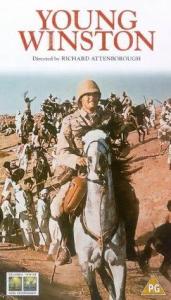 My favourite story was probably ‘From Pretoria to the Sea’ which depicts Winston Churchill’s escape from a prison camp during the Boer War, memorably dramatized in the film Young Winston). Buchan notes that Winston Churchill published the story of his escape during the war (in two volumes initially but later published as a single volume entitled The Boer War). However, at the time of publication it was important not to implicate any friends still in the Transvaal and so, Buchan proudly states, ‘the next part of his journey has never been explicitly told.’ He recounts how Churchill’s exploits attracted growing public attention with newspapers reporting on his progress with varying degrees of accuracy. ‘It was rumoured that he had escaped disguised as a woman, and again disguised as a policeman; and finally it was reported that he was still in hiding in Pretoria.’
In the Preface to the book, John Buchan reflects on the ‘eternal fascination about tales of hurried journeys’. He suggests the drama they provide appeals to ‘a very ancient instinct in human nature’ and the conflict between time and space they involve can create what he calls ‘great moments’. He writes, ‘Whether failure or success is the result, life is sharpened, intensified, idealized’. In A Book of Escapes and Hurried Journeys, John Buchan certainly brings to life many of such ‘great moments’ from history.
In three words: Engaging, exciting, adventure
Try something similar: Beautiful Star & Other Stories by Andrew Swanston
Follow my blog via Bloglovin
 About the Author
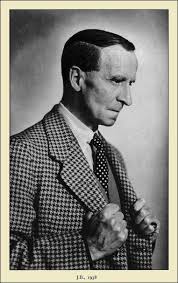
John Buchan (1875 – 1940) was an author, poet, lawyer, publisher, journalist, war correspondent, Member of Parliament, University Chancellor, keen angler and family man. He was ennobled and, as Lord Tweedsmuir, became Governor-General of Canada. In this role, he signed Canada’s entry into the Second World War. Nowadays he is probably best known – maybe only known – as the author of The Thirty-Nine Steps. However, in his lifetime he published over 100 books: fiction, poetry, short stories, biographies, memoirs and history.
You can find out more about John Buchan, his life and literary output by visiting The John Buchan Society website.
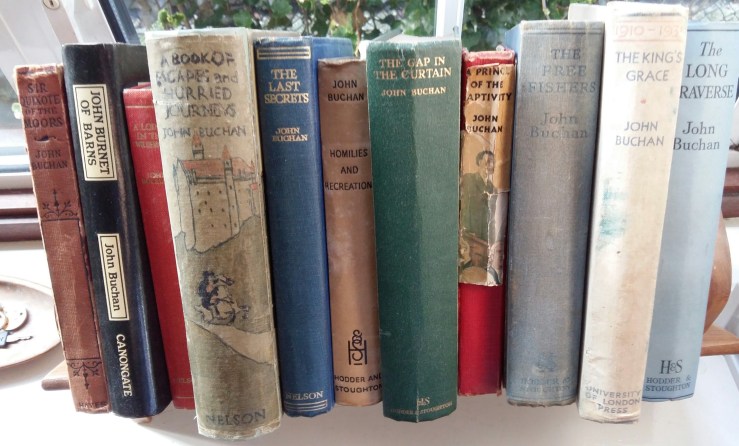

 My Buchan of the Month for May is The Last Secrets. Subtitled ‘The Final Mysteries of Exploration’, it was published in the UK by Thomas Nelson & Sons in September 1923 and in the US by Houghton Mifflin in 1924.
 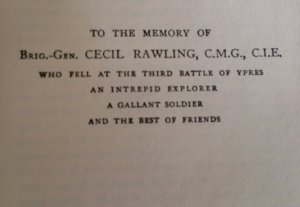 As his first biographer, Janet Adam Smith, notes one of Buchan’s “cherished pipe-dreams” was an expedition to Everest. Cecil Rawling, a friend of Buchan’s brother, Willie, (who died in 1912) had been planning an expedition to Everest and Buchan eagerly joined in with preparations. The outbreak of the First World War and Rawling’s own death in 1917 put an end to the plans, as did Buchan’s poor health once the war ended. The Last Secrets is dedicated to Cecil Rawling.


