
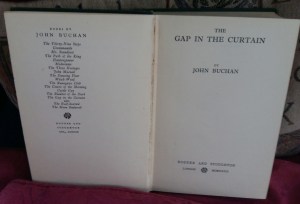
 About the Book
Guests at a country house party are enabled by an eccentric scientist to see a glimpse of an issue of The Times newspaper dated a year hence.
Format: Hardcover (320 pages) Publisher: Hodder & Stoughton
Publication date: July 1932 Genre: Fiction
My Review
 My Buchan of the Month for July is The Gap in the Curtain which was published in 1932 by Hodder & Stoughton. My copy is a first edition but unfortunately without a dust jacket. You can read my earlier blog post introducing the book here.
The Gap in the Curtain concerns the experiences of a group of guests at a country house party, including lawyer Sir Edward Leithen, who take part in an experiment conducted by the enigmatic Professor Moe. After a period of “training” involving mental exercises and a special diet, they are each given a glimpse of the future by way of an item in The Times newspaper dated a year hence. Being a logical and down-to-earth fellow, Leithen sees nothing but a blank page. However, the other five who take part are profoundly affected by what they see. The different ways in which they react to the foreknowledge they have been granted over the next twelve months are recounted by Leithen.
For two of the guests, David Mayot and Arnold Tavanger, the insights relate to the worlds of politics and finance. The attempts by Mayot (described by Leithen as having “not a very generous allowance of brains” and “as much magnetism as a pillar-box”) to second-guess how the political situation he saw might come about involves a good deal of tactical and frankly not very principled behind the scenes manoeuvring. I have to say I found this a little dull with way too much discussion of the positions of the different political factions. The satirical nature of the description of politics may have been more recognisable to readers of the day.
What keen investor Arnold Tavanger sees in The Times leads him to embark on a journey across continents to secure what he believes will bring him huge financial rewards. His epic trip across Africa sees him take to the air with a pilot “who was one-fourth scientist and three-fourths adventurer, and who did not value his on or anybody else’s life at two pins”. They encounter thunderstorms and at one point end up with two lizards and a snake in the fuselage! In the end though, Tavanger’s experiences lead him to conclude “Our ignorance of the future has been widely ordained of Heaven. For unless man were to be like God and know everything, it is better that he should know nothing. If he knows one fact only, instead of profiting by it he will assuredly land in the soup”.
Reggie Daker’s insight into what he will be undertaking a year hence takes him completely by surprise, being the last thing on earth he would consider doing. However, over the course of the next few months, the reader witnesses the influence of the attractive Verona Cortal and her family on the rather compliant by nature Reggie. Says Leithen, “He had the air of a smallish rabbit caught in a largish trap. But it was a stoical rabbit, for to me he made no complaint.” Eventually, fate lends a hand to provide Reggie with a means of escape.
The final two guests – Robert Goodeve and Captain Charles Ottery – both see articles in The Times concerning themselves that are much more profound in nature. It is in their two stories that Buchan really addresses the notions of predestination and free will. For one of the characters, the fate he is presented with turns him into a haunted man. It confirms a subconscious belief he has always held that his is a family whose lives are destined to end tragically, that “They have spirit without fortitude.”
For the other, it provokes a courageous response to the hand dealt him, helped by the love of a good woman. “What concerned him was how to pass the next eight months without disgracing his manhood”. It seems clear which of the two responses Buchan admires most. Not only by the way in which the last story ends but also by the fact it contains a reference to one of Buchan’s most cherished books, The Pilgrim’s Progress by John Bunyan. “He had come out of the Valley of the Shadow to the Delectable Mountains.”
Essentially a collection of short stories exploring the psychological impact of foreknowledge, The Gap in the Curtain is a mixed bag with some stories I enjoyed and others less so. Next month’s Buchan of the Month is A Prince of the Captivity.
In three words: Inventive, entertaining, thoughtful
Try something similar: The Watcher by the Threshold by John Buchan
Follow this blog via Bloglovin
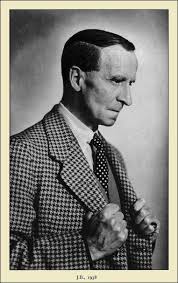 About the Author
John Buchan (1875 – 1940) was an author, poet, lawyer, publisher, journalist, war correspondent, Member of Parliament, University Chancellor, keen angler and family man. He was ennobled and, as Lord Tweedsmuir, became Governor-General of Canada. In this role, he signed Canada’s entry into the Second World War. Nowadays he is probably best known – maybe only known – as the author of The Thirty-Nine Steps. However, in his lifetime he published over 100 books: fiction, poetry, short stories, biographies, memoirs and history.
You can find out more about John Buchan, his life and literary output by visiting The John Buchan Society website.

 Top Ten Tuesday is a weekly meme created by The Broke and the Bookish and now hosted by Jana at
  This week is a Freebie with participants asked to come up with their own topic. I’ve chosen to look ahead to the nine (yes, only nine!) books left on my


