Welcome to today’s stop on the blog tour for Children’s Fate by Carolyn Hughes, the fourth book in her Meonbridge Chronicles series set in 14th century England. My thanks to Rachel at Rachel’s Random Resources for inviting me to take part in the tour and to Carolyn for my digital review copy. Do check out the posts by my tour buddies for today Anne at Being Anne and Elaine at Splashes Into Books.
 About the Book
How can a mother just stand by when her daughter is being cozened into sin?
It’s 1360, eleven years since the Black Death devastated all of England, and six years since Emma Ward fled Meonbridge with her children, to find a more prosperous life in Winchester. Long satisfied that she’d made the right decision, Emma is now terrified that she was wrong. For she’s convinced her daughter Bea is in grave danger, being exploited by her scheming and immoral mistress. Bea herself is confused: fearful and ashamed of her sudden descent into sin, but also thrilled by her wealthy and attentive client.
When Emma resolves to rescue Bea from ruin and tricks her into returning to Meonbridge, Bea doesn’t at first suspect her mother’s motives. She is happy to renew her former friendships but, yearning for her rich lover, Bea soon absconds back to the city. Yet, only months later, plague is stalking Winchester again and, in terror, Bea flees once more to Meonbridge. But, this time, she finds herself unwelcome, and fear, hostility and hatred threaten…
Terror, betrayal and deceit, but also love and courage, in a time of continuing change and challenge –
Format: ebook (452 pages) Publisher: Riverdown Books
Publication date: 26th October 2020 Genre: Historical Fiction
Find Children’s Fate (The Meonbridge Chronicles #4) on Goodreads
Purchase links
Amazon UK
Links provided for convenience only, not as part of an affiliate programme
My Review
Children’s Fate is the fourth in Carolyn Hughes’ series about the village of Meonbridge. You can find out more about the Meon Valley, the location of the fictional village, in this post on The History Girls blog. Carolyn’s website also has a very useful glossary of medieval terms. Readers new to the series – or those who need their memories jogged – need not worry because the author incorporates useful recaps on events in the first three books. Indeed, new readers may be surprised to learn that life in Meonbridge has not been without incident over the years.
As before, Children’s Fate explores the social and economic impacts of the Black Death on life. “Folk weren’t tied to manors any more, or to one master.” The focus of the story is very much on the women of the village, in particular Emma Ward and her daughter Bea. Life in Winchester brings opportunities for those prepared to grasp them but also temptations, as Emma and Bea will discover. Their return to Meonbridge coincides with the Midsummer celebrations which involve torchlit processions around the village ‘bone-fires’, music and dancing, feasting and ‘fire-leaping’ by the young men.
Building on historical fact, the year 1361 sees the return of the plague, presaged in the belief of many by a solar eclipse. For some, the resurgence of the pestilence is an Act of God, a sign of the Almighty’s displeasure at the prevalence of sin in their communities. The only defence is confession or the power of prayer. Luckily, we live in an age when science can provide us with facts about the method of transmission. Our 14th century forbears lacked such information although the instructions to ‘keep your families at home, avoid public places where you can’ and wear a face covering were strikingly familiar. Carolyn talks about the experience of writing about a pandemic and its aftermath during a pandemic here.
Faced with the indiscriminate nature of the pestilence and the loss of loved ones, it’s no surprise the people of Meonbridge search for answers as to why some live and others die and that some, fuelled by grief, despair and fear, look for scapegoats. As is often the case, suspicion falls on outsiders and those who have recently returned to the village. leading to some dramatic scenes. The book’s conclusion sees happy endings for some and, for others, their just desserts.
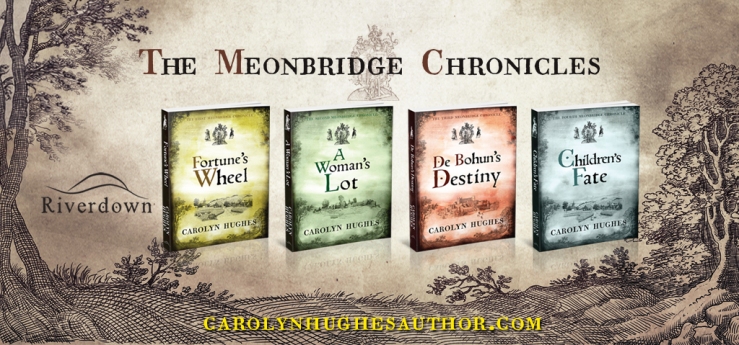
Looking back at my reviews of the three previous books in the series – Fortune’s Wheel, A Woman’s Lot and De Bohun’s Destiny – I see a frequent comment is how the detailed depiction of daily life gives the books a real sense of authenticity. This latest book is no exception. In Children’s Fate you don’t so much read about the folk of Meonbridge as dwell amongst them for a few precious hours.
In three words: Engaging, immersive, well-researched
Try something similar: The Turn of Midnight by Minette Walters
Follow this blog via Bloglovin
 About the Author
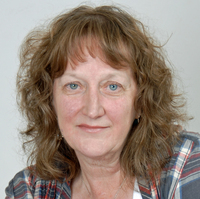
Carolyn Hughes was born in London but has lived most of her life in Hampshire. After completing a degree in Classics and English, she started her working life as a computer programmer, in those days a very new profession. But it was when she discovered technical authoring that she knew she had found her vocation. She spent the next few decades writing and editing all sorts of material, some fascinating, some dull, for a wide variety of clients, including an international hotel group, medical instrument manufacturers and the government.
She has written creatively for most of her adult life but it was not until her children grew up and flew the nest several years ago that writing historical fiction took centre stage in her life. She has a Master’s degree in Creative Writing from Portsmouth University and a PhD from the University of Southampton.
Children’s Fate is the fourth novel in the Meonbridge Chronicles series. A fifth novel is under way.
Connect with Carolyn
Website | Twitter | Facebook