
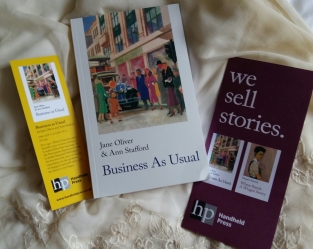
 About the Book
Hilary Fane, an Edinburgh girl fresh out of university, is determined to support herself by her own earnings in London for a year, despite the resentment of her surgeon fiancé. After a nervous beginning looking for a job while her savings rapidly diminish, she finds work as a typist in the London department store of Everyman’s (a very thin disguise for Selfridges).
Through luck and an inability to type well she rises rapidly through the ranks to work in the library, where she has to enforce modernising systems on her entrenched and frosty colleagues.
Format: Paperback (242 pages) Publisher: Handheld Press
Publication date: 23rd March 2020 [1933] Genre: Fiction, Modern Classics
Find Business as Usual on Goodreads
Purchase links
Bookshop.org
Disclosure: If you buy a book via the above link, I may earn a commission from Bookshop.org, whose fees support independent bookshops
Publisher | Hive | Amazon UK
Links provided for convenience only, not as part of an affiliate programme
My Review
Business As Usual by Jane Oliver and Ann Stafford was first published in 1933. It’s an epistolary novel with the story told by means of telegrams and memoranda, as well as letters from Hilary to her family and to her fiancé Basil. As in the original, this Handheld Classics edition is enlivened by occasional line drawings of characters and events featured in the book, the work of Ann Stafford. Kate Macdonald’s fascinating introduction also provides background information on the development of lending libraries as part of the services offered by stores like Everyman’s. There’s also a useful glossary.
Just like those to whom the book is dedicated – ‘The People Who Work From Nine Till Six’ – Hilary Fane works long hours, first in the book department of Everyman’s department store and then in its lending library. It’s a life of repetitive work, solitary lunches, weighing up how to spend every shilling, travelling to and from work on crowded buses, as well as the surreptitious washing of stockings (forbidden by her hostel’s rules).
Despite this, Hilary is a prolific letter writer especially to Basil, who works as a surgeon back in her home city of Edinburgh while she is seeking a career and independence in London. Interestingly, the reader never sees Basil’s replies to Hilary’s letters, only her responses to those replies. I have to say that pretty early on I developed a rather poor impression of Basil as Hilary seems to miss him a lot more than he does her. In one letter she writes rather touchingly, “I wish I had you here. It’s such a waste being happy alone. Happiness won’t hoard either. It isn’t the least use trying to keep it for the next black mood. It won’t even keep overnight.” I was not entirely disappointed, or surprised, by the later turn of events.
The book subtly reveals the class distinctions of the time. For example, as Hilary observes when she is given responsibility for the ‘Fiction C’ section of the lending library, “The best people don’t have Fiction C subscriptions, because they only cost 10/- a year and provide the copies that other people have spilt tea over or dropped in the bath”. This also gives you a sense of the humour that runs through the book such as the scene in which Hilary’s Aunt Bertha makes an unexpected visit to the library or when Hilary is called upon to investigate the case of the rabbit pie. Later, given the task of suggesting improvements to the library’s exceedingly complex processes which are jealously guarded by its longer serving members of staff, Hilary’s findings demonstrate there is little ‘rational’ about Everyman’s Rational Reader Services.
Hilary’s letters and memos featuring the occasional use of capital letters to stress important points, such as an ‘Immense Concession’ or a ‘Momentous Step’, put me in mind of Dear Mrs. Bird by A J Pearce, hence my ‘Try Something Similar’ recommendation below.
Business as Usual is a little gem of a book that is not only a delightfully entertaining read but provides an insight into a particular period of time and facet of everyday life. And anyway, who can resist a book set in a bookshop or library? Not this reader, certainly.
In three words: Charming, funny, spirited
Try something similar: Dear Mrs. Bird by A J Pearce
Follow this blog via Bloglovin
About the Authors
Jane Oliver was the pen-name of Helen Rees (née Evans, 1903-1970). After working as a PE teacher and as Clemence Dane’s secretary and learning to fly, Helen became a successful historical novelist. She was the widow of John Llewelyn Rhys in whose name she founded the John Llewelyn Rhys prize for Commonwealth writers from her own royalties. Ann Stafford (the pen-name of Anne Pedler, 1900-1966) also became a successful novelist. Together they published at least 97 novels. Business As Usual was their first joint book. They lived in Hampshire.


 About the Book
 About the Author

