
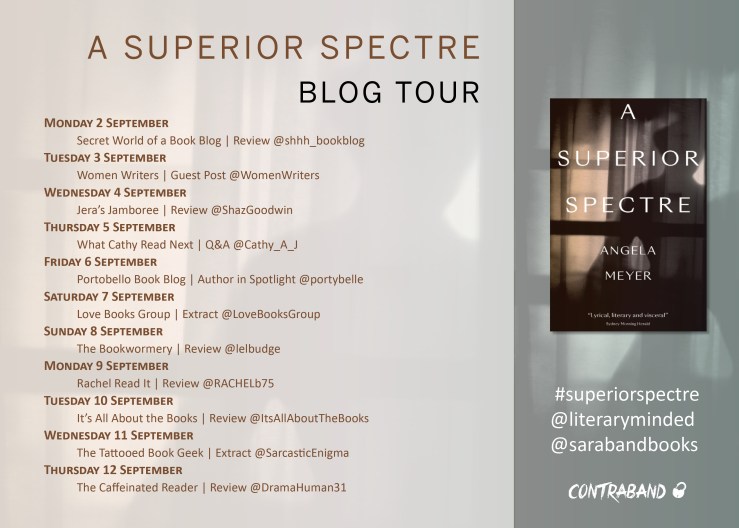
I’m delighted to welcome author Angela Meyer to What Cathy Read Next today as part of the blog tour for her novel A Superior Spectre. You can read my interview with Angela below.
 About the Book
Jeff is dying. Haunted by memories and grappling with shame, he runs away to a remote part of Scotland with a piece of beta tech that allows him to enter the mind of someone in the past. Instructed to only use it three times, Jeff – self-indulgent, isolated and deteriorating – ignores this advice.
In the late 1860s, Leonora lives in the Scottish Highlands, surrounded by nature. Contemplating the social conventions that bind her, her contented life and a secret romantic friendship with the local laird are interrupted when her father sends her to stay with her aunt in Edinburgh. But Leonora’s ability to embrace her new life is shadowed by a dark presence that begins to lurk behind her eyes, and strange visions.
A Superior Spectre is a novel about curiosity, entitlement and manipulation. It reminds us that the scariest ghosts aren’t the ones that go bump in the night, but those that are born and create a place for themselves in the human soul…
Format: Paperback (288 pp.) Publisher: Saraband
Publication date: 15th August 2019 Genre: Crime/Thriller, Historical Fiction, Literary
Purchase Links*
Amazon.co.uk | Amazon.com
*link provided for convenience, not as part of any affiliate programme
Find A Superior Spectre on Goodreads
Interview with Angela Meyer, author of A Superior Spectre
Angela, welcome to What Cathy Read Next. Without giving too much away, can you tell us a bit about A Superior Spectre?
Hi Cathy, thank you for having me on your blog! A selfish, dying man abuses an experimental technology that allows him to invade the mind of a nineteenth century Scottish woman. And while the book contains some big ideas, people have been finding it a page-turner (which is nice!).
The book is described as ‘a novel about curiosity, entitlement and manipulation’. What attracted you to exploring those particular issues?
We often talk about curiosity in a positive way, but curiosity is skewed by power, and dominant or cultural ideas of ‘right’ and ‘wrong’. A Superior Spectre asks questions about this on a large and small scale.
My character Jeff is someone who has grown up under capitalism, who is taught to feel entitled to indulge his curiosity, his thoughts and emotions, and he comes up against the ‘right’ and ‘wrong’ of his context. He dwells on, and feels great shame about, certain desires, and yet he continually invades the mind of a woman, and also treats the thoughts and feelings of other women in his life fairly dismissively. He’s a product of patriarchal capitalism, and I guess the novel is fairly sceptical about the fact that even with a literal empathic experience (living in Leonora’s head) it is difficult to shift what’s embedded in behaviour, in the mind.
I’m drawn to these themes because I’ve always been fascinated by the ways individual psychology is shaped by our social, political, cultural context (not just our immediate upbringing). There’s another layer to all this with the tech itself, and how readily we accept and incorporate new (commercially driven) technology into our lives.
In the book, Jeff ignores the advice to use the piece of experimental technology three times only. Is there a wider message there about our use (or misuse) of technology?
Tying in with the above, it’s quite a classic sci fi trope, really, but as relevant now than ever. The most incredible things are being done in neurotech. I just learned the other day about Elon Musk’s neuralink, for example. It’s all supposed to help people with devastating illness and disability. But they also say the tech will ‘enhance’ human ability. And who is going to have access to that first? Elon Musk. The one per cent. Who will also feel ‘entitled’ to enhance their abilities, to become superhuman? All of us in the West are taught we deserve such things…
A Superior Spectre is partly set in Scotland. What made you choose that as a location?
The simple answer is that it was just always set there. The idea itself was tied in with the place. I have spent a lot of time in Scotland and I love it deeply, like a person. I am not Scottish. I am part-Norwegian. I feel at home in these Northern landscapes. But my character, Jeff, is Australian, as I am. And it is his lens through which we see Scotland (partly or fully? Or at all? Readers decide when they read it).
Part of the book is set in the 1860s. How did you go about creating a picture of life in that period?
A combination of research, immersion in the places I write about, and some very ‘method’ writing which involved being holed up in isolated parts of Scotland with no electricity. I even stayed in Barnhill, George Orwell’s house, on the isle of Jura. Because so much of my writing is about sensation, about being in the body (or someone else being in your body!) I find that being or having been in the place you’re writing about, even if the past is just a ghost over the landscape, is helpful. But maybe I also, simply, feel entitled to my curiosity…
You’ve published award-winning short fiction. Are the challenges of writing a full-length novel different and, if so, in what way?
So many years! And also structure. A novel has to have multiple threads, has to have tension, has to have a satisfying payoff (in a plot and/or character sense), has to contain so much and keep the reader interested for so long. It’s a huge challenge. Short stories are difficult, but you can play, abandon, start again. A short story could be ‘about’ the mood, the rhythm of the sentences, the voice – not just the story. But to write one that works, that is resonant, is also a huge challenge. I want to keep getting better in both these forms.
You’ve worked in publishing. Did this help with the experience of seeing your own novel through to publication?
In Australia, because I am known in the industry, I think publishers did read it quite quickly, but it didn’t mean they picked it up! That took a year. What has been very helpful is understanding the publishing process. I know how hard it is to get published, how hard people work at all levels in publishing, and how limited the opportunities are for authors to have their books seen, read, talked about. I’ve truly been grateful for every opportunity, every stage of the process, and the fact that I get to go through it all again with A Superior Spectre now coming out in the UK.
Which other writers do you admire?
So many. Deborah Levy is a big one at the moment. Kafka has always been a favourite. John Cheever’s Diaries have been a wonderful companion in the last few years. Janet Frame. Australian writers Jane Rawson and Krissy Kneen. So many more…!
What are you working on next?
The next release is my Mslexia Award-winning novella, Joan Smokes. And I’m working on another novel, slowly…
Thanks, Angela, for those fascinating answers to my questions.
 About the Author
Angela Meyer’s Joan Smokes won the inaugural Mslexia Novella Competition in 2019. Her short fiction has been widely published, including in Best Australian Stories, Island, The Big Issue, The Australian, The Lifted Brow and Killings. By day she works as a publisher for Echo Publishing, an Australian imprint of Bonnier Books UK, and in this role has discovered and developed a range of award-winning, globally published and bestselling talent, including global number one bestselling author Heather Morris. A Superior Spectre, Angela’s debut novel, is already shortlisted for a number of prestigious awards.
Website | Twitter | Facebook | Instagram

 About the Book
 About the Author

 What Cathy Read Next...