

I’m delighted to be hosting today’s stop on the blog tour for The Mistress of Pennington’s by Rachel Brimble. Set in 1910, it’s described as a compelling tale of female empowerment in Bath’s leading department store and perfect for fans of the TV series Mr Selfridge and The Paradise.
Plus, there’s a giveaway (open internationally) with a chance for one lucky person to win a £20/$20 Amazon Gift Card. Enter using the Rafflecopter link here.
Giveaway Terms and Conditions – The winner will be selected at random via Rafflecopter from all valid entries and will be notified by Twitter and/or email. If no response is received within 7 days then the giveaway organiser reserves the right to select an alternative winner. Open to all entrants aged 18 or over. Any personal data given as part of the competition entry is used for this purpose only and will not be shared with third parties, with the exception of the winner’s information. This will passed to the giveaway organiser and used only for fulfilment of the prize, after which time the data will be deleted. I am not responsible for despatch or delivery of the prize.
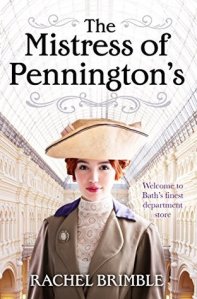 About the Book
Elizabeth Pennington should be the rightful heir of Bath’s premier department store through her enterprising schemes and dogged hard work. Her father, Edward Pennington believes his daughter lacks the business acumen to run his empire and is resolute a man will succeed him.
Determined to break from her father’s iron-clad hold and prove she is worthy of inheriting the store, Elizabeth forms an unlikely alliance with ambitious and charismatic master glove-maker Joseph Carter. United they forge forward to bring Pennington’s into a new decade, embracing woman’s equality and progression whilst trying not to mix business and pleasure.
Can this dream team thwart Edward Pennington’s plans for the store? Or will Edward prove himself an unshakeable force who will ultimately ruin both Elizabeth and Joseph?
Format: Paperback, ebook (454 pp.) Publisher: Aria Fiction
Published: 1st July 2018 Genre: Historical Fiction, Romance
Purchase Links*
Amazon.co.uk ǀ Amazon.com ǀ Kobo
*links provided for convenience, not as part of any affiliate programme
Find The Mistress of Pennington’s on Goodreads
My Review
Elizabeth Pennington seeks to be ‘Mistress’ of Pennington’s, the department store owned and run (with a very firm hand) by her father, Edward, but she’s not there yet. Recalling the words of her mother, ‘Go forth and conquer the world, Elizabeth’, Elizabeth hopes things are about to change, with the help of talented glove-maker, Joseph Carter.
One can perhaps forgive the instant attraction – from their very first glimpse of each other – between the beautiful Elizabeth and the handsome Joseph, since it soon becomes apparent they share a history of tragedy in their personal lives and recognise in each other a similar social outlook and driving ambition. For Joseph, the attraction is heightened by the fact that Elizabeth seems to possess the same qualities as a woman who played a big part in his life and whose influence still drives him. For Elizabeth, the attraction is heightened by the difference she sees between Joseph and the sort of men her father favours as potential suitors – men who’ve achieved their wealth and position in society through inheritance rather than their own endeavours. However, both Elizabeth and Joseph have reservations about entering into a relationship that might become more than merely professional. When it becomes apparent there is previous history between the two families, things become even more complicated.
The book is set in an interesting period when the campaign for women’s suffrage was reaching its peak. The prejudice those courageous and doughty campaigners faced is encapsulated in the character of Edward Pennington, who clearly believes women are good for nothing more than child rearing or providing pleasure in the bedroom. Edward finds it difficult to see beyond Elizabeth’s gender and recognise her obvious business acumen, seeing her new ideas for Pennington’s as a threat rather than as a valuable contribution to the success of the business (as you suspect he would if they had come from a man). For example, her suggestion of a trial of Joseph’s designs elicits the dismissive response: ‘Will you be able to control your feminine desires long enough to wrangle a profitable deal for the store?’
It’s also a time when the opportunities for mass production and mass marketing are being explored by those with vision in the commercial world. Edward Pennington definitely does not fall into this category. You get the feeling that, even if the story line was moved to the modern day, Pennington’s would be the only department store without an online presence.
I haven’t watched either of the TV series with which the book has been compared – Mr. Selfridge and The Paradise – so can’t comment on the accuracy of the comparison. However, I can envision The Mistress of Pennington’s making ideal Sunday night viewing. I can also see the book, with its engaging leading characters, period setting and romantic story line, appealing to Rachel Brimble’s many fans and to those looking for a new historical fiction saga in which to become engrossed. There are some loose ends – including one quite large one – left unresolved, no doubt deliberately so they can be picked up in future books in the series.
I received a review copy courtesy of Rachel’s Random Resources in return for an honest and unbiased review.
In three words: Engaging, light, romance
Try something similar…The Indigo Girl by Natasha Boyd (read my review here)
 About the Author
Rachel lives with her husband and two teenage daughters in a small town near Bath in the UK. Since 2007, she has had several novels published by small US presses, eight books published by Harlequin Superromance (Templeton Cove Stories) and four Victorian romances with eKensington/Lyrical.
In January 2018, she signed a four-book deal with Aria Fiction for a brand new Edwardian series set in Bath’s finest department store. The first book, The Mistress of Pennington’s was released in July 2018.
Rachel is a member of the Romantic Novelists Association and Romance Writers of America, and was selected to mentor the Superromance finalist of So You Think You Can Write 2014 contest. When she isn’t writing, you’ll find Rachel with her head in a book or walking the beautiful English countryside with her family. Her dream place to live is Bourton-on-the-Water in South West England.
Connect with Rachel
Website ǀ Blog | Facebook ǀ Twitter ǀ Instagram ǀ Goodreads

 About the Book
 About the Author

