 About the Book
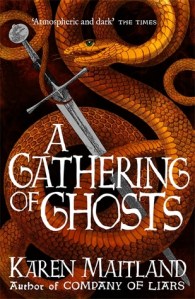
The year is 1316 and high on the wilds of Dartmoor, hidden by the mist, stands the isolated Priory of St Mary, owned by the Sisters of the Knights of St. John. People travel from far and wide in search of healing at the ancient holy well that lies beneath the chapel.
But the locals believe the well was theirs long before Christianity arrived and there are those who would do anything to reclaim their sacred spring… As plagues of frogs cascade from the well and the water turns to blood, is there witchcraft afoot? Or is the Old World fighting back at last?
Format: Hardcover, ebook (544 pp.) Publisher: Headline Review
Published: 6th September 2018 Genre: Historical Fiction, Historical Thriller
Purchase Links*
Amazon.co.uk ǀ Amazon.com ǀ Hive.co.uk (supporting UK bookshops)
*links provided for convenience, not as part of any affiliate programme
Find A Gathering of Ghosts on Goodreads
My Review
I read my first Karen Maitland book – The Vanishing Witch – in 2016 and immediately upon finishing it added all her other medieval thrillers to my wishlist on Goodreads. I actually have a copy of The Plague Charmer sitting on my bookshelf unread (which is a crime in itself). My abiding impression of The Vanishing Witch was of the author’s skill in creating an intense atmosphere and sense of the supernatural, all combined with an intriguing mystery. I’m pleased to say this is equally evident in A Gathering of Ghosts which has atmosphere and elements of the supernatural by the bucket load!
The Dartmoor of the book is not a place for the casual sightseer but a wild place of wind and rain, and bogs waiting to trap the unwary traveller. It’s certainly not somewhere you want to venture late at night when it takes on a nightmarish quality and, as some of the locals believe, the spirits of the netherworld hold sway. As one visitor to the Priory observes, ‘…both sisters and servants had babbled about rampaging tinners and murderous outlaws, as if Dartmoor was to be found on the edge of the world among the isles of the dog-headed men rather than in the civilised realm of fair England.’
Set largely in the isolated Priory of St. Mary, cut off for months at a time due to winter storms and autumn rains, the author creates a unsettlingly claustrophobic atmosphere that seems to affect some of the Sisters more than others. (Shades of Black Narcissus here.) The arrival of one small boy creates an even more unnerving atmosphere, for reasons the reader will soon discover.
The presence of an ancient holy well beneath the priory chapel, now dedicated to St. Lucia but believed by the locals to belong to the pagan goddess, Brigid, is just one of the many oppositions explored in the book: religious belief versus superstition, pagan versus Christian, good versus evil. Whatever their beliefs, though, their adherents seem to share a similar conviction that, if they only make their appeals fervently enough, their wishes will be granted. On occasions, this doesn’t happen exactly in the way they were expecting. Another opposition in the book is male versus female but, happily, the men don’t always escape punishment for their actions and, in some ways, the female characters are seen as possessing if not superior power in this world, then the ability to call on superior power from the spirit world or from God.
The book contains some fascinating detail about the tin mines found on Dartmoor at the time and the so-called ‘stannary’ law that applied to their operation. For some, the tin mines are a vital source of employment and food in a time of famine or a refuge. Others see the excavations as a wounding of the land, upsetting the balance of nature. For some, the threat the tinners pose is more commercial. As one of the book’s narrators, Sorrel, finds out they certainly weren’t pleasant places to be, particularly for a woman. ‘But as we breasted the rise, the noise that burst in my ears made me stagger backwards: iron hammers smashing granite, stones crashing into buckets, the whinnying of packhorses, the shouts of men, the bellows of women and the yells of children… It was as if the ground had yawned wide before me and I was starting down into the pit of Hell.’
Readers who like a good dose of the supernatural in their historical mysteries will love A Gathering of Ghosts. Readers who like a strong sense of period atmosphere will likewise be more than happy. And all will no doubt appreciate the extent of the author’s research, as evidenced by the fascinating Historical Notes and extensive Glossary at the end of the book.
I received an advance review copy courtesy of publishers, Headline, and NetGalley in return for an honest and unbiased review.
In three words: Atmospheric, spooky, dark
Try something similar…The Dark Monk (The Hangman’s Daughter #2) by Oliver Potzsch
 About the Author
Karen Maitland has recently moved to the wonderful county of Devon and has a doctorate in psycholinguistics. She is fascinated by the myth and magic of the Middle Ages, which she draws on for her novels. She experienced the medieval lifestyle for real, when she worked for eighteen months in a rural village in Nigeria, living without electricity, plumbing or sanitation.
Her first medieval thriller was Company of Liars, was set at the time of the Black Death in 1348. This was followed by The Owl Killers, about the beguinages, the medieval cities of women. The Gallows Curse is set in the reign of bad King John and Falcons of Fire and Ice, which is a dark thriller, set in Portugal during the Inquisition and Iceland at the time of the Reformation. She is published by Michael Joseph/Penguin.
Karen is also one of six historical crime writers known as the Medieval Murderers – Philip Gooden, Susannah Gregory, Michael Jecks, Bernard Knight and Ian Morson – who together write an annual joint murder-mystery novel, including The Sacred Stone, Hill of Bones and The First Murder published by Simon & Schuster.
Connect with Karen

 About the Book
 About the Author