Blog Tour/Review: The Marriage of Miss Jane Austen, Vol.1 by Collins Hemingway

TMOMJA_Blog Tour Banner_FINAL

I’m delighted to be hosting today’s stop on the blog tour for Volume 1 of Collins Hemingway’s trilogy, The Marriage of Miss Jane Austen.   (Volumes 2 & 3 are also available to purchase.) You can read my review below but safe to say it’s perfect for fans of Jane Austen’s books or lovers of historical romances (even those who’ve never read Jane Austen).

WinI’m pleased to say there is a giveaway (INTL) with a chance to win one of two paperback copies of The Marriage of Miss Jane Austen.  To enter and view the giveaway rules, visit the tour page here and scroll down to the bottom of the page.

But get your skates on, as entries must be received by 11:59pm EST on January 12th 2018.


The Marriage of Miss Jane AustenAbout the Book

Everyone should marry once for love – even Jane Austen.

Jane Austen, single and seemingly comfortable in the role of clergyman’s daughter and aspiring writer in the early 1800s, tells friends and family to hold out for true affection in any prospective relationship. Everybody, she says, has a right to marry once in their lives for love.  But when, after a series of disappointing relationships, the prospect of true love arrives for her, will she have the courage to act?

The Marriage of Miss Jane Austen re-imagines the life of England’s archetypal female by exploring what might have happened if she had ever married. It shows how a meaningful, caring relationship would have changed her as a person and a writer.  It also takes her beyond England’s tranquil country villages and plunges her info what the Regency era was really about: great explorations and scientific advances, political foment, and an unceasing, bloody war.  In such times, can love – can marriage -triumph?

Praise for The Marriage of Miss Jane Austen

“What if Austen, who penned so many classic love stories, found her own romantic match? Ashton Dennis fits right into the Austen universe, while this Jane remains true to life, an intelligent and determined young woman. The writing is Austen-ian, and Hemingway has a talent for witty banter and wry observations that would make Elizabeth Bennet proud. An enjoyable first novel in an imaginative, well-researched series.”  (Kirkus Reviews)

“A skilful portrayal of a…literary icon takes this historical romance on an imaginative journey of the soul. … Insight and intuition, along with meticulous research, have created a believable version of her character in this tender story of Ashton and Jane. … Excellent character development enhances the plausibility of the scenario. Background, motivation, eccentricity – everything that constitutes a personality allow these fascinating people to step off the pages in lifelike form.” (Julia Ann Charpentier, Foreword CLARION Reviews, 4 stars)

“All readers of Jane Austen wonder what Jane’s life might have been like had she married, or had money. The Marriage of Miss Jane Austen explores these intriguing possibilities. It also depicts Austen in a rapidly changing world, connecting her to important aspects of the era-war, slavery, industrialization, and new modes of travel. Hemingway’s book raises many ‘what if’s’ in his thoughtful and thought-provoking portrayal of Jane Austen falling in love.” (Susannah Fullerton, author of A Dance with Jane Austen and Happily Ever After: Celebrating Jane Austen’s Pride and Prejudice)

“[An] engaging and remarkably convincing romance. …Wry, observant, laconic – much like Jane Austen herself, without ever dipping into pastiche or mimicry. … Hemingway, with the lightest touch, builds up a thoroughly convincing alternative history for Jane. …[A] thoughtful re-imagining of Austen’s love life.” (Joceline Bury, Jane Austen’s Regency World)

Format: Hardcover, eBook, paperback (200 pp.)  Publisher: AuthorHouse
Published: 20th June 2015                                          Genre: Historical Fiction

Purchase Links*
Amazon.co.uk  ǀ  Amazon.com
*links provided for convenience, not as part of any affiliate programme

Find The Marriage of Miss Jane Austen, Vol.1 on Goodreads


My Review

The author has created a fun, light and affectionate tribute to Jane Austen alongside speculating on how her life might have turned out had she married, and delivering an engaging historical romance.   The book captures the spirit of Jane Austen’s appraising eye of society, its foibles and – to modern day eyes – its bewildering rules of etiquette.

Jane and her sister, Cassandra, despite neither of them being that old, find themselves on the way to being consigned to the ranks of spinsterhood.  ‘She was in her own clique, of course, along with Cass, that of women who were stylish, if overly stale.  Her invitations no longer came from young men who were on their way up in society but from older men who had stalled or were in decline: unmarried clergy from poorly endowed parishes or lately widowed men of middle age and anxious finance.’

It doesn’t help that their branch of the family is relatively poor and dependent on the support of more well-off relatives for both money and accommodation, moving from house to house of acquaintances and distant family members.  As Jane writes, ‘Like travelling minstrels, we earn our victuals by entertaining our hosts and helping with the odd family tasks.  One afternoon chasing the children around, two witty rejoinders, and three darned stockings will earn a meal, by my estimation.’

In fact, Jane and Cassandra have begun to think that love and marriage is something they will never experience since both have suffered the tragic loss of men for whom they had felt affection.  ‘Cassandra’s expression shaded from thoughtfulness to entreaty and finally pain. “Shall we never find love?” she asked.  “Is it over?  Are we never to be happy?  Never to embrace the kindness of a man, the blessings of a child?”’

However, Jane does have an admirer: Ashton Dennis, a wealthy young man.  But although she likes him, she can feel no romantic affinity with him as he has little interest in literature or the arts.  His focus seems only to be on the business of running his family’s estate.  And Jane could never love or consider marriage to a man like that could she?

When Ashton goes abroad to “find himself”, as we might describe it these days, he and Jane strike up a lively, witty correspondence, which makes up Part 2 of the book.   Jane provides him with news from home about current affairs and scientific developments.  This provides the opportunity for the author to give the reader a fascinating insight into important events of the time such as the Louisiana Purchase (the sale of Louisiana by Napoleon to America), the progress through Parliament of the Anti-slavery Bill, and the latest scientific and technological discoveries.  Over the months he is away, as she reads Ashton’s letters in response to hers, Jane gradually starts to see a different side to him.  How this will be resolved is the subject of Part 3 of the book.

As well as the story of Jane and Ashton, there is much for lovers of Jane Austen’s novels to enjoy with many scenes alluding to plot lines, characters or events in her books (although at the time this book is set, she has yet to be published).  So, for example, we have Ashton’s mother warning off Jane from any marital interest in him, much in the way Lady Catherine de Burgh tries to do with Elizabeth in Pride and Prejudice…and taking possession of the most famous line from that book to boot.  “A single man in possession of a good fortune does not automatically need a wife – not from your class.  It is a misconception from which both you and your mother suffer.”

The author also captures the witty, acute observations readers have come to expect in Austen’s novels.

On being asked her view of a potential match for Ashton: “She is the sort of person who professes a love of books without reading, and who is lively without wit. Yet – Mr Dennis – I am not the person to ask about marriage.  I live on the corner of Old and Unattached.”

On dealing with marriage proposals: ‘Every polished young woman has a dozen stratagems to deflect the purpose of an unwelcome suitor.  One practices firm but gentle rebuffs in front of the mirror almost as often as one practices coquettish ways of saying yes to the proper man.’

I also loved this little joke about writing a book as Ashton reacts in amazement that Jane has written a novel that has been accepted for publication: ‘To think that you have spent – what, a year, more? – to compose a work on a single topic, about a set of characters, is beyond my ken.  I salute you, madam!’

This was a fun, engaging, well-written book that captured the spirit of Jane Austen’s books and which I really enjoyed.  I received a review copy courtesy of Historical Fiction Virtual Book Tours in return for an honest and unbiased review.

Follow my blog with Bloglovin

In three words: Light, affectionate, romance

Try something similar…Duels & Deception by Cindy Anstey (click here to read my review)


Collins HemingwayAbout the Author

Whether his subject is literature, history, or science, Collins Hemingway has a passion for the art of creative investigation. For him, the most compelling fiction deeply explores the heart and soul of its characters, while also engaging them in the complex and often dangerous world in which they have a stake. He wants to explore all that goes into people’s lives and everything that makes them complete though fallible human beings. His fiction is shaped by the language of the heart and an abiding regard for courage in the face of adversity.

As a non-fiction book author, Hemingway has worked alongside some of the world’s thought leaders on topics as diverse as corporate culture and ethics; the Internet and mobile technology; the ins and outs of the retail trade; and the cognitive potential of the brain. Best known for the #1 best-selling book on business and technology, Business @ the Speed of Thought, which he co-authored with Bill Gates, he has earned a reputation for tackling challenging subjects with clarity and insight, writing for the non-technical but intelligent reader.  Hemingway has published shorter non-fiction on topics including computer technology, medicine, and aviation, and he has written award-winning journalism.

Published books include The Marriage of Miss Jane Austen trilogy, Business @ the Speed of Thought, with Bill Gates, Built for Growth, with Arthur Rubinfeld, What Happy Companies Know, with Dan Baker and Cathy Greenberg, Maximum Brainpower, with Shlomo Breznitz, and The Fifth Wave, with Robert Marcus.

Hemingway lives in Bend, Oregon, with his wife, Wendy. Together they have three adult sons and three granddaughters. He supports the Oregon Community Foundation and other civic organizations engaged in conservation and social services in Central Oregon.

Connect with Collins

Website  ǀ  Facebook  ǀ  Twitter  ǀ Pinterest  ǀ Instagram ǀ Goodreads


TMOMJA_Blog Tour Banner_FINAL

Blog Tour/Q&A: Blackmail, Sex and Lies by Kathryn McMaster

Blackmail Sex Lies Initial Banner

I’m thrilled to be co-hosting today’s stop on the blog tour for Blackmail, Sex and Lies by Kathryn McMaster. The book is based on the true story of Madeleine Smith who was accused of murdering her lover.  Be sure to check out the other great book bloggers taking part in the tour.

Below I have a fascinating interview with Kathryn in which she talks about her research for the book, the need for multi-tasking, why Sunday is writing day and her childhood fascination with true crime stories.

WinWhy not enter my giveaway with a chance to win your own ebook copy of Blackmail, Sex and Lies. To enter, click here. The winner will be selected at random. Entries must be received by 20th December 2017.


Follow my blog with Bloglovin


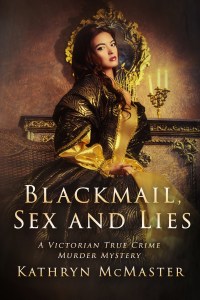
Blackmail Sex Lies - CoverAbout the Book

Blackmail, Sex and Lies is a story of deception, scandal, and fractured traditional Victorian social values. It is the tale of a naïve, young woman caught up in a whirlwind romance with a much older man. However, both have personality flaws that result in poor choices, and ultimately lead to a tragic end.

This Victorian murder mystery, based on a true story, takes place in Glasgow, Scotland, 1857. It explores the disastrous romance between the vivacious socialite, Madeleine Hamilton Smith, and her working class lover, Pierre Emile L’Angelier. After a two-year torrid, and forbidden relationship with L’Angelier, that takes place against her parents’ wishes, the situation changes dramatically when William Minnoch enters the scene. This new man in Madeleine’s life is handsome, rich, and of her social class. He is also a man of whom her family approve. Sadly, insane jealous rages, and threats of blackmail, are suddenly silenced by an untimely death.

For 160 years, people have believed Madeleine Smith to have been guilty of murder. But was she? Could she have been innocent after all?

Format: ebook, paperback (198 pp.) Publisher: Drama Llama Press Published: 30th August 2017         Genre: True Crime, Historical Fiction

Purchase Links*
Amazon.co.uk ǀ Amazon.com
*links provided for convenience, not as part of any affiliate programme

Find Blackmail, Sex and Lies on Goodreads


Interview: Kathryn McMaster, author of Blackmail, Sex and Lies

Without giving too much away, can you tell me a bit about Blackmail, Sex and Lies?

The book is based on a true story that took place in 1857. A young, naïve, Glaswegian socialite, Madeleine Smith is charmed and beguiled by an older man, Pierre Emile L’Anglier. He is a social climber, not of her class, who uses Madeleine in the worst possible way to improve himself in seducing her and then telling her that there is really no way out of the situation, as under Scottish law they are now married. The relationship becomes controlling and abusive, and eventually he dies, rather unexpectedly. For 160 years, Madeleine was suspected of murdering him. But did she? Evidence shows otherwise, but you will have to read the book and decide for yourself.

Blackmail, Sex and Lies is described as ‘creative non-fiction’. Why did you choose to write a fictionalised account of the story of Madeleine Smith?

There were already eight or nine books published as true accounts of the Madeleine Smith story, but nothing that showed us the terrible state of mind she must have been in. She was still a minor, she was forbidden by her family to see this man, but continued to do so, and therefore she had no one to unburden herself when the relationship turned toxic. Reading a dry, factual account does not bring the characters to life, shows their inner fears, nor do you get a feel for how society was in those days, and how the events affected all those involved, including her family. Fictionalising true crimes does this. However, you have to be still careful that you stick the facts and you don’t stray too far from what took place.

You’ve chosen an arresting title for the book. How did you come up with it?

Blackmail, Sex and Lies encapsulates the contents of the book perfectly. L’Angelier seduces her, Madeleine lies to him as she tries to extract herself from the relationship that has turned abusive, and then he blackmails her.

How did you approach the research for the book? Do you enjoy the process of research?

I love researching. For about ten years, I researched both my and my husband’s family trees, and so poring over old documents, court records, census records, and newspapers of the day is nothing new. I use all of these resources at my disposal before sifting through the facts, inconsistencies and opinions of others before writing. The research period can sometimes be as long as three or four months before I start outlining the book, and deciding whether the accused was innocent or guilty. Only then do I start writing.

What was the most surprising fact you uncovered during your research?

It would have to be the open use of arsenic in everyday living during the Victorian era. Yes, they impregnated flypaper to kill flies, fair enough, but they also used it in dyes for wallpaper, paint, and even fabrics. The users often complained to the manufacturers that these products made them ill, but their complaints were ignored. In addition to that, they used it as a beauty product to soften the face and skin when added to water. Right up until the late 18th century, and even the early 19th century arsenic soap and arsenic wafers were used as cosmetics both in Britain and America. In the book I have advertisements where they advocate the use of arsenic. L’Angelier himself was an arsenic eater, taking it for stamina and to improve his health. So you can see the dilemma now of his death and the accused’s position.

What was the biggest challenge you encountered when writing the book?

Time. I run several author Facebook groups and I also co-own the book marketing platform, One Stop Fiction. This takes a lot of time away from my writing, and it always a difficult balance to make sure one doesn’t suffer at the expense of the other.

You’ve written that what fascinates you is the ‘why’ rather than the ‘how’ of crime. Where does this interest come from?

For about forty-five years I have been interested in crime and the criminal mind. My father had a large library of true crime books, and while others were reading Enid Blyton and other safer fiction for their age, I would sneak these books into my room and read them with the aid of a torch under the bedclothes. I was fascinated and horrified at the same time.

This interest never left me, and after a long career in secondary and adult education, I started taking courses on criminal profiling and a degree in Forensic Science, Criminal Investigation. It is definitely the most interesting part of the crime, because nine times we know how a crime has been committed. However, the motive behind such a killing is more interesting. What was the trigger that caused this person to turn to crime, and to commit heinous acts against others? What makes the mind of the criminal tick? How different would they have turned out if they had been brought up in a different environment? Are criminals born or are they created? These are the questions that I find the most interesting.

Do you have a special place to write or any writing rituals?

Because I am so busy, and at my computer every day, for a lot of the day, I write when I can. I now set Sunday aside as my writing day, but do try and write a few paragraphs each day, during the week. It is not ideal, and I get frustrated when I can’t find the time to write. If I am at a part in my writing where I cannot break off and leave it, it is not uncommon for me to be writing late into the early hours of the following morning, or even getting up at 3:00 a.m. to get a chapter written before my working day begins. My special writing place is usually either in bed or on the couch. As all my children are adults, and I am ‘retired’ I have very few interruptions within the home, for which I am grateful.

Which other writers do you admire?

I admire anyone who can spin a good, entertaining story that sucks you in from the first pages, and has you captivated until the last. There are some authors who are consistently good at doing that, and then there are others who write a ‘one hit wonder’ and seem to lose their mojo and never write anything great after that. While I love reading, I won’t pick up a book based on the author, but rather by the reviews that it has received, and the storyline to see if it will be of interest to me. With time being so precious, I don’t have the time to waste on authors who trade on their reputation they made with one or two novels, and then didn’t write anything great after that.

What are you working on next?

I am a little undisciplined in my writing as I have so many ideas for books that I may start one manuscript, and then something else pops up that grabs my attention, so I leave that book to research the next story. I think I have at least four manuscripts that I started recently, none of them finished, or even close to finished.

One deals with a very strange murder that took place in the late 1990s down in the south of England. Another, entitled Six Short Summers, is about Barbara Whitham Waterhouse who was murdered in 1891. Her murder needs to be told as it is related to my first book, Who Killed Little Johnny Gill?. John Gill’s murder and mutilation was so atrocious that it was thought to be the work of Jack the Ripper, however, when Barbara was murdered, her injuries were very similar to that of Johnny Gill’s, who had been murdered in Manningham, Bradford, three years earlier and just eight miles apart.

Barbara’s story is the one I need to finish after the one I am currently writing, entitled Triple Murder at Sea, about a murder that took place aboard the sailing vessel the Herbert Fuller in 1896. I started writing this after Johnny Gill, but then Madeleine Smith derailed me, and so I left it for a while. Triple Murder at Sea is a novella, offered free to subscribers to my website – when it is finished – which should be before Christmas, if all goes well!

Thank you, Kathryn, for those fascinating answers to my questions.


Kathryn mcmasterAbout the Author

Kathryn McMaster is a writer, entrepreneur, wife, mother, and champion of good indie authors. She co-owns the book promotion company One Stop Fiction where readers can sign up to receive news of free and discounted 4 and 5 star reviewed books. She is also a bestselling author of historical murder mysteries set in the Victorian and Edwardian eras. Her debut novel, Who Killed Little Johnny Gill? was well received. All her novels are based on true stories and she melds fact with fiction, writing in the creative non-fiction style. She lives on her 30 acre farm in the beautiful Casentino Valley, Italy for 6 months of the year, and during the other half of the year, on the small island of Gozo, Malta.

Connect with Kathryn

Website ǀ Facebook ǀ Twitter ǀ Goodreads

Blackmail Sex and Lies - Full Banner