
I’m delighted to be hosting today’s stop on the blog tour for Lords of the Greenwood by Chris Thorndycroft and to bring you an absolutely fascinating guest post from Chris exploring the origins of two of the fictional titles commonly given to that famous outlaw, Robin Hood.
 There’s also a giveaway (open internationally) with a chance to win one of two ebook copies of Lords of the Greenwood. You can enter via the tour page here (scroll down to the bottom of the page) where you can also find links to reviews, extracts and interviews with the author hosted by the other great bloggers on the tour.
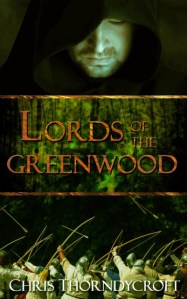 About the Book
Nottinghamshire, 1264. England is on the brink of civil war. The barons are in revolt against King Henry III. Such times suit Roger Godberd, sergeant in the garrison at Nottingham Castle. After throwing in their lot with the barons who embark on a bloody campaign for control of England, Roger and his companions are betrayed and seek refuge in Sherwood Forest. There they begin their new lives as outlaws evading their old enemy, the High Sheriff of Nottinghamshire.
Yorkshire, 1320. Wrongfully accused of murder, young Robert Hood of Wakefield finds himself outlawed with only his bitter enemy Will Shacklock for company. Taking to the woods of Barnsdale, Robert and Will agree on an uneasy truce and begin recruiting a band of robbers fleeing the chaos of the Earl of Lancaster’s rebellion against King Edward II. Eventually drawing the attention of the king himself, Robert and his band are given a choice; be hanged as common criminals or enter the king’s service as agents of the crown…
Blending real history with medieval ballads this is the entwined saga of two men, separated by a generation, united by legend, who inspired the tales of England’s famous hooded outlaw.
Format: ebook (469 pp.) Publisher:
Published: 16th January 2018 Genre: Historical Fiction
Purchase Links*
Amazon.co.uk ǀ Amazon.com ǀ Smashwords
*links provided for convenience, not as part of any affiliate programme
Find Lords of the Greenwood on Goodreads
Guest post: ‘Locksley or Huntington? Robin Hood’s Noble Heritage’ by Chris Thorndycroft, author of Lords of the Greenwood
Robin of Locksley? Earl Robert of Huntington? Common ragamuffin or disgraced nobleman? The background of Robin Hood and the reasons for his outlawry vary from story to story and are really at the discretion of the writer. Sometimes he’s a local lad peeved by the mistreatment of his fellow commoners but more often than not he is a man of rank with lands and titles to his name. I’m not going to go into all the historical candidates for the real Robin Hood here but the origins of two fictional titles often given to our favourite forest outlaw are interesting in themselves.
The earliest association of Robin with the Earl of Huntington was in Anthony Munday’s 1601 play The Downfall of Robert, Earl of Huntington and its sequel The Death of Robert, Earl of Huntington. Filled with love triangles, skulduggery and the usual Shakespearean shenanigans of crossdressing and mistaken identities, these plays were also the first stories to place Robin Hood in the reign of Richard the Lionheart (the only king mentioned in the early ballads is an unspecified King Edward).
Nobody knows where Munday got the idea that Robin Hood was the Earl of Huntington but it was probably just a bit of fantasy on his part which caught on. Interestingly, there is a grave in the grounds of where Kirklees Priory once stood (the traditional place of Robin’s death in the ballads) which has the following inscription:
Hear Underneath dis laitl Stean
Laz robert earl of Huntingtun
Ne’er arcir ver as hie sa geud
An pipl kauld im robin heud
Sick utlawz as hi an iz men
Vil england nivr si agen
Obiit 24 kal Dekembris 1247

The pseudo-archaic English suggests that the current monument is a modern replica. Indeed, the 1569 chronicle of Richard Grafton (and a sketch done by historian Nathanial Johnston in 1665) makes no mention of the Earl of Huntington on the gravestone1. The current inscription may have been taken from the 1630 ballad A True Tale of Robin Hood by Martin Parker which, clearly inspired by Munday’s plays, gives a very similar epitaph2.
The Earl of Huntington is a non-existent title but Munday may have been thinking of Huntingdon which is a title in the peerage of England. Created in the last days of Saxon England, the first Earl of Huntingdon was Waltheof who twice rebelled against William the Conqueror and, at the time of his execution, was the last of England’s Saxon earls. Through his daughter’s marriage to King David of Scotland, the earldom passed to Scottish princes. It was one of these princes (David, the 8th Earl) who helped besiege Nottingham Castle ahead of Richard the Lionheart’s return to England in 1194. When the last earl died childless in 1237, the title became extinct.
Even taking into account the six successive creations of the title over the years, there has never been an Earl of Huntingdon called Robert to date, however the swashbuckling exploits of Waltheof and Earl David may have inspired Munday to use the title in his plays.
And what of Locksley? This connection originated in a narrative called the Sloane Manuscript dating from about 1600. Mixing bits of the ballads with snippets of local folklore, the manuscript claims that Robin Hood was born in ‘Lockesley’, Yorkshire in the reign of Richard I and that he became an outlaw after incurring large debts.
There is a Loxley in South Yorkshire that lies within the boundaries of Hallamshire which traditionally belonged to the Earls of Huntingdon (possibly presenting us with an interesting cross-pollination of folklore). The 17th century antiquarian Roger Dodsworth claimed that, not only did Robin hail from Loxley, but the Earl of Huntingdon was in fact Little John!3 Several Earls of Huntingdon were called John but nothing about them stands out as an indication that they were Robin Hood’s faithful lieutenant.
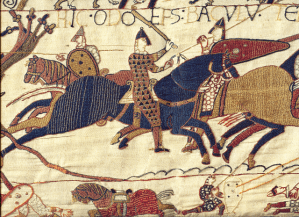
There is also a Loxley in Warwickshire and the antiquarian J. R. Planche suggested that its 12th century lord, Robert Fitz Odo, was the real Robin Hood (drop the Fitz and you’ll see what he means)4. This Robert Odo of Loxley appears to have been stripped of his knighthood and disinherited in 1196 but there is no record of him turning outlaw.
Interestingly, there is a grave in a Loxley churchyard dedicated to Constance, a member of the family who owned Loxley Hall in the 19th century, but the grave slab is much older and bears a striking resemblance to the drawing done by Nathanial Johnston of Robin Hood’s grave at Kirklees. Is this the original Kirklees gravestone removed to Loxley by people who knew that the real Robin Hood was Robert Fitz Odo? Or is the Loxley gravestone a replica? Or is it all just a coincidence? Impossible to say.
Sir Walter Scott cemented the Locksley tradition in his 1820 novel Ivanhoe. His version of Robin as a common freedom fighter standing up for the oppressed Saxons during the reign of Richard the Lionheart is a version most books and movies have conformed to ever since. The Huntington connection has not wholly died out and was used perhaps most memorably in the 1984-1986 British TV series Robin of Sherwood which cleverly utilised two Robins – Robin of Loxley and Robert of Huntingdon.
Whatever writers of fiction choose to call Robin Hood there is a wealth of possibilities for the character’s background. England’s histories of dispossessed knights and rebellious earls have long been rich pickings for a swashbuckling origin story and they will continue to be so. © Chris Thorndycroft
Sources
- Richard Grafton, A Chronicle at Large… (1569) http://d.lib.rochester.edu/teams/text/richard-graftons-chronicle-at-large-1569
- Martin Parker, A True Tale of Robin Hood http://www.sacred-texts.com/neu/eng/child/ch154.htm
- Joseph Hunter, The Great Hero of the Ancient Minstrelsy of England, “Robin Hood”: His Period, Real Character, Etc. Investigated, and Perhaps Ascertained (1883) https://books.google.no/books?id=01QJAAAAQAAJ&printsec=frontcover&dq=bibliogroup:%22Mr.+Hunter%27s+critical+and+historical+tracts%22&hl=en&sa=X&ved=0ahUKEwjc7bO62NzZAhUODOwKHWL9CuIQ6AEILzAB#v=onepage&q&f=false
- J.R. Planche, A Ramble with Robin Hood (1864)
 About the Author
Chris Thorndycroft is a British writer of historical fiction, horror and fantasy. His early short stories appeared in magazines and anthologies such as Dark Moon Digest and American Nightmare. His first novel under his own name was A Brother’s Oath.
He also writes under the pseudonym P. J. Thorndyke.
Connect with Chris

 About the Book
 About the Author

 What Cathy Read Next...